EUR/USD consolidates as traders holder their breath ahead of tariffs
- EUR/USD continued to churn near the 1.0800 level on Tuesday.
- Markets are bracing for tariff announcements from the Trump administration on Wednesday.
- Economic data takes a back seat to Trump tariff stress, but NFP still looms ahead.

EUR/USD stuck to familiar levels on Tuesday, churning chart paper close to the 1.0800 handle as investors brace for US President Donald Trump’s long-threatened “reciprocal” tariffs package, due to be announced on Wednesday at 1900 GMT (4 pm EST). The exact details of President Trump’s ever-changing tariff proposals remain cloudy at best, and are due to change several times or even be outright delayed, as Donald Trump has already done on four separate occasions since taking office 71 days ago.
Forex Today: It is all about “Liberation Day”
The Wall Street Journal reported on Tuesday that the United States Trade Representative Office may be preparing a last-minute alternative tariff proposal to present to Donald Trump in an effort to alleviate and streamline a lopsided pile of tariff threats from the US President over the past 71 days.
European inflation figures for March came in with little surprises on Tuesday. The US ISM Manufacturing PMI for March sank faster than expected, falling to 49.0 from 50.3 as businesses hunker down ahead of expected tariff announcements. Median market forecasts expected a print of 49.5 or better. The ISM Manufacturing New Orders Index also fell sharply for the second month in a row, declining to a two-year low of 45.2.
European economic data remains strictly mid-tier through the remainder of the trading week, however most traders will be busy juggling tariff reactions through Wednesday anyway. However, a fresh print of US Nonfarm Payrolls (NFP) labor figures are due this Friday. This NFP release could be a major datapoint for markets as the US economy heads into a post-tariff economic environment, with March’s labor data set to act as a “bellwether” for the impacts of the Trump team’s tariff plans.
EUR/USD price forecast
EUR/USD continues to trade in the middle of a technical trap, with buyers unable to take a firm leg higher, but short pressure too limited to push Fiber price action back under the 200-day Exponential Moving Average (EMA) just south of the 1.0700 handle.
EUR/USD snapped a near-term losing streak, pushing technical oscillators into oversold territory, but a continuation pattern remains unlikely as market participants focus on geopolitical factors.
EUR/USD daily chart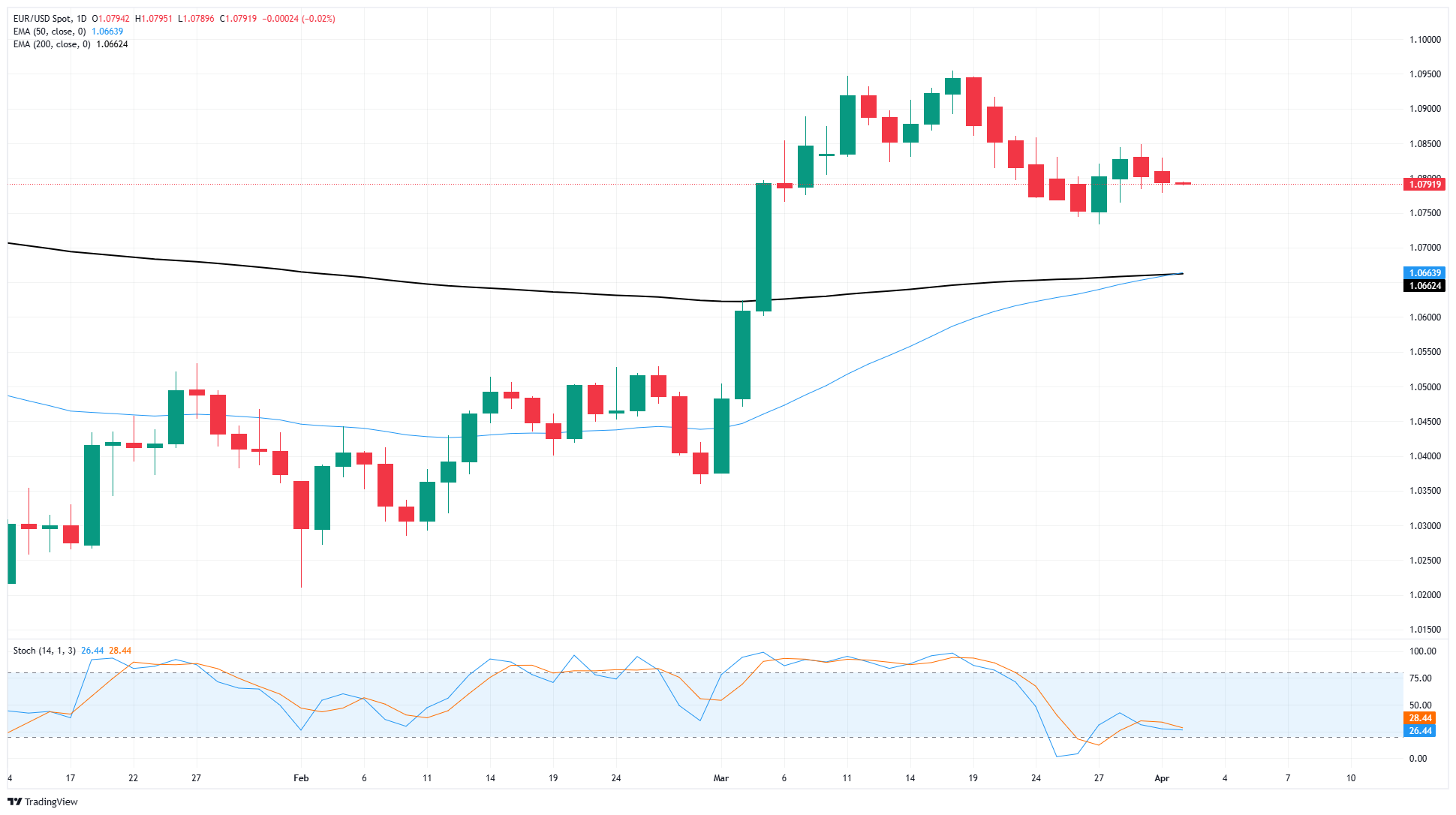
Dow Jones FAQs
The Dow Jones Industrial Average, one of the oldest stock market indices in the world, is compiled of the 30 most traded stocks in the US. The index is price-weighted rather than weighted by capitalization. It is calculated by summing the prices of the constituent stocks and dividing them by a factor, currently 0.152. The index was founded by Charles Dow, who also founded the Wall Street Journal. In later years it has been criticized for not being broadly representative enough because it only tracks 30 conglomerates, unlike broader indices such as the S&P 500.
Many different factors drive the Dow Jones Industrial Average (DJIA). The aggregate performance of the component companies revealed in quarterly company earnings reports is the main one. US and global macroeconomic data also contributes as it impacts on investor sentiment. The level of interest rates, set by the Federal Reserve (Fed), also influences the DJIA as it affects the cost of credit, on which many corporations are heavily reliant. Therefore, inflation can be a major driver as well as other metrics which impact the Fed decisions.
Dow Theory is a method for identifying the primary trend of the stock market developed by Charles Dow. A key step is to compare the direction of the Dow Jones Industrial Average (DJIA) and the Dow Jones Transportation Average (DJTA) and only follow trends where both are moving in the same direction. Volume is a confirmatory criteria. The theory uses elements of peak and trough analysis. Dow’s theory posits three trend phases: accumulation, when smart money starts buying or selling; public participation, when the wider public joins in; and distribution, when the smart money exits.
There are a number of ways to trade the DJIA. One is to use ETFs which allow investors to trade the DJIA as a single security, rather than having to buy shares in all 30 constituent companies. A leading example is the SPDR Dow Jones Industrial Average ETF (DIA). DJIA futures contracts enable traders to speculate on the future value of the index and Options provide the right, but not the obligation, to buy or sell the index at a predetermined price in the future. Mutual funds enable investors to buy a share of a diversified portfolio of DJIA stocks thus providing exposure to the overall index.
BRANDED CONTENT
If you're looking for the best brokers to trade the EUR/USD pair, explore our selected options. Knowing each broker’s strengths will help you find the ideal fit for your trading strategy.
Author

Joshua Gibson
FXStreet
Joshua joins the FXStreet team as an Economics and Finance double major from Vancouver Island University with twelve years' experience as an independent trader focusing on technical analysis.