EUR/USD gains as US Dollar drops ahead of Fed Powell’s testimony
- EUR/USD moves higher to near 1.0330 as the US Dollar faces pressure ahead of Fed Chair Jerome Powell’s testimony before Congress.
- US President Trump imposed 25% tariffs on imports of steel and aluminum from all nations.
- The Eurozone is expected to be the major casualty of Trump’s reciprocal tariffs.

EUR/USD rises to near 1.0330 in Tuesday’s North American session as the US Dollar (USD) drops ahead of the Federal Reserve (Fed) Chair Jerome Powell’s testimony before Congress at 15:00 GMT. The US Dollar Index (DXY), which tracks the Greenback's value against six major currencies, falls 0.15% to near 108.15, at the press time.
Investors will pay close attention to Powell’s comments to know for how long the Fed will keep interest rates steady in the range of 4.25%-4.50% and the likely impact of 25% tariffs on all steel and aluminum imports on the monetary policy outlook.
In January, the Fed left interest rates unchanged and Powell said that the central bank will remain in the waiting mode until it sees “real progress in inflation or at least some weakness in labor market”.
On Monday, United States (US) President Donald Trump signed executive orders of a 25% levy on imports of steel and aluminum from all nations, which will come into effect on March 12. Trump also said that there will be reciprocal tariffs over nations where he sees unfair trade practices in the coming days. The US President has outlined tariffs on metals to boost local production and reduce dependence on other nations.
Market participants are concerned over Trump’s international agenda, which is expected to result in a global trade war and high inflation in the US economy.
For fresh cues on inflation, investors will focus on the US Consumer Price Index (CPI) data for January, which will be released on Wednesday at 13:30 GMT. Economists expect the annual core CPI – which excludes volatile food and energy prices – to have grown at a slower pace of 3.1%, compared to a 3.2% increase in December. In the same period, the headline inflation is estimated to have remained steady at 2.9%.
Daily digest market movers: EUR/USD is also up due to Euro's outperformance
- EUR/USD moves higher as the Euro (EUR) outperforms its major peers, even though market participants expect Trump’s reciprocal tariffs will be unfavorable for the Eurozone. The impact of reciprocal tariffs is expected to be severe on the Eurozone as it charges 10% levies on automobile imports from the US and pays 2.5% import duty for domestic autos supplied to them. Such a scenario will be unfavorable for the Euro as lower sales would result in economic contraction.
- The outlook of the Euro is also vulnerable on the monetary policy front given the possibility that the rate differential between the European Central Bank (ECB) and the Fed could widen. Traders have fully priced in three interest rate cuts by the ECB and see them coming by the summer. Firm dovish bets are based on expectations that inflationary pressures are expected to return sustainably to near the central bank’s target of 2%.
- Three interest rate cuts by the ECB of 25 basis points (bps) would push the Deposit Facility rate lower to 2%, a figure that is close to the neutral rate, as projected by economists at the ECB.
- Contrary to market expectations, ECB policymaker and Governor of the Bank of Portugal Mario Centeno expects that the central bank could go “below the neutral rate” as the Eurozone economy is not “strong enough to support inflation at 2%”.
Euro PRICE Today
The table below shows the percentage change of Euro (EUR) against listed major currencies today. Euro was the strongest against the Japanese Yen.
| USD | EUR | GBP | JPY | CAD | AUD | NZD | CHF | |
|---|---|---|---|---|---|---|---|---|
| USD | -0.23% | -0.28% | 0.24% | 0.05% | -0.09% | -0.16% | 0.20% | |
| EUR | 0.23% | -0.07% | 0.46% | 0.28% | 0.13% | 0.06% | 0.43% | |
| GBP | 0.28% | 0.07% | 0.55% | 0.34% | 0.18% | 0.11% | 0.48% | |
| JPY | -0.24% | -0.46% | -0.55% | -0.19% | -0.34% | -0.41% | -0.03% | |
| CAD | -0.05% | -0.28% | -0.34% | 0.19% | -0.14% | -0.21% | 0.15% | |
| AUD | 0.09% | -0.13% | -0.18% | 0.34% | 0.14% | -0.07% | 0.32% | |
| NZD | 0.16% | -0.06% | -0.11% | 0.41% | 0.21% | 0.07% | 0.37% | |
| CHF | -0.20% | -0.43% | -0.48% | 0.03% | -0.15% | -0.32% | -0.37% |
The heat map shows percentage changes of major currencies against each other. The base currency is picked from the left column, while the quote currency is picked from the top row. For example, if you pick the Euro from the left column and move along the horizontal line to the US Dollar, the percentage change displayed in the box will represent EUR (base)/USD (quote).
Technical Analysis: EUR/USD remains below 50-day EMA
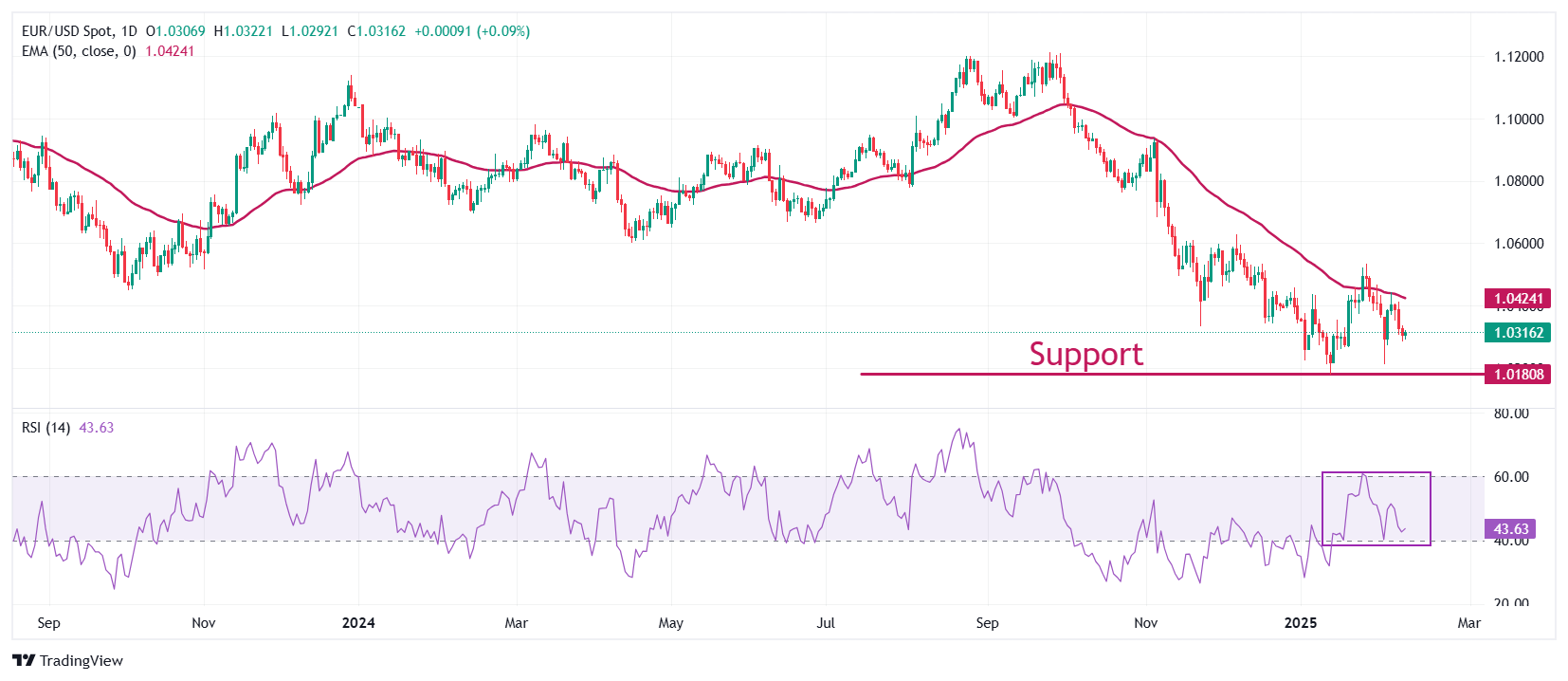
EUR/USD trades inside Monday’s trading range around 1.0300 in Tuesday’s North American session. The outlook of the major currency pair remains bearish as the 50-day Exponential Moving Average (EMA) around 1.0430 continues to be a major barricade for the Euro bulls.
The 14-day Relative Strength Index (RSI) oscillates in the 40.00-60.00 range, indicating a sideways trend.
Looking down, the January 13 low of 1.0177 and the round-level support of 1.0100 will act as major support zones for the pair. Conversely, the psychological resistance of 1.0500 will be the key barrier for the Euro bulls.
Fed FAQs
Monetary policy in the US is shaped by the Federal Reserve (Fed). The Fed has two mandates: to achieve price stability and foster full employment. Its primary tool to achieve these goals is by adjusting interest rates. When prices are rising too quickly and inflation is above the Fed’s 2% target, it raises interest rates, increasing borrowing costs throughout the economy. This results in a stronger US Dollar (USD) as it makes the US a more attractive place for international investors to park their money. When inflation falls below 2% or the Unemployment Rate is too high, the Fed may lower interest rates to encourage borrowing, which weighs on the Greenback.
The Federal Reserve (Fed) holds eight policy meetings a year, where the Federal Open Market Committee (FOMC) assesses economic conditions and makes monetary policy decisions. The FOMC is attended by twelve Fed officials – the seven members of the Board of Governors, the president of the Federal Reserve Bank of New York, and four of the remaining eleven regional Reserve Bank presidents, who serve one-year terms on a rotating basis.
In extreme situations, the Federal Reserve may resort to a policy named Quantitative Easing (QE). QE is the process by which the Fed substantially increases the flow of credit in a stuck financial system. It is a non-standard policy measure used during crises or when inflation is extremely low. It was the Fed’s weapon of choice during the Great Financial Crisis in 2008. It involves the Fed printing more Dollars and using them to buy high grade bonds from financial institutions. QE usually weakens the US Dollar.
Quantitative tightening (QT) is the reverse process of QE, whereby the Federal Reserve stops buying bonds from financial institutions and does not reinvest the principal from the bonds it holds maturing, to purchase new bonds. It is usually positive for the value of the US Dollar.
Author

Sagar Dua
FXStreet
Sagar Dua is associated with the financial markets from his college days. Along with pursuing post-graduation in Commerce in 2014, he started his markets training with chart analysis.