EUR/USD closing in most bullish month in 12 years ahead of Eurozone inflation, Federal Reserve talk
- EUR/USD pares the biggest monthly gains since September 2010.
- Recently hawkish comments from Federal Reserve officials underpinned United States Treasury Yields and US Dollar.
- Softer statistics, easing Covid fears from China and looming concerns over Eurozone recession keeps traders on their toes.
- Firmer Eurozone inflation may help EUR/USD to grind but Federal Reserve Chairman Jerome Powell could favor the month-end consolidation.


EUR/USD remains pressured around 1.0330, after printing a two-day downtrend, as it prepares for the big day during early Wednesday in Asia. Even so, the major currency pair stays on the way to posting the most significant monthly run-up in 12 years as Federal Reserve’s (Fed) signals for easy rate hikes got appreciation, even if the latest hawkish Fed talks allowed the United States Treasury bond yields and the US Dollar to consolidate monthly losses.
United States Treasury bond yields, US Dollar lick their wounds
US 10-year Treasury bond yields ended Tuesday on a firmer footing, up six basis points (bps) to 3.748% by the end of the North American trading session. The same helped the US Dollar Index (DXY) to print a three-day uptrend around 106.80 even as statistics from the United States weren’t so upbeat. The reason could be linked to the hawkish comments supporting the US Federal Reserve’s steadily high-interest rates, even if a mild cut in the aggression is expected.
It’s worth noting, however, that the stated bond yields remain negative on a monthly basis, posting the first monthly loss in four, whereas the US Dollar Index stays on the way to printing the biggest monthly loss since September 2010.
That said, New York Federal Reserve Bank President John Williams and St. Louis Fed President James "Jim" Bullard were the latest supporters of higher rates. On the other hand, the US Conference Board (CB) Consumer Confidence Index dropped to 100.2 in November versus 102.2 prior (revised down from 102.5).
Optimism surrounding China contrasts with fears from Eurozone to weigh on EUR/USD
Easing tensions from China contrasts with looming economic fears from the Eurozone and challenge the EUR/USD buyers of late.
After witnessing a retreat in the daily Covid infections from a record high, Chinese authorities took a sigh of relief and announced multiple measures to ease the strict lockdown in the key areas.
Recently, Bloomberg reported the reopening of some city buildings in the greater Zhengzhou region, the home of a key iPhone plant. Earlier on Tuesday, the news broke that China's Guangdong province will allow the close contacts of Covid cases to quarantine at home.
On the other hand, mixed statistics from Eurozone and comments from the officials failed to push back the chatters surrounding the bloc’s economic slowdown.
That said, the Euro area Economic Sentiment Indicator improved to 93.7 in November versus 93.5 expected and 92.7 prior (revised). However, the bloc’s Business Climate gauge eased to 0.54 from 0.74 previous readings while the Consumer Confidence reprinted -23.9 figures for the said month. Further, Germany’s preliminary inflation, as per the Harmonized Index of Consumer Prices (HICP) indicator, eased to 11.3% YoY while matching the market forecasts versus 11.6% prior. Additionally, inflation as measured by the Consumer Price Index (CPI), declined to 10% YoY during November from 10.4% previous readings. Following the data, Germany’s Economy Minister Robert Habeck said on Tuesday, "We will be and remain a strong land.”
It’s worth mentioning that the bloc is in consultation with the Group of Seven (G7) nations to announce a price cap on Russian Oil exports and teases another round of geopolitical tension with Moscow as Deputy Prime Minister Alexander Novak said on Tuesday that Russia wouldn't supply Oil under price cap in any case. The same could amplify recession concerns in the bloc and can weigh on the regional currency even if the European Central Bank (ECB) officials appear hawkish. Recently, European Central Bank (ECB) Vice President Luis de Guindos anticipated a decline in headline inflation during the first half of the next year while speaking at a virtual event XIII Encuentro Financiero on Tuesday.
All eyes on Federal Reserve Chairman Jerome Powell
Although a lot is at stake and in the line, market players will pay more attention to the speech from Federal Reserve (Fed) Chairman Jerome Powell’s first public appearance since November Federal Open Market Committee (FOMC) meeting. The event should exert more downside pressure on the EUR/USD price if the Fed boss meets the hawkish expectations of the market.
Ahead of the meeting, Analysts at the ANZ said, “We expect Powell to reaffirm the Fed’s unwavering commitment to tackling inflation, the need for more measured rate rises taking account of increased two-way economic risks as policy becomes restrictive, and a degree of optimism that the Fed will be able to pull off a soft landing.”
Also important will be the preliminary inflation data from Eurozone. As per the Harmonized Index of Consumer Prices (HICP) indicator, the inflation in the bloc is likely to ease to 10.4% YoY versus 10.6% prior, which in turn could weigh on the EUR/USD. The reason could be linked to the impending recession fears and the European Central Bank’s (ECB) readiness to ease if needed, per the latest comments from the officials.
Other than Fed Chair Powell’s speech and Eurozone inflation, an early signal for Friday’s United States Nonfarm Payrolls (NFP), namely the ADP Employment Change for November, will also be closely watched by the EUR/USD traders. The private employment gauge will likely register downbeat figures of 200K versus 239K prior.
Furthermore, the second readings of the United States Gross Domestic Product (GDP) for the third quarter (Q3), expected to confirm 2.6% Annualized growth, will also be crucial for the EUR/USD pair if posting a change.
EUR/USD technical analysis
EUR/USD bulls faced rejection from a 3.5-month-old ascending resistance line and the 200-Day Moving Average (DMA).
The following pullback took clues from the Moving Average Convergence and Divergence (MACD) indicator and the Relative Strength Index (RSI) line, placed at 14.
The reason could be a bearish divergence on the RSI and an impending bear cross on the MACD. That said, the higher high on price joins the lower tops on RSI (14) to portray the bearish RSI divergence while the MACD line’s piercing of the signal line from below teases bear cross.
As a result, the EUR/USD bears are all set to approach an 11-week-old horizontal support area surrounding 1.0220-200. However, the quote’s further downside needs validation from the October peak near 1.0095 before directing the sellers toward July’s low of 0.9952.
Alternatively, the 200-DMA and an upward-sloping resistance line from August 10, respectively, near 1.0380 and 1.0510, could restrict the immediate upside of the EUR/USD pair.
Following that, the 61.8% Fibonacci retracement level of the EUR/USD’s south-run trajectory from late March to September 28, close to 1.0555, will precede the June 27 swing high near 1.0615 to challenge the pair buyers.
Overall, EUR/USD bulls run out of steam as traders await the key events.
EUR/USD: Daily chart
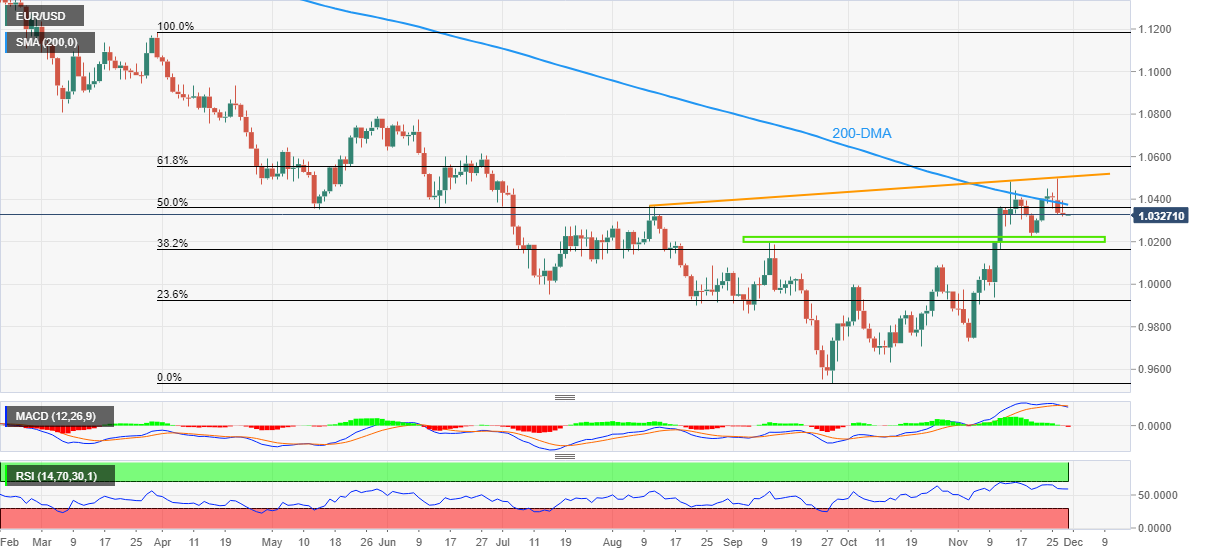
Trend: Further downside expected
Author
Anil Panchal
FXStreet
Anil Panchal has nearly 15 years of experience in tracking financial markets. With a keen interest in macroeconomics, Anil aptly tracks global news/updates and stays well-informed about the global financial moves and their implications.

















