EUR/USD faces selling pressure near 1.0900 as US Dollar rebound, ECB policy in focus
- 09EUR/USD falls from 1.0900 as the US Dollar steadies but remains feeble due to firm Fed rate-cut prospects.
- Traders raise Fed rate-cut bets amid fears of slower US economic growth.
- The ECB is due to announce June’s monetary policy decision on Thursday.

EUR/USD slumps from the round-level resistance of 1.0900 in Tuesday’s American session. The major currency pair faces pressure as of the US Dollar (USD) rebounds. The US Dollar Index (DXY), which tracks the Greenback’s value against six major currencies, recovers sharply after posting a fresh almost two-month low near the crucial support of 104.00 despite weak United States (US) ISM Manufacturing PMI report for May deepens fears of slowing economic growth and eases risks of persistent inflation.
The report showed that the Manufacturing PMI, which gauges the health of factory activity, contracted for the second straight month. The economic data came in at 48.7, lower than the consensus of 49.6 and the prior reading of 49.2. Apart from that, the New Orders Index, which reflects the demand outlook, fell to 45.4 from the former reading of 49.1, suggesting sluggishness in the economy in the midst of the second quarter as the Federal Reserve (Fed) maintains a restrictive monetary policy.
Financial markets were already worried about slowing US economic strength as the Q1 Gross Domestic Product (GDP) growth was downwardly revised to 1.3% from the preliminary estimates of 1.6%.
Weak US factory data has boosted market expectations that the Fed will begin reducing interest rates from the September meeting. The CME FedWatch tool shows that the probability of a rate cut in the September meeting has increased to 60% from 45.8% a week ago.
Meanwhile, the US Bureau of Labor Statistics (BLS) has reported lower-than-expected JOLTS Job Openings data for April. The agency reported that fresh job postings were 8.06 million, lower than expectations of 8.34 million and the prior release of 8.35 million, downwardly revised from 8.49 million. Going forward, investors will focus on the US ISM Services PMI, ADP Employment Change and the Nonfarm Payrolls (NFP) report for May. This slew of economic data will influence market speculation for Fed rate cuts in September.
Daily digest market movers: EUR/USD comes under pressure as US Dollar rebounds strongly
- EUR/USD is down as the US Dollar manages to gain ground. The major event for the Euro will be the European Central Bank’s (ECB) interest rate decision, which will be announced on Thursday. As ECB policymakers have remained comfortable with expectations of opting for the first rate cut since 2019, investors are keen to know the interest rate outlook beyond the June meeting.
- Financial markets expect the ECB to reduce its key borrowing rates by 60 basis points (bps) this year, which suggests two rate cuts, compared to at least five at the beginning of the year. However, these expectations have waned due to a rebound in price pressures in May, stubborn service inflation, and an improved economic outlook.
- May’s preliminary Eurozone Harmonized Index of Consumer Prices (HICP) report showed a higher-than-expected increase in annual price pressures. The report also showed that services inflation, which is driven by wage growth, rose by 4.1%, the most in seven months. Meanwhile, the Eurozone economy grew by 0.3% in 1Q, beating the estimates of 0.2%.
- The majority of ECB policymakers have been reluctant to offer a specific rate trajectory and have advised they will remain data-dependent.
Technical Analysis: EUR/USD edges down from 1.0900
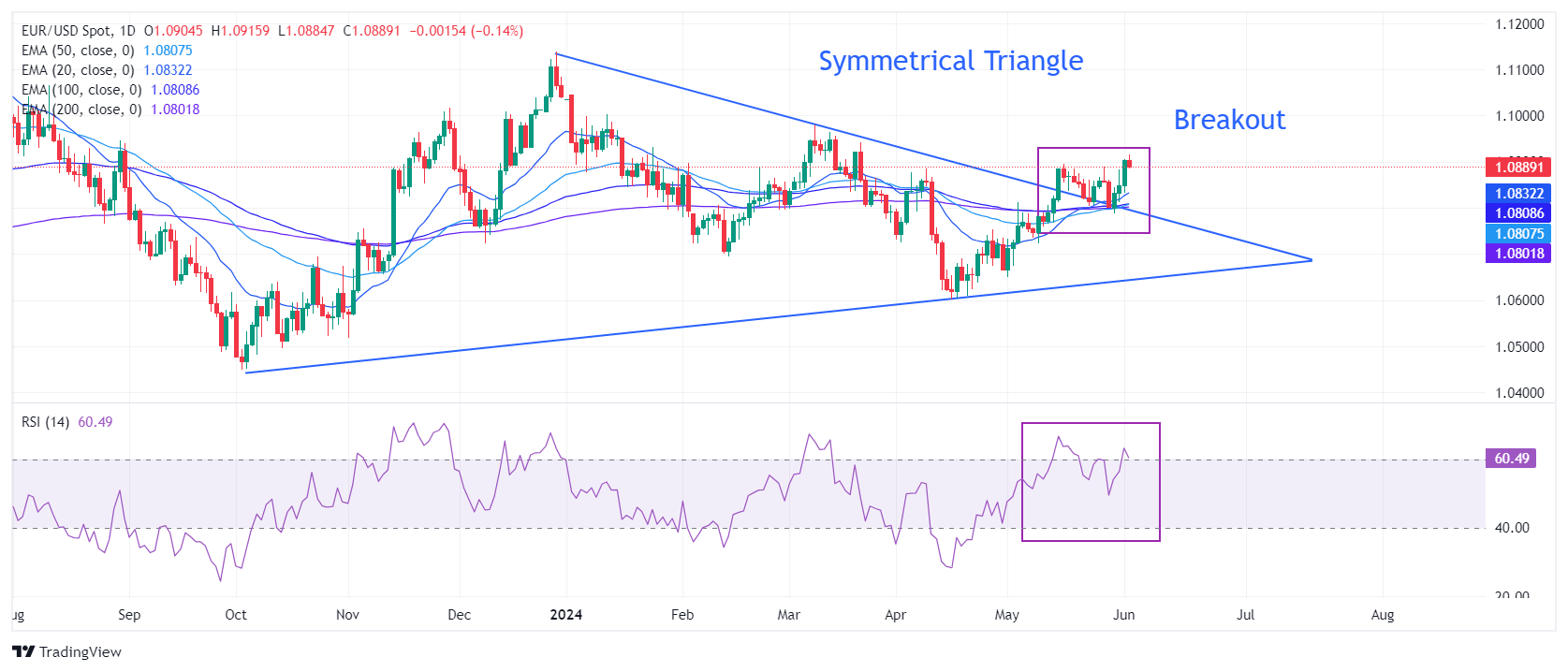
EUR/USD faces a sell-off near 1.0900 in the New York session. Earlier, the shared currency pair extended its upside to 1.0910, driven by strength due to the breakout from the Symmetrical Triangle formation in the daily time frame. The near-term outlook of the pair remains firm as the 50-day Exponential Moving Average (EMA) near 1.0800 is sloping higher.
The 14-period Relative Strength Index (RSI) has slipped into the 40.00-60.00 range, suggesting that the momentum, which leaned toward the upside, has faded for now.
The major currency pair is expected to extend its upside towards the March 21 high, around 1.0940, and the psychological resistance of 1.1000. However, a downside move below the 200-day EMA at 1.0800 could push it further down.
Economic Indicator
Nonfarm Payrolls
The Nonfarm Payrolls release presents the number of new jobs created in the US during the previous month in all non-agricultural businesses; it is released by the US Bureau of Labor Statistics (BLS). The monthly changes in payrolls can be extremely volatile. The number is also subject to strong reviews, which can also trigger volatility in the Forex board. Generally speaking, a high reading is seen as bullish for the US Dollar (USD), while a low reading is seen as bearish, although previous months' reviews and the Unemployment Rate are as relevant as the headline figure. The market's reaction, therefore, depends on how the market assesses all the data contained in the BLS report as a whole.
Read more.Next release: Fri Jun 07, 2024 12:30
Frequency: Monthly
Consensus: 190K
Previous: 175K
Source: US Bureau of Labor Statistics
America’s monthly jobs report is considered the most important economic indicator for forex traders. Released on the first Friday following the reported month, the change in the number of positions is closely correlated with the overall performance of the economy and is monitored by policymakers. Full employment is one of the Federal Reserve’s mandates and it considers developments in the labor market when setting its policies, thus impacting currencies. Despite several leading indicators shaping estimates, Nonfarm Payrolls tend to surprise markets and trigger substantial volatility. Actual figures beating the consensus tend to be USD bullish.
Author

Sagar Dua
FXStreet
Sagar Dua is associated with the financial markets from his college days. Along with pursuing post-graduation in Commerce in 2014, he started his markets training with chart analysis.














