EUR/USD gains ground as markets gear up for another NFP
- EUR/USD surges 0.60% at its peak, boosted by soft US jobs data and hopes ahead of Nonfarm Payrolls.
- French political uncertainty persists as the government faces its first no-confidence vote ouster since 1962.
- Investors weigh mixed Eurozone retail sales against Fed Chair Powell’s cautious yet balanced economic outlook.

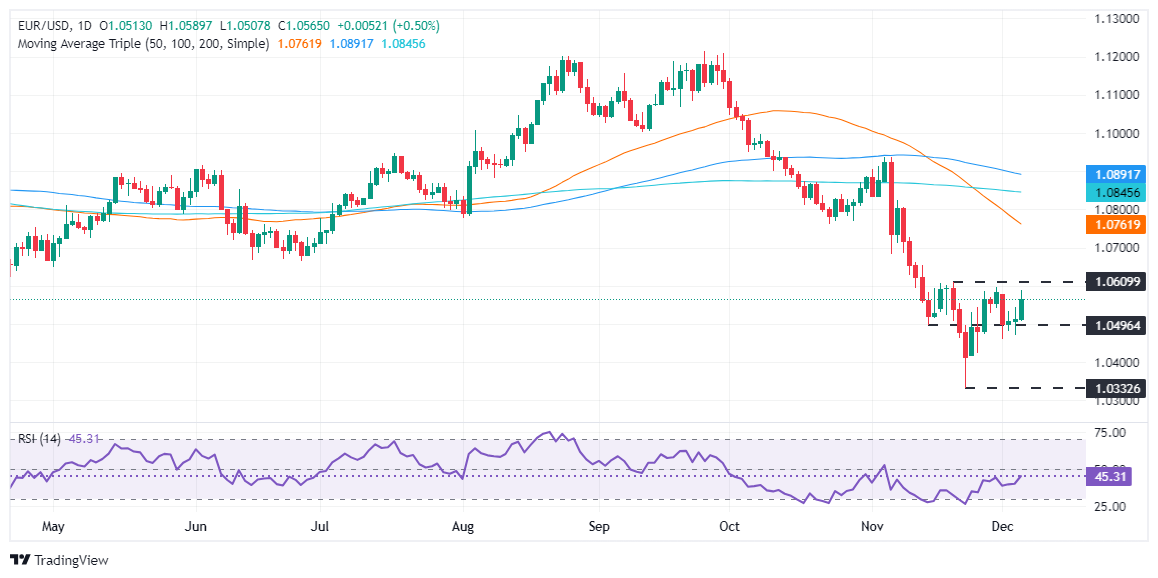
The EUR/USD shrugged off political turmoil in France and edged up by over 0.60% at its highest on Thursday. US jobs data came weaker than expected, while investors expect the release of US Nonfarm Payrolls figures on Friday. The pair trades at 1.0578 after bouncing off daily lows of 1.0505.
Euro gains against the Dollar, reaching 1.0578 as US jobless claims rise and trade deficit narrows
The US Department of Labor revealed that Initial Jobless Claims for the week ending November 30 rose by 9k to 224k, above the median estimate of 215k. The 4-week moving average stood at 218.3k.
At the same time, the US Bureau of Economic Analysis (BEA) revealed that the US trade deficit in October narrowed to $-73.8 billion from $-83.8 billion in the previous month.
The EUR/USD extended its gains following the data release, clearing the 1.0540 area and rising to a daily peak of 1.0589 before paring some of its gains.
Despite this, Euro bulls are not out of the woods yet, as the French Government lost a no-confidence vote for the first time since 1962. Prime Minister Michel Barner was ousted with 331 votes in favor of his removal. Despite this, the existing Government will remain in place, as under the French constitution, a new election can’t happen until a year after the last one, until the summer of 2025.
The Euroarea revealed that Retail Sales in October exceeded the median estimate of 1.7%, which came at 1.9% YoY but below September’s 3% increase. On a monthly basis, sales dropped from 0.5% to -0.5%, well below expectations of a -0.3% contraction.
On Wednesday, Federal Reserve Chair Jerome Powell was “slightly hawkish,” adding that the economy remains in good shape, that the balance between achieving the central bank’s dual mandate is balanced, and that there is no urgency to cut rates.
This week, the docket will feature nonfarm payroll figures for November, which are expected to show that the economy added 200K jobs while the unemployment rate is expected to rise to 4.2%.
EUR/USD Price Forecast: Technical outlook
Despite recovering some ground, EUR/USD buyers need to drive the exchange rate above 1.0600. If they fail to do so, it will exacerbate a retest of the weekly lows of 1.0460, hit on Monday. But first, traders will face 1.0500, and if those two levels are cleared, a re-test of the yearly low of 1.0331 is on the cards.
Otherwise, if EUR/USD extends its gains past 1.0600, the next major resistance would be the June 26 swing low of 1.0666.
Nonfarm Payrolls FAQs
Nonfarm Payrolls (NFP) are part of the US Bureau of Labor Statistics monthly jobs report. The Nonfarm Payrolls component specifically measures the change in the number of people employed in the US during the previous month, excluding the farming industry.
The Nonfarm Payrolls figure can influence the decisions of the Federal Reserve by providing a measure of how successfully the Fed is meeting its mandate of fostering full employment and 2% inflation. A relatively high NFP figure means more people are in employment, earning more money and therefore probably spending more. A relatively low Nonfarm Payrolls’ result, on the either hand, could mean people are struggling to find work. The Fed will typically raise interest rates to combat high inflation triggered by low unemployment, and lower them to stimulate a stagnant labor market.
Nonfarm Payrolls generally have a positive correlation with the US Dollar. This means when payrolls’ figures come out higher-than-expected the USD tends to rally and vice versa when they are lower. NFPs influence the US Dollar by virtue of their impact on inflation, monetary policy expectations and interest rates. A higher NFP usually means the Federal Reserve will be more tight in its monetary policy, supporting the USD.
Nonfarm Payrolls are generally negatively-correlated with the price of Gold. This means a higher-than-expected payrolls’ figure will have a depressing effect on the Gold price and vice versa. Higher NFP generally has a positive effect on the value of the USD, and like most major commodities Gold is priced in US Dollars. If the USD gains in value, therefore, it requires less Dollars to buy an ounce of Gold. Also, higher interest rates (typically helped higher NFPs) also lessen the attractiveness of Gold as an investment compared to staying in cash, where the money will at least earn interest.
Nonfarm Payrolls is only one component within a bigger jobs report and it can be overshadowed by the other components. At times, when NFP come out higher-than-forecast, but the Average Weekly Earnings is lower than expected, the market has ignored the potentially inflationary effect of the headline result and interpreted the fall in earnings as deflationary. The Participation Rate and the Average Weekly Hours components can also influence the market reaction, but only in seldom events like the “Great Resignation” or the Global Financial Crisis.
Author

Christian Borjon Valencia
FXStreet
Markets analyst, news editor, and trading instructor with over 14 years of experience across FX, commodities, US equity indices, and global macro markets.














