EUR/USD holds ground with traders mulling German defense spending vote next week
- EUR/USD briefly heads back to 1.0900 on a flurry of headlines on Friday.
- The World Trade Organization could examine if US President Trump’s tariff policy is illegal.
- Markets have a sign of relief on the odds of a spending bill being passed, avoiding the US government shutdown, later this Friday.

The EUR/USD pair edges higher and recovers to 1.0900 at the time of writing on Friday, erasing its sluggish performance from earlier this week. The resurgence in the pair comes after two headlines emerged late Thursday. United States (US) Senate Democratic Leader Chuck Schumer announced that he plans to vote to keep the government open, backing the House-passed government funding measures and effectively ending the shutdown risk in the US.
Meanwhile, Canada initiated a dispute complaint at the World Trade Organization (WTO) and requested a look into US President Donald Trump’s tariff implementations, which might be illegal and contradict the WTO trade rules, Reuters reports. That would mean a huge setback for President Trump’s plans ahead of the reciprocal tariffs that will take effect in April.
Daily digest market movers: All on Germany
- On Tuesday normally voting will take place in the German Bundestag on the defense spending package. If a two-thirds majority is reached on Tuesday, the spending plan would be a huge lift for the Euro.
- Gold, as a safe haven asset, has breached the $3,000 mark on Friday in a recession-feared-induced rally as traders are concerned about economic growth and the tariffs outlook, with reciprocal levies coming into effect in April.
- The University of Michigan has released its preliminary consumer expectations reading for March:
- The US Consumer Sentiment Index fell below 60 to 57.9. A big miss against expectations at 63.1 and from 64.7 in February.
- The US 5-year Consumer Inflation Expectation jumped to 3.9%, beating the 3.5% in the final February reading.
- Equities are attempting to brush off this week’s negative tone. All indices are up over 0.50% across Europe and the US on Friday.
- The CME Fedwatch Tool projects a 97.0% chance for the Federal Reserve (Fed) to keep interest rates unchanged in Wednesday’s upcoming decision. The chances of a rate cut at the May meeting stand at 32.8%, while they show a 78.5% probability of rates being lower than current levels in June.
- The US 10-year yield trades around 4.329%, off its near five-month low of 4.10% printed on March 4 and after hitting a five-day high on Thursday.
Technical Analysis: Defense spending key
Friday’s close is vital for the EUR/USD pair. From the looks on the technical charts, the pair has good odds of closing above a crucial ascending trend line (green in the chart below), which offered support on Thursday and Friday. A close above that line would mean that the 1.1000 psychological level could get in the cards heading into next week.
On the upside, 1.1000 is the key level to look out for. Once that level is breached, the pair enters the famous 1.1000-1.1500 range, where often it tends to stay for quite some time. Certainly, the 1.1200 big figure, which coincides with the highs of September and October last year, looks interesting for a brief test and possible breach higher.
On the downside, the ascending trend line at 1.0840 should still provide support for now. In case it breaks, the road is open to head into the 1.0700 region. The 200-day Simple Moving Average (SMA) around 1.0722 should be key for traders who want to buy the dip.
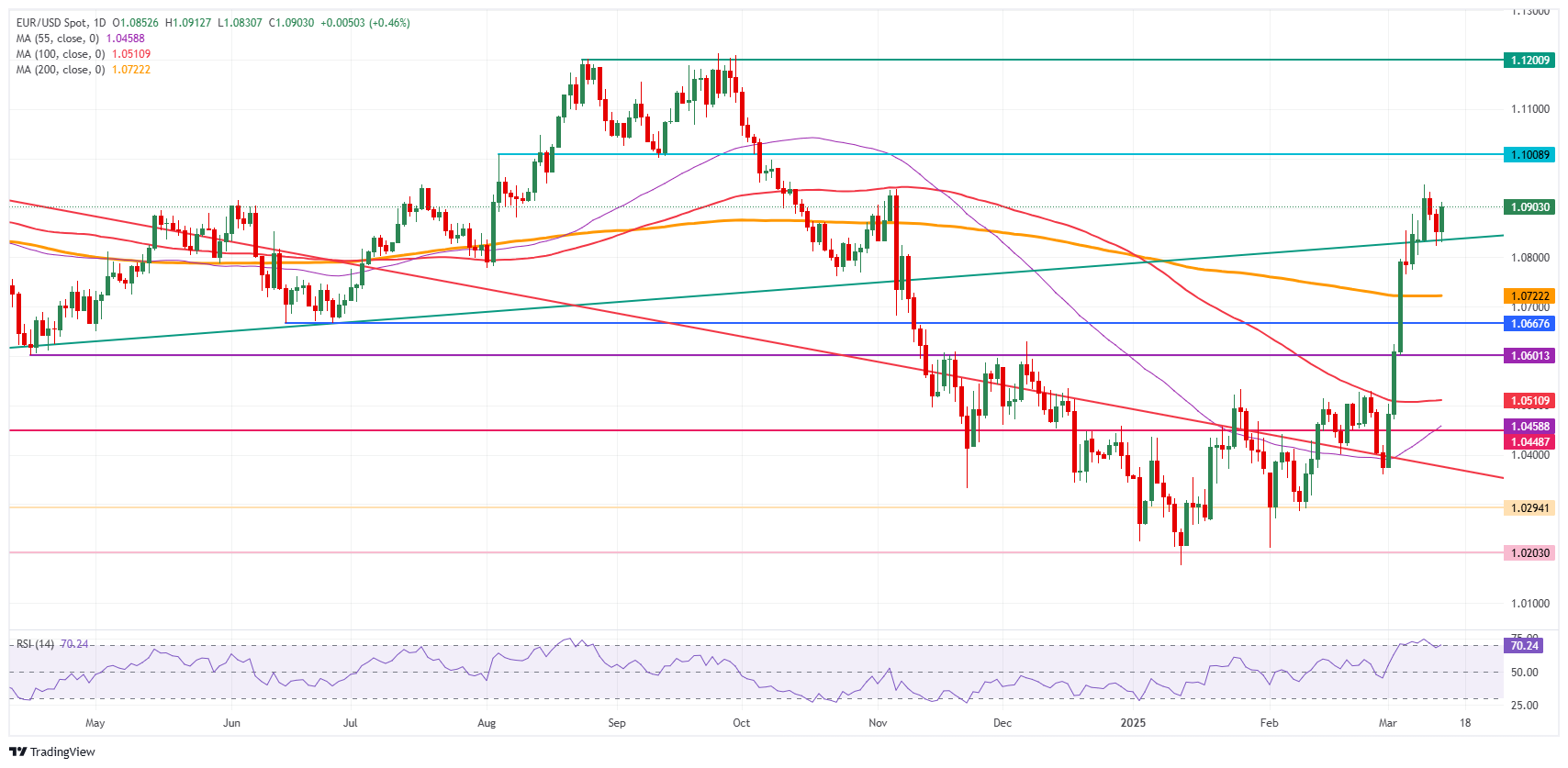
EUR/USD: Daily Chart
Euro FAQs
The Euro is the currency for the 19 European Union countries that belong to the Eurozone. It is the second most heavily traded currency in the world behind the US Dollar. In 2022, it accounted for 31% of all foreign exchange transactions, with an average daily turnover of over $2.2 trillion a day. EUR/USD is the most heavily traded currency pair in the world, accounting for an estimated 30% off all transactions, followed by EUR/JPY (4%), EUR/GBP (3%) and EUR/AUD (2%).
The European Central Bank (ECB) in Frankfurt, Germany, is the reserve bank for the Eurozone. The ECB sets interest rates and manages monetary policy. The ECB’s primary mandate is to maintain price stability, which means either controlling inflation or stimulating growth. Its primary tool is the raising or lowering of interest rates. Relatively high interest rates – or the expectation of higher rates – will usually benefit the Euro and vice versa. The ECB Governing Council makes monetary policy decisions at meetings held eight times a year. Decisions are made by heads of the Eurozone national banks and six permanent members, including the President of the ECB, Christine Lagarde.
Eurozone inflation data, measured by the Harmonized Index of Consumer Prices (HICP), is an important econometric for the Euro. If inflation rises more than expected, especially if above the ECB’s 2% target, it obliges the ECB to raise interest rates to bring it back under control. Relatively high interest rates compared to its counterparts will usually benefit the Euro, as it makes the region more attractive as a place for global investors to park their money.
Data releases gauge the health of the economy and can impact on the Euro. Indicators such as GDP, Manufacturing and Services PMIs, employment, and consumer sentiment surveys can all influence the direction of the single currency. A strong economy is good for the Euro. Not only does it attract more foreign investment but it may encourage the ECB to put up interest rates, which will directly strengthen the Euro. Otherwise, if economic data is weak, the Euro is likely to fall. Economic data for the four largest economies in the euro area (Germany, France, Italy and Spain) are especially significant, as they account for 75% of the Eurozone’s economy.
Another significant data release for the Euro is the Trade Balance. This indicator measures the difference between what a country earns from its exports and what it spends on imports over a given period. If a country produces highly sought after exports then its currency will gain in value purely from the extra demand created from foreign buyers seeking to purchase these goods. Therefore, a positive net Trade Balance strengthens a currency and vice versa for a negative balance.
Author

Filip Lagaart
FXStreet
Filip Lagaart is a former sales/trader with over 15 years of financial markets expertise under its belt.