EUR/USD crawls higher as the US Dollar retreats amid tariff uncertainty
- The Euro picks up as the impact of the strong US Nonfarm Payrolls report fades.
- Growing concerns about tariffs and the US fiscal health are adding pressure on the US Dollar.
- ECB President Lagarde and MPC member Villeroy hint at steady interest rates in July.
The EUR/USD pair is trimming some losses on Friday, and is trading at the upper range of the 1.1700s as the Dollar gives away post-NFP gains amid growing concerns about tariffs and following hawkish remarks from the European Central Bank (ECB) officials, including President Christine Lagarde.
In light of the scarce progress on trade deals, Trump affirmed that he will start sending letters to trading partners on Friday, informing them about the levies that will be applied to their products. Market concerns that high tariffs might boost inflation and lower economic growth have been a major weight for the US Dollar since April's "Liberation Day".
Beyond that, Trump's "big, beautiful tax bill" passed the scrutiny of the House of Representatives on Thursday and is likely to become law in the coming days. The Congressional Budget Office estimated that the bill will boost the current fiscal deficit of $39.2 trillion by $3.3 trillion over the next 10 years, which raised fears of a debt crisis in the world's major economy and has been another source of negative pressure for the US Dollar.
On Friday, ECB's Lagarde and Villeroy maintained that the bank is in a good position on rates and inflation and fully committed to keeping price inflation at the 2% target, which suggests that the bank will keep its benchmark interest rate unchanged, at the current 2% level after their meeting on late July.
The US Dollar jumped on Thursday as the Nonfarm Payrolls report showed that the US economy created way more employment than expected in June, highlighting the resilience of the labour market and dampening hopes of imminent rate cuts by the Federal Reserve (Fed). Chances of a Fed cut in July have dropped to 5%, from around 20% before the data release, according to the CME Group's Fed Watch Tool.
Euro PRICE Today
The table below shows the percentage change of Euro (EUR) against listed major currencies today. Euro was the strongest against the US Dollar.
| USD | EUR | GBP | JPY | CAD | AUD | NZD | CHF | |
|---|---|---|---|---|---|---|---|---|
| USD | -0.19% | -0.15% | -0.49% | -0.08% | 0.08% | -0.03% | -0.35% | |
| EUR | 0.19% | 0.06% | -0.27% | 0.13% | 0.15% | 0.14% | -0.12% | |
| GBP | 0.15% | -0.06% | -0.36% | 0.06% | 0.10% | 0.08% | -0.19% | |
| JPY | 0.49% | 0.27% | 0.36% | 0.41% | 0.44% | 0.38% | 0.04% | |
| CAD | 0.08% | -0.13% | -0.06% | -0.41% | 0.01% | 0.01% | -0.25% | |
| AUD | -0.08% | -0.15% | -0.10% | -0.44% | -0.01% | -0.05% | -0.29% | |
| NZD | 0.03% | -0.14% | -0.08% | -0.38% | -0.01% | 0.05% | -0.27% | |
| CHF | 0.35% | 0.12% | 0.19% | -0.04% | 0.25% | 0.29% | 0.27% |
The heat map shows percentage changes of major currencies against each other. The base currency is picked from the left column, while the quote currency is picked from the top row. For example, if you pick the Euro from the left column and move along the horizontal line to the US Dollar, the percentage change displayed in the box will represent EUR (base)/USD (quote).
Daily digest market movers: Rangebound trading with US markets closed
- The EUR/USD is trading within Thursday's range, on track to a moderate advance on the week. The pair is likely to go through an "inside day" with trading volume subdued, with the US market closed for the Independence Day holiday and the Eurozone calendar lacking first-tier data releases.
- On Thursday, US Nonfarm Payrolls data surprised, showing a 147,000 increase in net jobs, beating expectations of a 110,000 reading. The Unemployment Rate fell to 4.1% from 4.2%, against expectations of an increase to 4.3%.
- Later on Thursday, the US ISM Services PMI showed a stronger-than-expected rebound of the sector's business activity. June's index improved to 50.8 from the 49.9 print seen in May, also beating expectations of a 50.5 reading.
- Eurozone Producer Prices Index (PPI) figures released on Friday showed that inflation at the factory gate contracted for its third consecutive month and at a faster-than-expected pace, 0.6% from April instead of the 0.5% forecasted by market analysts.
- Also on Friday, German Factory Orders revealed a 1.4% contraction in May, well beyond the 0.1% contraction forecasted by market analysts, following a 1.6% growth in April. These figures add to evidence of the weak economic prospects in the Eurozone's major economy and are likely to weigh on the Euro.
- Likewise, France's Industrial Output declined by 0.5% in May following a 1.4% drop in April, against market expectations of a 0.3% improvement.
- On Thursday, the Eurozone services activity data revealed the sector grew again in June. The final HCOB Services PMI was revised to 50.5 from the 50.0 flash estimate, following a 49.7 reading in May. The report, however, warned about a weak demand despite the improving business sentiment. The impact on the Euro was minimal.
EUR/USD is losing momentum with the 1.1800 area holding bulls
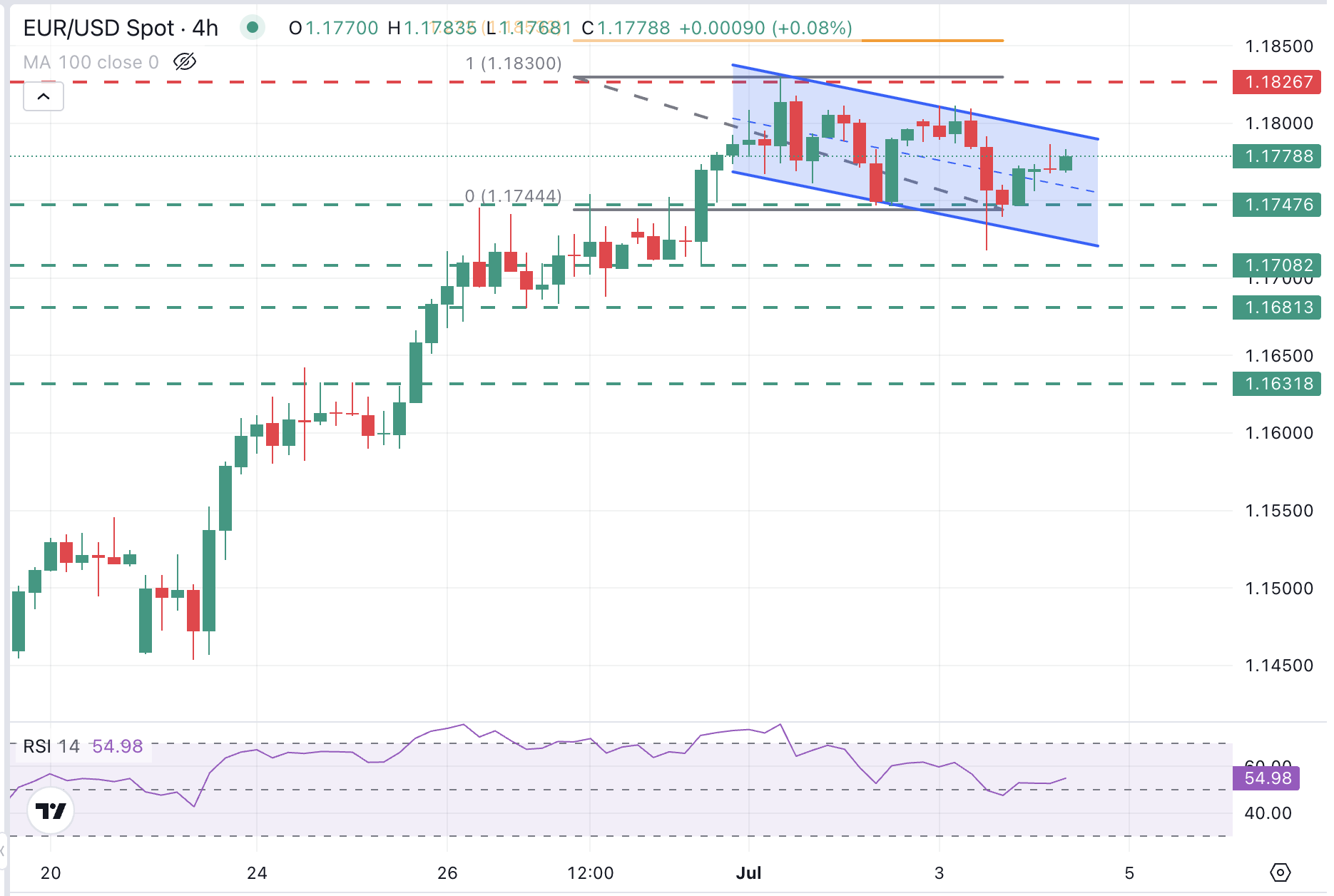
EUR/USD has been consolidating gains for most of the week after having reached its highest levels in nearly four years at 1.1830. The pair, however, is losing momentum, unable to find significant acceptance above 1.1800, with the 14-period Relative Strength Index (RSI) hovering near the 50 level that divides the bullish from the bearish territory.
A lower low on Thursday is another bearish sign, although the pair has not confirmed below the 1.1745-1.1750 area (June 26 and 27 highs and July 2 low). Below here, the June 30 low, at 1.1710, and the June 27 low at 1.1680 would be the potential downside targets.
On the upside, the pair might find resistance at the 1.1800 level, where the trendline resistance from Monday's highs lies, ahead of the mentioned high at 1.1825, and the 127.2% Fibonacci extension level of the July 1-2 reversal at 1.1850.
Tariffs FAQs
Tariffs are customs duties levied on certain merchandise imports or a category of products. Tariffs are designed to help local producers and manufacturers be more competitive in the market by providing a price advantage over similar goods that can be imported. Tariffs are widely used as tools of protectionism, along with trade barriers and import quotas.
Although tariffs and taxes both generate government revenue to fund public goods and services, they have several distinctions. Tariffs are prepaid at the port of entry, while taxes are paid at the time of purchase. Taxes are imposed on individual taxpayers and businesses, while tariffs are paid by importers.
There are two schools of thought among economists regarding the usage of tariffs. While some argue that tariffs are necessary to protect domestic industries and address trade imbalances, others see them as a harmful tool that could potentially drive prices higher over the long term and lead to a damaging trade war by encouraging tit-for-tat tariffs.
During the run-up to the presidential election in November 2024, Donald Trump made it clear that he intends to use tariffs to support the US economy and American producers. In 2024, Mexico, China and Canada accounted for 42% of total US imports. In this period, Mexico stood out as the top exporter with $466.6 billion, according to the US Census Bureau. Hence, Trump wants to focus on these three nations when imposing tariffs. He also plans to use the revenue generated through tariffs to lower personal income taxes.
Author

Guillermo Alcala
FXStreet
Graduated in Communication Sciences at the Universidad del Pais Vasco and Universiteit van Amsterdam, Guillermo has been working as financial news editor and copywriter in diverse Forex-related firms, like FXStreet and Kantox.