EUR/USD sees more upside as US employment data misses estimates
- EUR/USD trades firmly around 1.0850 as US official employment data come in softer than expected.
- US President Trump announced exemptions on more products imported from Canada and Mexico.
- German debt reforms have forced traders to pare ECB dovish bets.

EUR/USD trades firmly around the fresh four-month high of 1.0850 in Friday’s North American session after the release of the softer-than-expected United States (US) Nonfarm Payrolls (NFP) data for February. The US NFP report showed that the economy added 151K fresh workers, slightly lower than estimates of 160K. However, the pace of labor demand remained higher than what investors saw in January. In the previous month, 125K fresh workers were added, downwardly revised from 143K.
The Unemployment Rate accelerated to 4.1%, from estimates and the former release of 4%. Meanwhile, Average Hourly Earnings, a key measure of wage growth, rose at a slower pace of 4%, compared to estimates of 4.1% on year-on-year. Month-on-month wage growth measure grew by 0.3%, as expected. Slower-than-expected growth in labor demand and Average Hourly Earnings are expected to force traders to pare market expectations that the Federal Reserve (Fed) will keep interest rates in the current range of 4.25%-4.50% for longer.
The US Dollar Index (DXY), which tracks the Greenback’s value against six major currencies, extends its losing streak for the fifth trading day and slumps to a four-month low of around 103.50.
The Greenback was already on the backfoot as investors have become increasingly concerned over the United States (US) economic outlook due to uncertainty over President Donald Trump’s tariff agenda. Market participants believe that the pressure of higher tariffs will be borne by US importers, who would pass on the impact to consumers. Such a scenario would diminish their purchasing power and, eventually, the domestic demand.
On Thursday, Trump announced tariff relaxations on a number of products, which come under the purview of the United States-Mexico-Canada Agreement (USMCA) until April 2, the same day when he is expected to introduce reciprocal tariffs. The US President imposed 25% levies on Canada and Mexico on Tuesday but provided a one-month exemption on automobiles after discussing with the big three US carmakers on Wednesday.
Daily digest market movers: EUR/USD advances on German debt reforms
- Strength in the EUR/USD pair is also driven by the Euro’s (EUR) outperformance amid diminishing European Central Bank (ECB) dovish bets due to German debt reforms. Market participants believe that the confirmation of creating a 500 billion Euro (EUR) infrastructure fund and reforms in the so-called “debt brake” by German officials will be inflationary for the economy. Such a scenario would force the ECB to slow down the pace of the monetary expansion cycle.
- However, ECB President Christine Lagarde refrained from gauging the impact of German debt reforms in the press conference after the interest rate decision on Thursday and said the increased defense and infrastructure spending is still a "work in progress" and the ECB "needs time" to understand the impact.
- Traders have revised downward their expectations for the ECB’s monetary policy outlook and think that the central bank could pause the interest rate cut cycle in April after easing five times in a row. Before the monetary policy meeting on Thursday, traders had fully priced in two more interest rate cuts by the summer.
- Christine Lagarde didn’t provide a specific rate-cut plan and reiterated that the central bank remains “data-dependent” and decisions on rates will be made on a “meeting-by-meeting basis" after the ECB reduced the Deposit Facility rate by 25 basis points (bps) to 2.5%, as expected. Lagarde guided that risks to economic growth remain tilted to the “downside” and Trump’s tariff war could weigh on the Eurozone economy further.
- The next major trigger for the Euro is discussions over boosting defense and infrastructure spending as well as sweeping changes to state borrowing rules at Germany's lower house of parliament from March 13. The Bundestag (German parliament) lower house will vote on the "debt brake" reforms on March 18, Reuters reported.
Euro PRICE Today
The table below shows the percentage change of Euro (EUR) against listed major currencies today. Euro was the strongest against the Australian Dollar.
| USD | EUR | GBP | JPY | CAD | AUD | NZD | CHF | |
|---|---|---|---|---|---|---|---|---|
| USD | -0.64% | -0.27% | -0.32% | 0.42% | 0.65% | 0.54% | -0.53% | |
| EUR | 0.64% | 0.38% | 0.34% | 1.06% | 1.30% | 1.19% | 0.12% | |
| GBP | 0.27% | -0.38% | -0.04% | 0.68% | 0.91% | 0.80% | -0.23% | |
| JPY | 0.32% | -0.34% | 0.04% | 0.73% | 0.96% | 0.85% | -0.18% | |
| CAD | -0.42% | -1.06% | -0.68% | -0.73% | 0.22% | 0.12% | -0.90% | |
| AUD | -0.65% | -1.30% | -0.91% | -0.96% | -0.22% | -0.10% | -1.12% | |
| NZD | -0.54% | -1.19% | -0.80% | -0.85% | -0.12% | 0.10% | -1.02% | |
| CHF | 0.53% | -0.12% | 0.23% | 0.18% | 0.90% | 1.12% | 1.02% |
The heat map shows percentage changes of major currencies against each other. The base currency is picked from the left column, while the quote currency is picked from the top row. For example, if you pick the Euro from the left column and move along the horizontal line to the US Dollar, the percentage change displayed in the box will represent EUR (base)/USD (quote).
Technical Analysis: EUR/USD refreshes four-month high above 1.0850
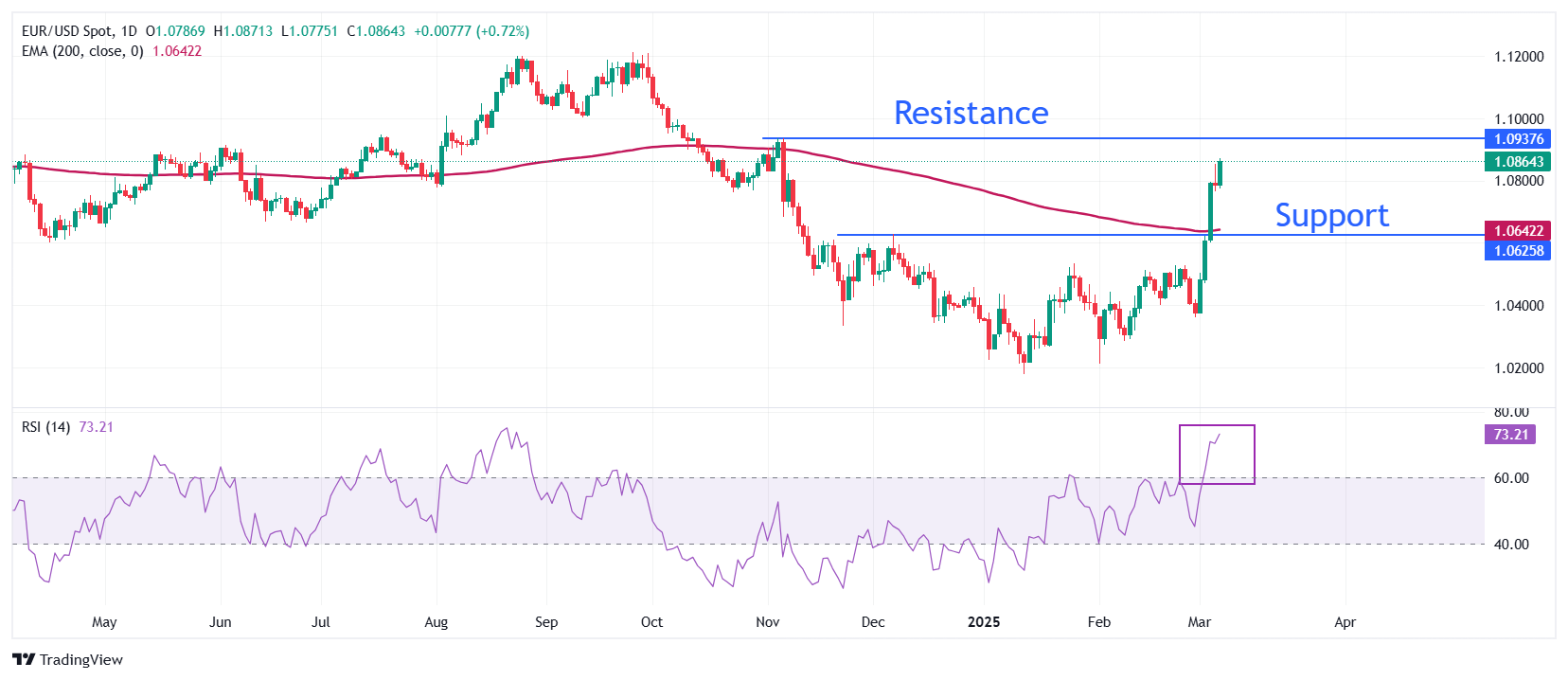
EUR/USD surges to over 1.0850 on Friday after a decisive breakout above the December 6 high of 1.0630 earlier this week. The long-term outlook of the major currency pair is bullish as it holds above the 200-day Exponential Moving Average (EMA), which trades around 1.0640.
The 14-day Relative Strength Index (RSI) jumps above 70.00, indicating a strong bullish momentum.
Looking down, the December 6 high of 1.0630 will act as the major support zone for the pair. Conversely, the November 6 high of 1.0937 and the psychological level of 1.1000 will be key barriers for the Euro bulls.
Author

Sagar Dua
FXStreet
Sagar Dua is associated with the financial markets from his college days. Along with pursuing post-graduation in Commerce in 2014, he started his markets training with chart analysis.