EUR/JPY strengthens as Trump’s tariff warning weighs on Yen
- The Euro gains for a second day against the Japanese Yen as the Yen weakens across the board.
- Trump posts letters on Truth Social threatening 25% tariffs on all Japanese imports starting August 1.
- The cross trades near 171.80, last seen in July 2024, up 0.56% on the day.


The Euro (EUR) extends its advance against the Japanese Yen (JPY) for the second straight session on Tuesday, as the Yen weakens broadly across major currencies. The latest wave of selling pressure on the Yen comes after US President Donald Trump posted a series of letters on his social media platform on Monday, warning of steep reciprocal tariffs targeting several countries, including Japan.
US President Trump threatened to impose a 25% tariff on all Japanese imports starting August 1, citing unfair trade practices. The renewed tariff threats have reignited trade tensions, denting demand for the safe-haven Yen and lifting EUR/JPY amid a broader risk-off sentiment.
The EUR/JPY cross has been trading on the front foot since early June, maintaining a steady upward trajectory. At the time of writing, the pair is hovering near 171.80 during the American session — a level last seen on July 17, 2024. The cross is up 0.56% on the day, supported by persistent Euro strength and broad-based Yen weakness.
Meanwhile, the European Union (EU) was not included in the latest US tariff threat. While countries like Japan and South Korea received formal letters warning of 25% import duties, the EU was not among them. Trade talks between the US and the EU are gaining momentum ahead of the extended tariff deadline. Reports suggest that Washington is proposing a reset of existing tariffs, aiming to lower most of the EU import duties to a 10% baseline while maintaining elevated duties on sensitive sectors, such as automobiles, steel and aluminum. Brussels is reportedly working on a draft framework deal to avoid a broader escalation, though internal disagreements within the EU, particularly between Germany and France, are complicating consensus. Failure to reach a timely agreement could trigger steep retaliatory tariffs, adding to already fragile market sentiment.
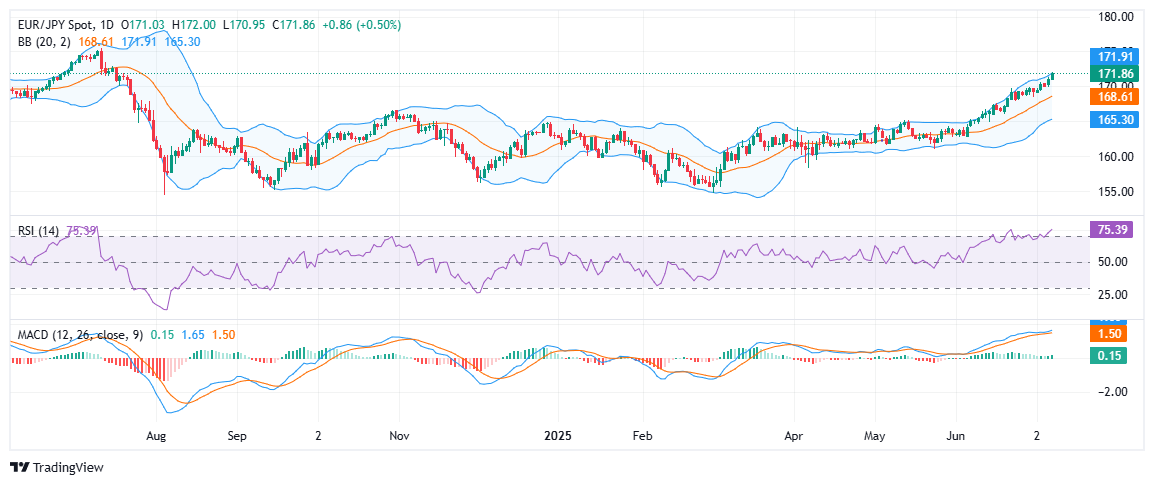
Technically, EUR/JPY maintains its bullish trajectory, trading near 171.80 during Tuesday’s American session. The cross remains well-supported above the ascending 20-day Simple Moving Average (SMA), currently at 168.61, which also serves as the middle line of the Bollinger Bands and continues to press against the upper boundary of the Bollinger Bands, reflecting sustained upside momentum. The recent breakout above the 170.00 psychological level has further reinforced the bullish structure, with no immediate signs of exhaustion.
Momentum indicators remain firmly in favor of the bulls. The Relative Strength Index (RSI) stands elevated at 75, hovering in overbought territory but consistent with strong trending conditions. Meanwhile, the Moving Average Convergence Divergence (MACD) histogram is expanding positively, and the MACD line holds above the signal line, confirming bullish momentum.
On the downside, initial support is seen at the 20-day SMA, mid-Bollinger Band near 168.60. A deeper pullback could expose the lower Bollinger Band around 165.00, a level that previously acted as resistance and may now serve as key support. On the upside, the next target could be the high of July 17, 2024, at 172.83
Author
Vishal Chaturvedi
FXStreet
I am a macro-focused research analyst with over four years of experience covering forex and commodities market. I enjoy breaking down complex economic trends and turning them into clear, actionable insights that help traders stay ahead of the curve.