EUR/JPY snaps three-day losing streak, edges higher as Eurozone inflation holds steady
- EUR/JPY rebounds to 163.20 on Monday after three days of losses, capped by resistance near 165.00.
- Eurozone inflation unchanged in April: headline at 2.2%, core CPI stable at 2.7%, reinforcing June ECB rate cut bets.
- BoJ’s Uchida flags potential for more hikes if recovery holds; Japan CPI and trade data eyed this week.
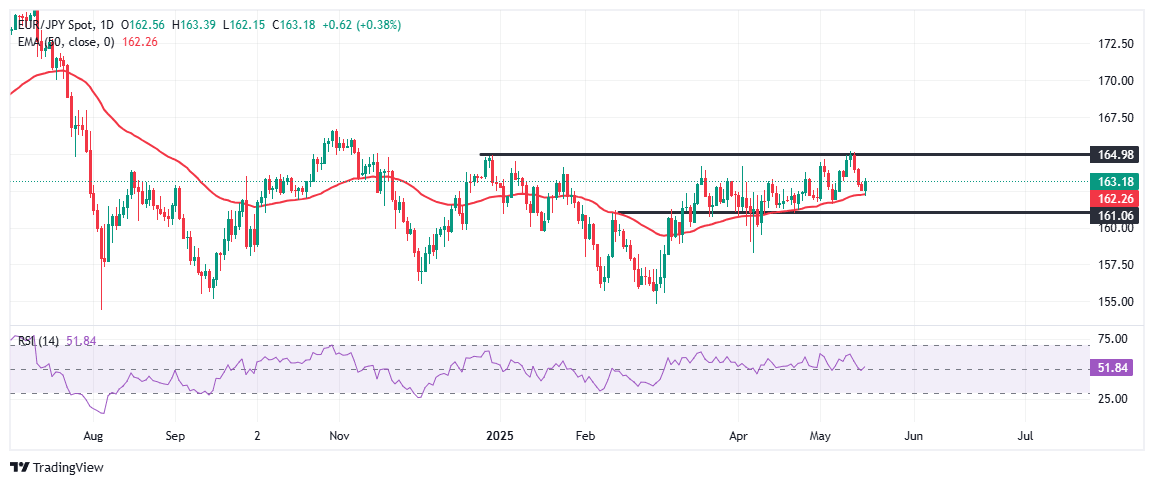
- EUR/JPY stays above 50-day EMA near 162.26; broader range between 161.00 and 165.00 intact


EUR/JPY trades modestly higher near 163.20 on Monday, snapping a three-day losing streak, as investors digest steady Eurozone inflation data, flexible policy signals from the Bank of Japan (BoJ), and fresh geopolitical developments ahead of key economic releases.
Latest Harmonized Index of Consumer Prices (HICP) figures from Eurostat confirmed that Eurozone headline inflation stayed at 2.2% in April, while core inflation held steady at 2.7%, both matching forecasts. The in-line data keeps the European Central Bank (ECB) on track for a widely expected 25 basis point rate cut in June, as policymakers focus on persistent growth risks and a still-anchored inflation outlook.
On the Japanese side, BoJ Deputy Governor Shinichi Uchida stated that the central bank could continue raising interest rates if Japan’s economy rebounds from the hit of higher US tariffs, noting that inflation is likely to stay near the 2% target if conditions unfold as projected. However, Uchida also cautioned that the global trade outlook remains highly uncertain.
This week’s Japanese trade balance, due on Tuesday, and Consumer Price Index (CPI) data on Thursday will be closely watched for further signals. A potential acceleration in core inflation could strengthen the BoJ’s case for additional tightening, while trade figures will offer a snapshot of Japan’s export performance amid tariff-driven disruptions.
Geopolitical headlines are also influencing sentiment. The European Union (EU) and the United Kingdom (UK) reached a tentative agreement on multiple areas—including defense, fisheries, and youth mobility—ahead of a key EU–UK summit. According to EU officials, the deal would allow British firms to participate in EU defense contracts, marking progress in post-Brexit cooperation and offering potential tailwinds for the Euro.
Meanwhile, in Asia, Japanese Prime Minister Shigeru Ishiba reiterated that Japan will not agree to any initial trade deal with the US that excludes automobiles, pressing Washington to lift its 25% tariff on Japanese cars. The stance underscores Japan’s firm position in ongoing trade talks and highlights the lingering risks of protectionist measures, which continue to support safe-haven flows into the Japanese Yen.
From a technical standpoint, EUR/JPY remains within a consolidation range between 161.00 and 165.00, rebounding off support and trading above the 50-day Exponential Moving Average (EMA) at 162.26. The 14-day Relative Strength Index (RSI) near 52 signals neutral momentum, with no immediate breakout signals. A daily close above 165.00 would be needed to confirm bullish continuation, while a move below 161.00 could open the door for deeper losses.
Author
Vishal Chaturvedi
FXStreet
I am a macro-focused research analyst with over four years of experience covering forex and commodities market. I enjoy breaking down complex economic trends and turning them into clear, actionable insights that help traders stay ahead of the curve.