EUR/JPY retreats from YTD high as ECB and BoJ adopt a cautious tone
- EUR/JPY edges lower after reaching a new YTD high at 167.62.
- Eurozone sentiment supports the Euro amid a cautious ECB tone.
- The Japanese Yen remains pressured as the Bank of Japan adopts a dovish tone.


The Euro (EUR) is pulling back against the Japanese Yen (JPY) on Tuesday after hitting a year-to-date high and its strongest level since July.
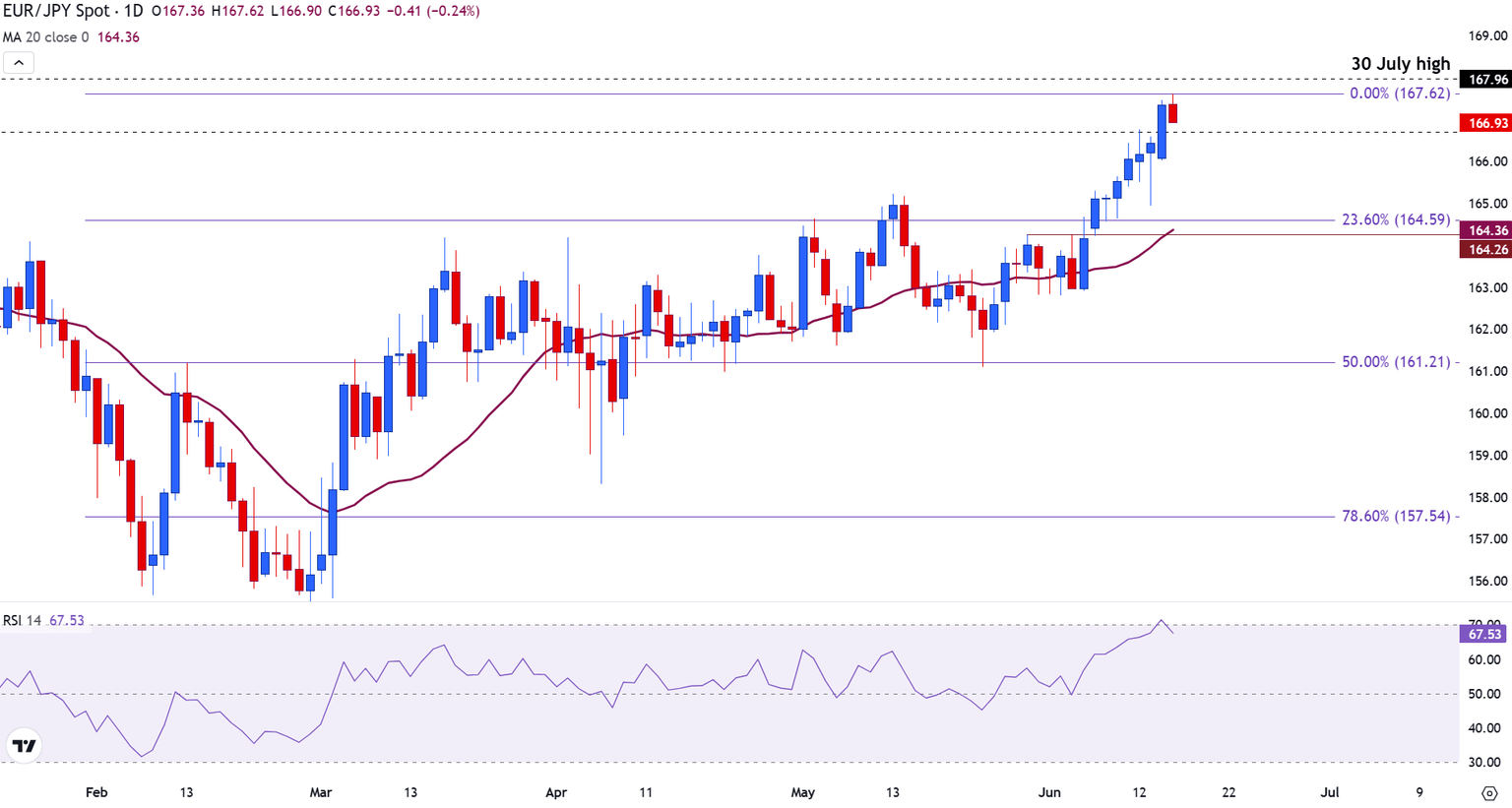
EUR/JPY reached an intraday peak of 167.62 before slipping to 167.00 at the time of writing, as traders locked in gains near overbought levels.
The dip comes as investors digest cautious messaging from both the European Central Bank (ECB) and the Bank of Japan (BoJ).
Monetary signals from the ECB and the BoJ reflect rising global risks
On the ECB side, France’s central bank governor, François Villeroy de Galhau, urged “agile pragmatism,” citing rising Oil prices and the Israel–Iran conflict.
Meanwhile, the Bank of Japan (BoJ) maintained its policy rate at 0.5% on Tuesday, a widely anticipated decision. In response to rising uncertainty, the BoJ announced it would gradually slow its bond tapering process through April 2026.
This cautious strategy reflects mounting concerns over a persistently weak Yen, inflation that remains above target, and broader risks to the global economy. BoJ Governor Kazuo Ueda warned that “the fallout from trade uncertainty could weigh on companies’ winter bonus payments and wage negotiations next year,” highlighting how international policies are influencing domestic policy calibration.
Eurozone sentiment supports the Euro amid a cautious ECB tone
On the data front, Eurozone sentiment continues to climb. Germany’s ZEW Economic Sentiment Index surged to 47.5 in June, easily beating forecasts of 35.0. The Eurozone-wide reading also topped expectations at 35.3. These stronger-than-expected prints helped support the Euro despite ECB caution.
EUR/JPY faces resistance as overbought signals emerge
Technically, EUR/JPY remains in an uptrend but is stalling at significant resistance near 167.60. The pair is still trading well above the 20-day Simple Moving Average (SMA) at 164.37. However, a Relative Strength Index (RSI) reading of 68 suggests a potential cooling-off period may be ahead. A drop below the 164.59–164.37 support zone could spark a deeper pullback, while a push above 167.62 opens the door to 168.90.
EUR/JPY daily chart
Central banks FAQs
Central Banks have a key mandate which is making sure that there is price stability in a country or region. Economies are constantly facing inflation or deflation when prices for certain goods and services are fluctuating. Constant rising prices for the same goods means inflation, constant lowered prices for the same goods means deflation. It is the task of the central bank to keep the demand in line by tweaking its policy rate. For the biggest central banks like the US Federal Reserve (Fed), the European Central Bank (ECB) or the Bank of England (BoE), the mandate is to keep inflation close to 2%.
A central bank has one important tool at its disposal to get inflation higher or lower, and that is by tweaking its benchmark policy rate, commonly known as interest rate. On pre-communicated moments, the central bank will issue a statement with its policy rate and provide additional reasoning on why it is either remaining or changing (cutting or hiking) it. Local banks will adjust their savings and lending rates accordingly, which in turn will make it either harder or easier for people to earn on their savings or for companies to take out loans and make investments in their businesses. When the central bank hikes interest rates substantially, this is called monetary tightening. When it is cutting its benchmark rate, it is called monetary easing.
A central bank is often politically independent. Members of the central bank policy board are passing through a series of panels and hearings before being appointed to a policy board seat. Each member in that board often has a certain conviction on how the central bank should control inflation and the subsequent monetary policy. Members that want a very loose monetary policy, with low rates and cheap lending, to boost the economy substantially while being content to see inflation slightly above 2%, are called ‘doves’. Members that rather want to see higher rates to reward savings and want to keep a lit on inflation at all time are called ‘hawks’ and will not rest until inflation is at or just below 2%.
Normally, there is a chairman or president who leads each meeting, needs to create a consensus between the hawks or doves and has his or her final say when it would come down to a vote split to avoid a 50-50 tie on whether the current policy should be adjusted. The chairman will deliver speeches which often can be followed live, where the current monetary stance and outlook is being communicated. A central bank will try to push forward its monetary policy without triggering violent swings in rates, equities, or its currency. All members of the central bank will channel their stance toward the markets in advance of a policy meeting event. A few days before a policy meeting takes place until the new policy has been communicated, members are forbidden to talk publicly. This is called the blackout period.
Author
Tammy Da Costa, CFTe®
FXStreet
Tammy is an economist and market analyst with a deep passion for financial markets, particularly commodities and geopolitics.