EUR/JPY retreats from YTD high amid trade tensions and overbought signals
- EUR/JPY tests a new YTD high of 172.28 as the safe-haven Yen remains under pressure.
- Europe remains optimistic about a potential trade deal with the US, but a lack of progress limits gains.
- EUR/JPY remains in overbought conditions after failing to test 173.00 resistance.


The Euro (EUR) is slipping against the Japanese Yen (JPY), easing from its recent year-to-date high of 172.28 reached on Wednesday amid fresh concerns over potential US tariffs targeting Japan.
After seven straight weeks of gains and a rally of more than 10% since March, the EUR/JPY pair finally hit resistance. Market participants had priced in optimism, but with trade tensions and central bank divergence back in focus, the pair has retreated below the 172.00 level.
Traders are now closely monitoring the ongoing negotiations between the US, the EU and Japan.
Tariff threats and trade tensions fuel uncertainty for Europe and Japan
On Monday, President Trump indicated that an official letter detailing new tariff measures would be released within two days, prompting speculation that the EU might receive it on Wednesday.
Adding to the urgency, German Chancellor Friedrich Merz addressed lawmakers on Wednesday, expressing hope for a swift trade deal with the US, one that ideally minimizes customs duties on both sides.
Meanwhile, the US is pressing ahead with plans to implement reciprocal tariffs starting in August. This has reignited concerns over the global cost implications, particularly for industries such as autos, steel and aluminium.
For policymakers, the stakes are rising.
Higher tariffs risk fuelling inflation, a concern particularly relevant in Japan, where consumer prices have already crept toward the Bank of Japan’s target.
Both the EU and Japan are bracing for 25% tariffs on auto parts and a 50% levy on steel and aluminium shipped to the US. Japan, in particular, was warned of a blanket 25% tariff on all goods headed to the American market.
With the Bank of Japan holding its policy rate steady at 0.5%, the increased trade friction dims any near-term prospects for a rate hike. As uncertainty mounts, currency volatility is likely to remain elevated in the sessions ahead.
EUR/JPY retreats as the pair remains in overbought territory
EUR/JPY has begun to retreat, with price action stalling after bulls failed to test the psychological resistance level of 173.00. After peaking at 172.28, the pair is edging lower, with prices falling below 172.00 at the time of writing.
Technically, the pair remains in a strong uptrend; however, signs of exhaustion are beginning to emerge. The Relative Strength Index (RSI) remains in overbought territory above 73 and is pointing lower, hinting at potential short-term consolidation or a corrective pullback.
EUR/JPY daily chart
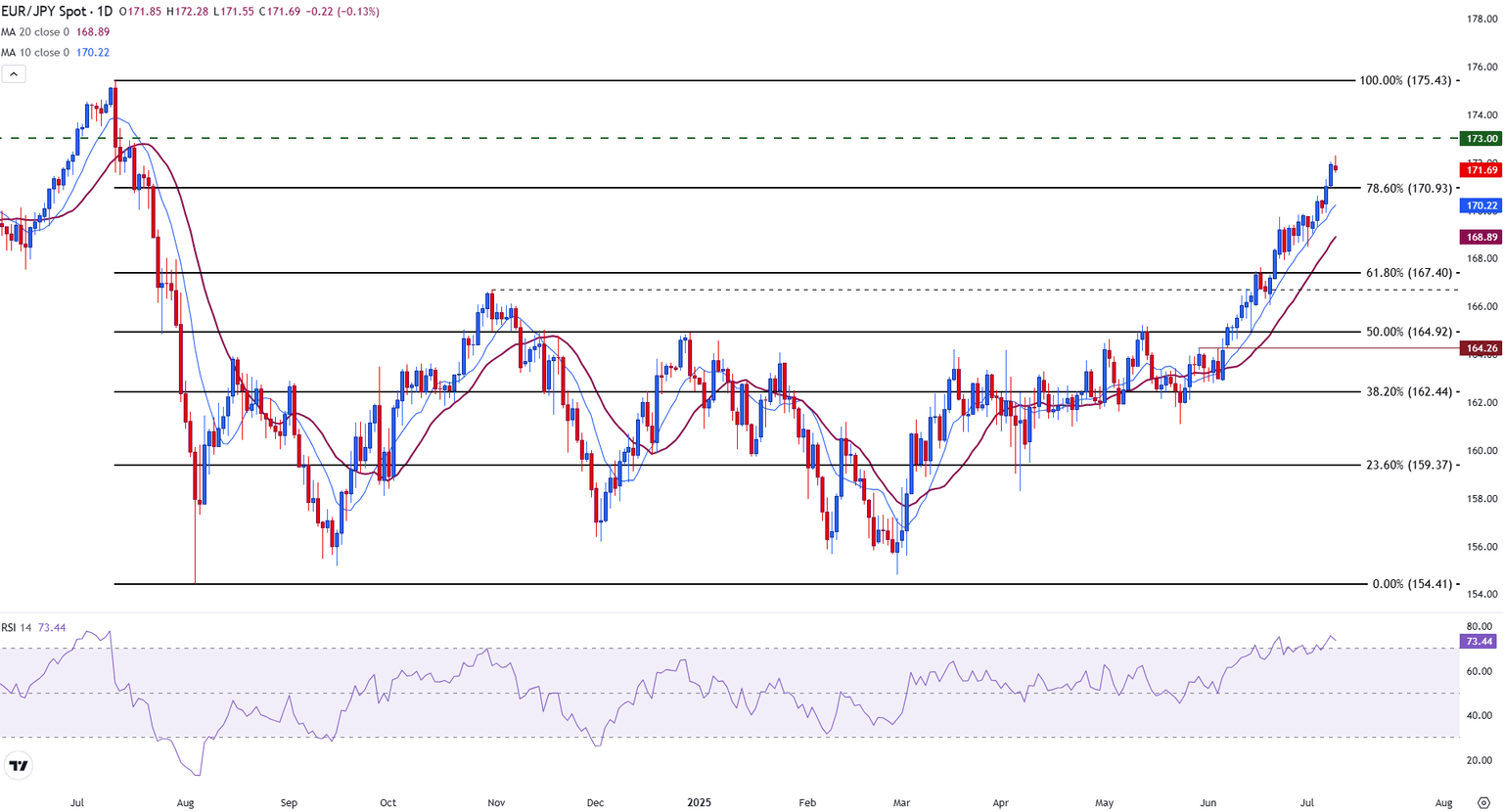
Support lies near the 78.6% Fibonacci retracement level of the July-August 2024 downtrend at 170.93, followed by the 20-day Simple Moving Average (SMA) at 168.89. A break below these levels could expose the 61.8% retracement at 167.40.
On the upside, a move above the 173.00 psychological level could bring the July 2024 high of 175.43 into play. But bulls may need a fundamental catalyst, such as a favorable trade deal, to push higher from here.
Overall, the technical setup suggests that while the broader bullish trend is intact, short-term momentum may be stretched, and a pause or correction is likely unless trade-related headlines provide further fuel.
Euro FAQs
The Euro is the currency for the 19 European Union countries that belong to the Eurozone. It is the second most heavily traded currency in the world behind the US Dollar. In 2022, it accounted for 31% of all foreign exchange transactions, with an average daily turnover of over $2.2 trillion a day. EUR/USD is the most heavily traded currency pair in the world, accounting for an estimated 30% off all transactions, followed by EUR/JPY (4%), EUR/GBP (3%) and EUR/AUD (2%).
The European Central Bank (ECB) in Frankfurt, Germany, is the reserve bank for the Eurozone. The ECB sets interest rates and manages monetary policy. The ECB’s primary mandate is to maintain price stability, which means either controlling inflation or stimulating growth. Its primary tool is the raising or lowering of interest rates. Relatively high interest rates – or the expectation of higher rates – will usually benefit the Euro and vice versa. The ECB Governing Council makes monetary policy decisions at meetings held eight times a year. Decisions are made by heads of the Eurozone national banks and six permanent members, including the President of the ECB, Christine Lagarde.
Eurozone inflation data, measured by the Harmonized Index of Consumer Prices (HICP), is an important econometric for the Euro. If inflation rises more than expected, especially if above the ECB’s 2% target, it obliges the ECB to raise interest rates to bring it back under control. Relatively high interest rates compared to its counterparts will usually benefit the Euro, as it makes the region more attractive as a place for global investors to park their money.
Data releases gauge the health of the economy and can impact on the Euro. Indicators such as GDP, Manufacturing and Services PMIs, employment, and consumer sentiment surveys can all influence the direction of the single currency. A strong economy is good for the Euro. Not only does it attract more foreign investment but it may encourage the ECB to put up interest rates, which will directly strengthen the Euro. Otherwise, if economic data is weak, the Euro is likely to fall. Economic data for the four largest economies in the euro area (Germany, France, Italy and Spain) are especially significant, as they account for 75% of the Eurozone’s economy.
Another significant data release for the Euro is the Trade Balance. This indicator measures the difference between what a country earns from its exports and what it spends on imports over a given period. If a country produces highly sought after exports then its currency will gain in value purely from the extra demand created from foreign buyers seeking to purchase these goods. Therefore, a positive net Trade Balance strengthens a currency and vice versa for a negative balance.
Author
Tammy Da Costa, CFTe®
FXStreet
Tammy is an economist and market analyst with a deep passion for financial markets, particularly commodities and geopolitics.