EUR/JPY Price Forecast: Rallies to near 157.00 as Yen weakens across the board
- EUR/JPY surges to near 157.00 as soft Tokyo CPI data sends the Yen on the backfoot.
- Moderate Tokyo CPI growth is expected to weigh on BoJ hawkish bets.
- Steady German HICP growth is unlikely to restrict the ECB from easing monetary policy further.

The EUR/JPY pair rallies to near 157.00 in the North American session on Friday. The pair strengthens as the Japanese Yen (JPY) is underperforming across the board after the release of the soft Tokyo Consumer Price Index (CPI) data for February.
Japanese Yen PRICE Today
The table below shows the percentage change of Japanese Yen (JPY) against listed major currencies today. Japanese Yen was the strongest against the New Zealand Dollar.
| USD | EUR | GBP | JPY | CAD | AUD | NZD | CHF | |
|---|---|---|---|---|---|---|---|---|
| USD | -0.08% | 0.06% | 0.66% | -0.16% | 0.31% | 0.52% | 0.31% | |
| EUR | 0.08% | 0.15% | 0.75% | -0.06% | 0.40% | 0.62% | 0.40% | |
| GBP | -0.06% | -0.15% | 0.59% | -0.22% | 0.25% | 0.46% | 0.24% | |
| JPY | -0.66% | -0.75% | -0.59% | -0.80% | -0.35% | -0.14% | -0.35% | |
| CAD | 0.16% | 0.06% | 0.22% | 0.80% | 0.46% | 0.68% | 0.46% | |
| AUD | -0.31% | -0.40% | -0.25% | 0.35% | -0.46% | 0.21% | -0.00% | |
| NZD | -0.52% | -0.62% | -0.46% | 0.14% | -0.68% | -0.21% | -0.22% | |
| CHF | -0.31% | -0.40% | -0.24% | 0.35% | -0.46% | 0.00% | 0.22% |
The heat map shows percentage changes of major currencies against each other. The base currency is picked from the left column, while the quote currency is picked from the top row. For example, if you pick the Japanese Yen from the left column and move along the horizontal line to the US Dollar, the percentage change displayed in the box will represent JPY (base)/USD (quote).
Statistics Bureau of Japan reported that the Tokyo headline CPI decelerated significantly to 2.9% from 3.4% in January. In the same period, the Tokyo CPI ex. Fresh Food rose by 2.2%, slower than estimates of 2.3% and the former release of 2.5%. Soft Tokyo CPI data is likely to weigh on market expectations that the Bank of Japan (BoJ) will raise interest rates again this year.
Meanwhile, the Euro (EUR) outperforms its major peers despite fears that United States (US) President Donald Trump’s tariff agenda will be unfavorable for the Eurozone economy. On Wednesday, Trump threatened to impose 25% tariffs on cars and other things imported from the Eurozone sooner.
On the domestic front, hotter-than-expected flash German Harmonized Index of Consumer Prices (HICP) data for February is unlikely to ease market expectations that the European Central Bank (ECB) will reduce its Deposit Facility rate by 25 basis points (bps) to 2.5% in the policy meeting on Thursday.
German HICP rose steadily by 2.8%, faster than estimates of 2.7% on year. Month-on-month HICP grew at a faster pace of 0.6% than expectations of 0.5%. In January, the underlying inflation data deflated by 0.2%.
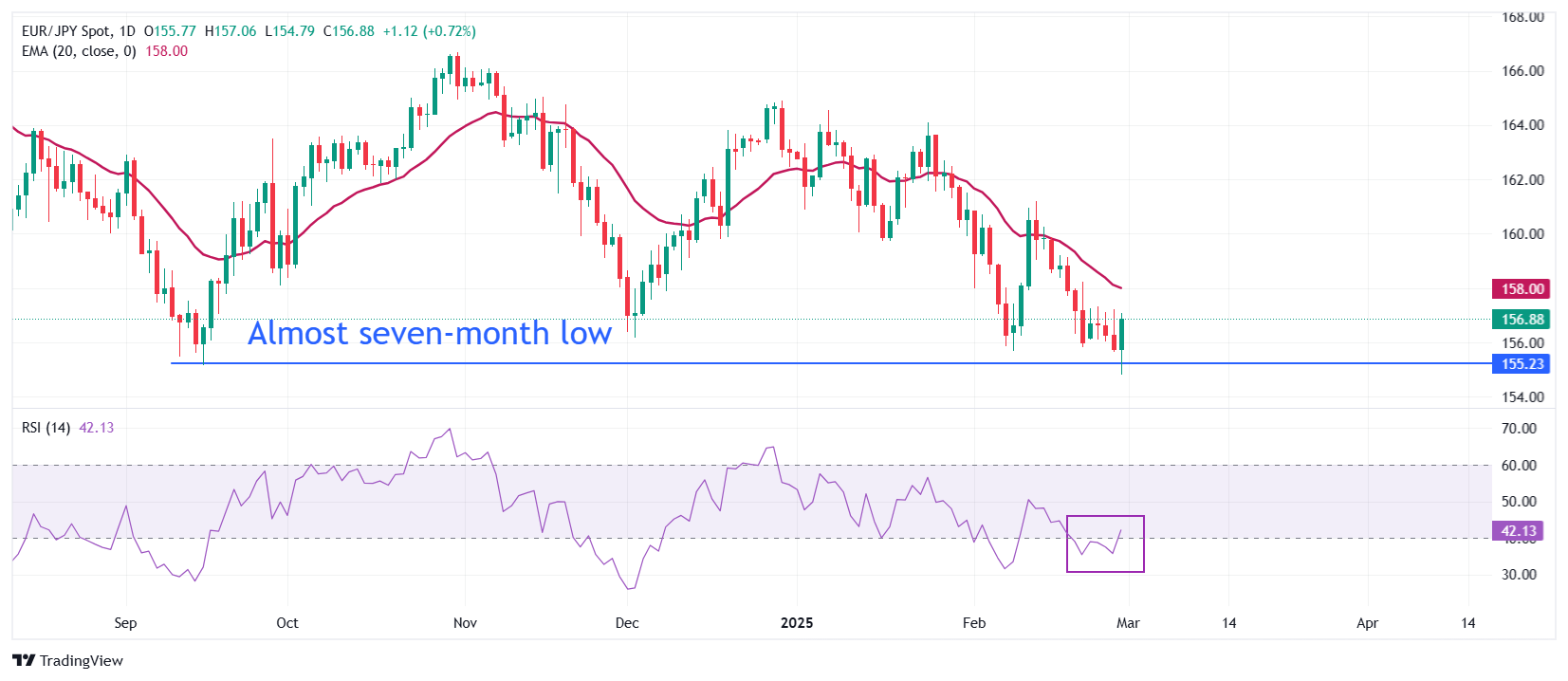
EUR/JPY recovers strongly after revisiting an almost seven-month low of 155.15 on Friday. However, the near-term outlook of the cross is still bearish as the 20-day Exponential Moving Average (EMA) is sloping downwards to near 158.00.
The 14-day Relative Strength Index (RSI) bounced back to the 40.00-60.00 range, which indicates that bearish momentum has ended. However, the negative bias remains intact.
More recovery in the EUR/JPY pair above the February 25 high of 157.30 would allow it to gain further towards the 20-day EMA around 158.00, followed by the February 19 high of 159.14.
On the flip side, a downside move by the pair below the intraday low of 154.80 would expose it to the August 5 low of 154.40 and the 19-month low of 153.17.
EUR/JPY daily chart
Japanese Yen FAQs
The Japanese Yen (JPY) is one of the world’s most traded currencies. Its value is broadly determined by the performance of the Japanese economy, but more specifically by the Bank of Japan’s policy, the differential between Japanese and US bond yields, or risk sentiment among traders, among other factors.
One of the Bank of Japan’s mandates is currency control, so its moves are key for the Yen. The BoJ has directly intervened in currency markets sometimes, generally to lower the value of the Yen, although it refrains from doing it often due to political concerns of its main trading partners. The BoJ ultra-loose monetary policy between 2013 and 2024 caused the Yen to depreciate against its main currency peers due to an increasing policy divergence between the Bank of Japan and other main central banks. More recently, the gradually unwinding of this ultra-loose policy has given some support to the Yen.
Over the last decade, the BoJ’s stance of sticking to ultra-loose monetary policy has led to a widening policy divergence with other central banks, particularly with the US Federal Reserve. This supported a widening of the differential between the 10-year US and Japanese bonds, which favored the US Dollar against the Japanese Yen. The BoJ decision in 2024 to gradually abandon the ultra-loose policy, coupled with interest-rate cuts in other major central banks, is narrowing this differential.
The Japanese Yen is often seen as a safe-haven investment. This means that in times of market stress, investors are more likely to put their money in the Japanese currency due to its supposed reliability and stability. Turbulent times are likely to strengthen the Yen’s value against other currencies seen as more risky to invest in.
Author

Sagar Dua
FXStreet
Sagar Dua is associated with the financial markets from his college days. Along with pursuing post-graduation in Commerce in 2014, he started his markets training with chart analysis.