|

EUR/JPY Price Analysis: Surpasses the Tenkan-Sen, hovers around 163.00

  • EUR/JPY sees a 0.19% rise, maintaining a position below the YTD high of 164.30 amid US and Japan holidays.
  • For further bullish momentum, EUR/JPY needs to breach 164.00; downside risks include a potential drop towards 161.25 support.

The EUR/JPY rose a decent 0.19% yet remains well below the latest cycle and a year-to-date (YTD) high at 164.30 on Thursday. At the time of writing, the pair exchanges hands at 163.09 amid thin liquidity conditions due to holidays in the US and Japan.

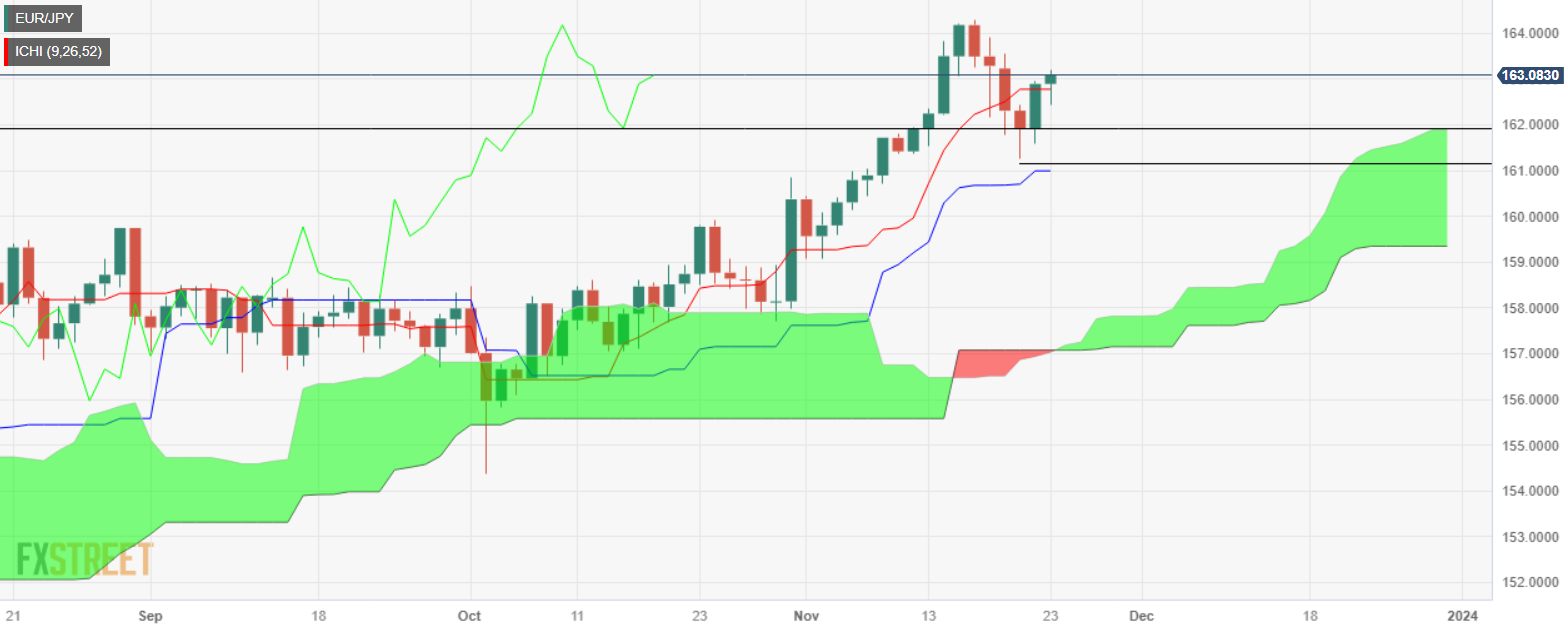
From a technical perspective, the EUR/JPY daily chart portrays the pair as neutral to upward biased, with price action remaining above the Ichimoku Cloud (Kumo) and above the Tenkan-Sen level at 162.77. Although the bias is bullish, the Tenkan and Kijun-Sen lines turned flat, suggesting consolidation lies ahead.

For a bullish continuation, the EUR/JPY needs to remain above 163.00 and test the 164.00 figure, ahead of threatening the year-to-date (YTD) high at 164.30. On the other hand, if the cross drops below the Tenkan-Sen at 162.77, that would exacerbate a drop to the Senkou Span A at 161.88. The next demand zone would be 161.25, the November 21 daily and last cycle low.

EUR/JPY Price Analysis – Daily Chart
EUR/JPY Technical Levels

EUR/JPY

Overview
Today last price163.09
Today Daily Change0.19
Today Daily Change %0.12
Today daily open162.9
 
Trends
Daily SMA20161.28
Daily SMA50159.17
Daily SMA100158.18
Daily SMA200153.02
 
Levels
Previous Daily High162.94
Previous Daily Low161.6
Previous Weekly High164.31
Previous Weekly Low161.54
Previous Monthly High160.85
Previous Monthly Low154.39
Daily Fibonacci 38.2%162.43
Daily Fibonacci 61.8%162.11
Daily Pivot Point S1162.01
Daily Pivot Point S2161.13
Daily Pivot Point S3160.67
Daily Pivot Point R1163.36
Daily Pivot Point R2163.82
Daily Pivot Point R3164.71

Author

Christian Borjon Valencia

Markets analyst, news editor, and trading instructor with over 14 years of experience across FX, commodities, US equity indices, and global macro markets.


More from Christian Borjon Valencia
Share:

Editor's Picks

GBP/USD remains stuck in tight range above 1.3600

GBP/USD extends its consolidation into a second consecutive day on Tuesday and fluctuates in a narrow band above 1.3600. The US Dollar stabilizes as investors assess US sanctions on Iran, while diplomatic efforts creep back amid reports that Pakistan is carrying an offer to Iran to halt the siege and lift sanctions under the Memorandum of Understanding.

EUR/USD stays below 1.1700 after weak US consumer confidence data

EUR/USD struggles to gather recovery momentum and trades below 1.1700 in the second half of the day on Tuesday. The US Dollar (USD) benefits from the cautious mood as investors assess the latest developments in the Middle East. Meanwhile, disappointing consumer sentiment data from the US helps the pair hold its ground.

Gold takes a breather after climbing to a fresh three-month high, US PCE in focus

Gold (XAU/USD) extends its intraday decline during American trading hours on Tuesday after setting a fresh three-month high of $4,697 earlier in the day.

Crypto Today: Bitcoin soars past $80K as Ethereum and XRP hold gains

Bitcoin (BTC) is trading above $80,000 on Tuesday. This is the highest level the Crypto King has traded since mid-May, underscoring a positive shift in investors' risk-on sentiment, liquidity conditions and the technical outlook.

Nvidia earnings: A quick look at expectations

The 2026 Q2 earnings season is nearly over for S&P 500 members, with the reporting cycle notably positive. But looming large this week is none other than AI-favorite NVIDIA (NVDA) , whose results will wrap up the reporting cycle for the Magnificent Seven group as well.

$20 billion offered, $2 billion taken: Why Treasury doubled its buyback cap

The US Treasury moved off its own calendar on Wednesday, and that is the part worth sitting with. At 12:32 GMT, the department said it would at least double the size of liquidity support buyback operations in the 10-year to 20-year and 20-year to 30-year sectors, lifting the maximum from $2 billion per operation to at least $4 billion, effective September 9 and running to November 4.














