|

EUR/JPY Price Analysis: Pair slides to 162.15 as bearish momentum intensifies

  • EUR/JPY drops sharply on Monday toward key 162.00 support levels.
  • Technical indicators show mounting selling pressure, with the pair nearing the 20- and 100-day SMA convergence.
  • Focus shifts to whether the pair can stabilize around 162.00 or risk further downside.

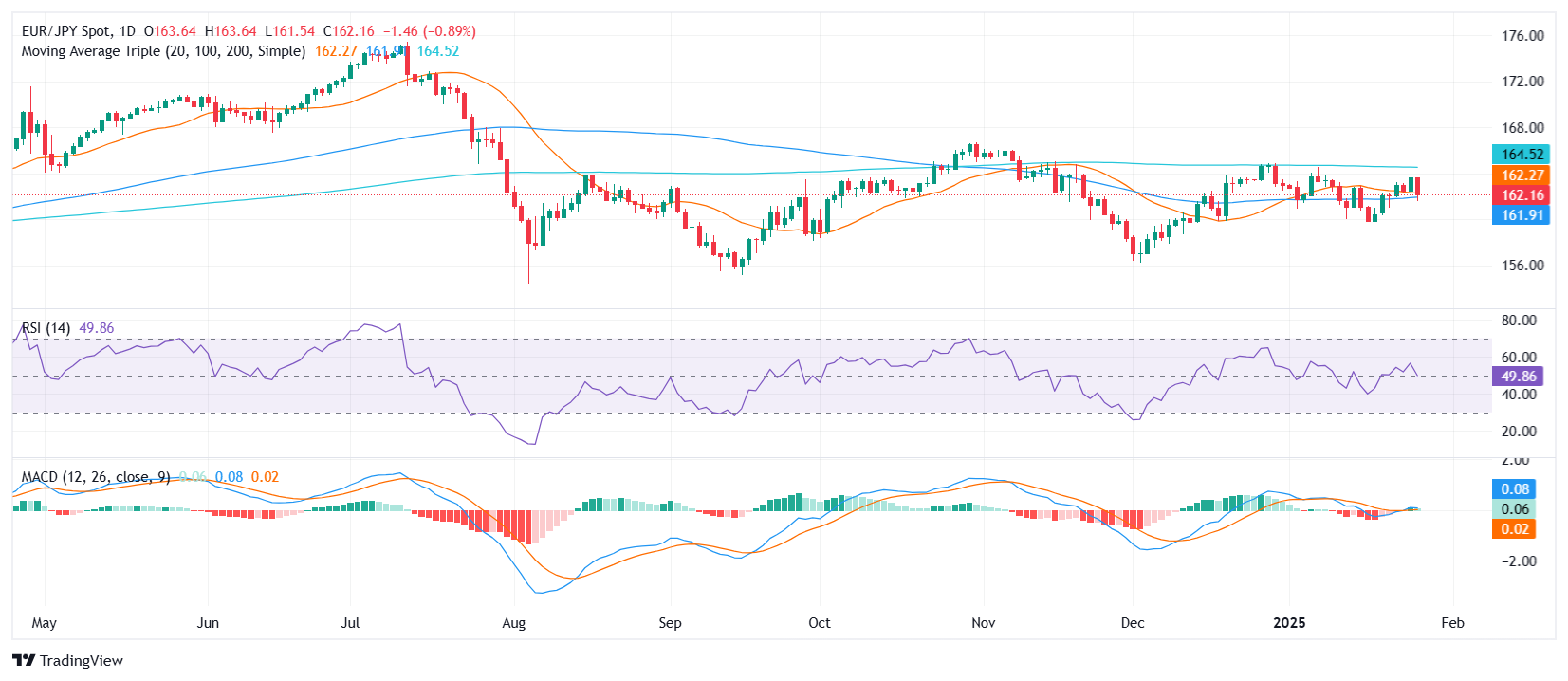
The EUR/JPY cross extended its losses on Monday, falling by 0.90% to settle at 162.15. The move highlights increased bearish momentum as the pair approaches a critical technical juncture, with the 20- and 100-day Simple Moving Average (SMA) convergence at 162.00 set to serve as a significant support zone. The steep decline marks a continuation of the downward trend observed over recent sessions, putting buyers under renewed pressure.

Technical indicators reinforce the bearish outlook. The Relative Strength Index (RSI) has dropped sharply to 49, slipping into negative territory and signaling weakening buying interest. Simultaneously, the Moving Average Convergence Divergence (MACD) histogram displays decreasing green bars, reflecting fading bullish traction and a growing bearish bias in the short term.

Looking ahead, the 162.00 level, where the 20- and 100-day SMAs converge, will be crucial in determining the pair’s next move. A decisive break below this area could open the door to further losses, with the next support seen at 161.50. Conversely, stabilization above this zone may encourage buyers to regroup and attempt a recovery toward the 163.00 resistance level. The pair’s ability to hold its ground at these critical levels will shape its trajectory in the coming sessions.

EUR/JPY daily chart
Author

Patricio Martín

Patricio is an economist from Argentina passionate about global finance and understanding the daily movements of the markets.


More from Patricio Martín
Share:

Markets move fast. We move first.

Orange Juice Newsletter brings you expert driven insights - not headlines. Every day on your inbox.

By subscribing you agree to our Terms and conditions.

Editor's Picks

EUR/USD eases to near 1.1650, eyes US PCE for fresh impetus

EUR/USD turns south to test 1.1650 in European trading on Friday, facing rejection once again near seven-week highs. The pair, however, continues to draw support from persistent US Dollar selling bias, despite a cautious market mood. Traders now await the US September PCE inflation and UoM Consumer Sentiment data. 

GBP/USD holds gains near 1.3350 ahead of US data

GBP/USD sticks to a positive bias near 1.3350 in the European session on Friday. Traders prefer to wait on the sidelines ahead of the key US inflation and sentiment data due later in the day. In the meantime, broad-based US Dollar weakness helps the pair stay afloat. 

Gold remains below $4,250 barrier as traders await US PCE data for directional impetus

Gold gains some positive traction on Friday, though it remains confined in the weekly range. Dovish Fed expectations continue to undermine the USD and lend support to the commodity. Bulls, however, might opt to wait for the US PCE Price Index before placing aggressive bets.

UoM Consumer Sentiment Index expected to post a mild recovery in December

December’s preliminary Michigan Consumer Sentiment Index is forecast to have picked up to 52 from a three-year low of 51.0 in November. A stalled labour market and higher price pressures are likely to weigh on consumers’ confidence.

Canada Unemployment Rate expected to edge higher in November ahead of BoC rate decision

Statistics Canada will release its Labour Force Survey on Friday, and markets are bracing for a weak print. The Unemployment Rate is expected to tick higher to 7% in November, while the Employment Change is forecast to come in flat after a nice gain in October.

Pi Network Price Forecast: Bearish streak nears critical support trendline

Pi Network (PI) edges lower on Friday for the third consecutive day, approaching a local support trendline. The on-chain data suggests an increase in supply pressure as Centralized Exchanges (CEXs) experience a surge in inflows.