|

EUR/JPY Price Analysis: Gains momentum, eyes key resistance levels on risk-on mood

  • EUR/JPY advances for the second consecutive day, trading around 162.27, reflecting a 0.25% rise amid a favorable risk-on market environment.
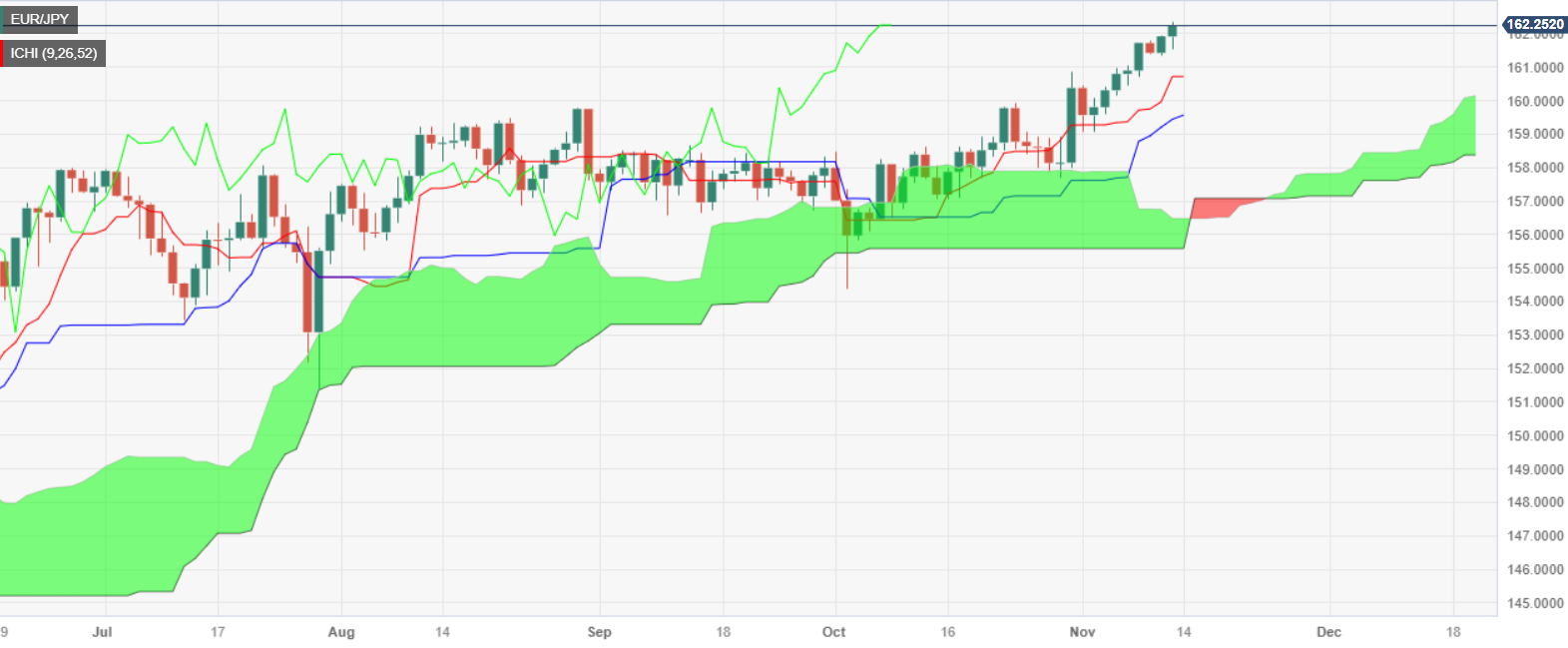
  • The pair shows an upward bias on the daily chart, with a significant resistance level at the August 2008 high of 165.60.
  • On the downside, initial support is identified at the Tenkan-Sen level of 160.72, followed by the Senkou Span A at 160.07 and the Kijun-Sen at 159.44.

EUR/JPY continues to advance for the second straight day, gaining traction toward 162.50 in late trading during the North American session, amid a risk-on impulse and despite Japanese authorities' intervention threats. At the time of writing, the EUR/JPY is exchanging hands at 162.27 up 0.25%.

From a daily chart perspective, the EUR/JPY remains upward biased, with the next resistance level emerging at around the August 2008 high of 165.60. A breach of the latter would expose the July 2008 high of 169.97, ahead of challenging the 170.00.

On the opposite flip side, the EUR/JPY first support would be the Tenkan-Sen level at 160.72 before challenging the Senkou Span A at 160.07 and the Kijun-Sen at 159.44.

EUR/JPY Price Analysis – Daily Chart
EUR/JPY Technical Levels

EUR/JPY

Overview
Today last price162.27
Today Daily Change0.35
Today Daily Change %0.22
Today daily open161.92
 
Trends
Daily SMA20159.52
Daily SMA50158.38
Daily SMA100157.73
Daily SMA200152.17
 
Levels
Previous Daily High161.95
Previous Daily Low161.36
Previous Weekly High161.95
Previous Weekly Low160.15
Previous Monthly High160.85
Previous Monthly Low154.39
Daily Fibonacci 38.2%161.72
Daily Fibonacci 61.8%161.58
Daily Pivot Point S1161.53
Daily Pivot Point S2161.15
Daily Pivot Point S3160.94
Daily Pivot Point R1162.12
Daily Pivot Point R2162.33
Daily Pivot Point R3162.71

Author

Christian Borjon Valencia

Markets analyst, news editor, and trading instructor with over 14 years of experience across FX, commodities, US equity indices, and global macro markets.


More from Christian Borjon Valencia
Share:

Editor's Picks

GBP/USD stays below 1.3400 after soft UK CPI data

GBP/USD struggles to gain traction and stays below 1.3400 in the second half of the day on Wednesday. The UK annual Consumer Price Index (CPI) inflation cooled to 2.6% in June against the market forecast of 2.7%, making it difficult for the British Pound gather recovery momentum. Meanwhile, investors keep a close eye on headlines coming out of the Middle East.

EUR/USD stabilizes near 1.1400 as markets focus on geopolitics

EUR/USD trades in a narrow channel at around 1.1400 on Wednesday. In the absence of high-impact data releases, escalating geopolitical tensions in the Middle East caps the pair's upside. On Thursday, the European Central Bank (ECB) will announce monetary policy decisions.

Gold holds gains above $4,100 undaunted by risk-off markets

Gold extends gains for the fourth consecutive day, standing comfortably above $4,100, unfazed by the risk-off market amid rising tensions in Iran and higher Oil prices. The pair has rallied nearly 2.5% so far this week and is on track for its best weekly performance in more than three months.

Cardano: Short-term recovery lacks retail support

Cardano price edges lower after the 50-day Exponential Moving Average at $1.770 capped two consecutive days of recovery seen earlier this week. ADA futures point to waning retail traction as Open Interest and trading volume decline amid elevated long liquidations. The technical outlook for ADA is bearish, as momentum remains subdued below a resistance trendline near $0.1782.

Chip stocks are more volatile than Oil

I continue to start the day by looking at these two charts: US crude & Kospi. The former is extending gains, trading above $86 per barrel for WTI and $92 per barrel for Brent, while the Kospi is up more than 4.5%, led higher by Korean chipmakers following a similar jump in VanEck's Semiconductor ETF yesterday.

US Dollar mid-year outlook: Exceptional currency, exceptional risks?
The US Dollar enters the second half of 2026 in a markedly different position from a year ago. The King currency has recovered, reflecting persistent US inflation, changing expectations for Fed policy, geopolitical tensions and renewed demand for defensive assets.