|

EUR/JPY Price Analysis: Euro steadies near 164.00 as bullish structure holds firm

  • EUR/JPY trades around the 164.00 zone after a modest pullback in Friday’s session.
  • Broader bias remains bullish, with supportive trend indicators offsetting mixed momentum signals.
  • Key support levels sit just below, while resistance aligns near recent highs.

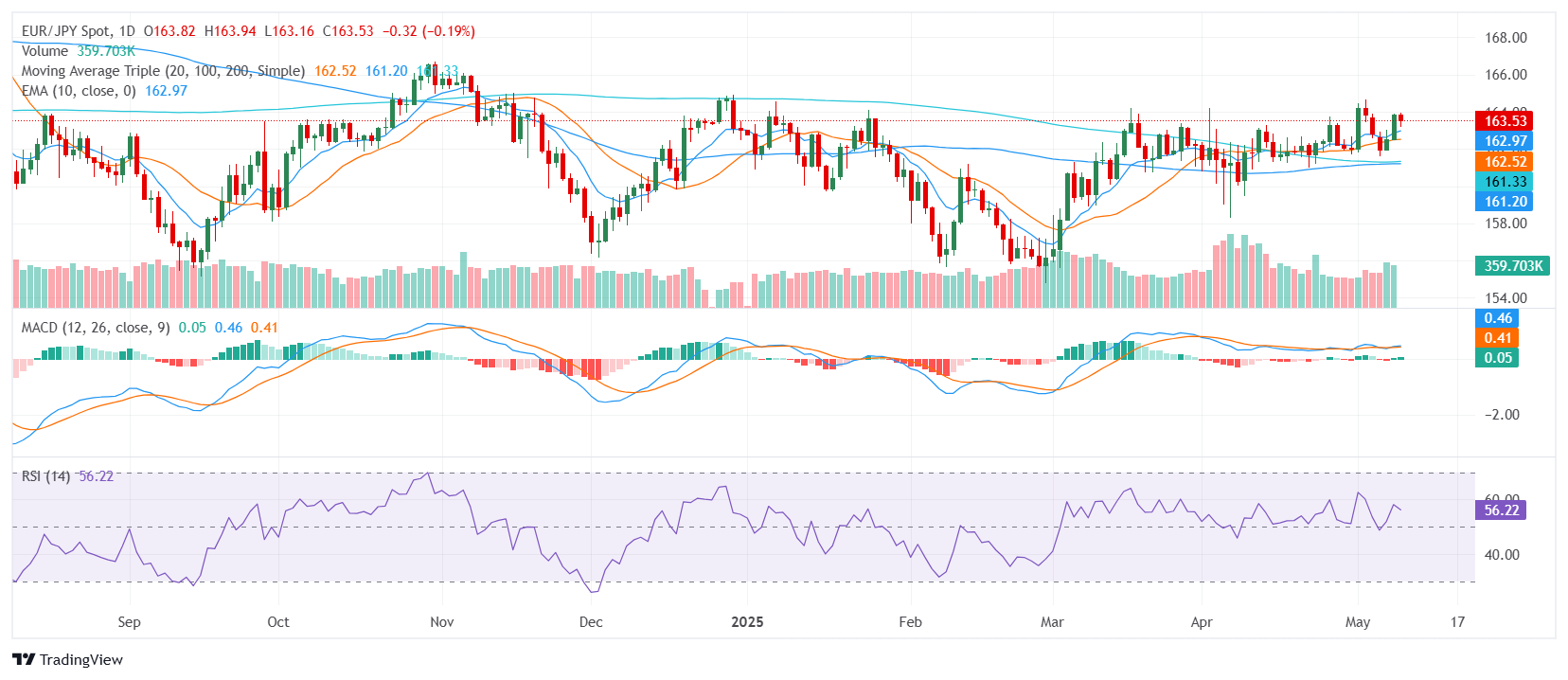
The EUR/JPY pair eased slightly on Friday, trading near the 164.00 zone after the European session, reflecting a modest pullback from recent gains. Despite the minor dip, the broader outlook remains positive, supported by a cluster of rising moving averages that continue to provide a strong technical base. Short-term momentum is mixed, but the overall structure remains clearly bullish.

Technically, the pair is flashing a bullish overall signal. The Relative Strength Index is neutral around 56, indicating balanced momentum without immediate overbought pressure. The Moving Average Convergence Divergence confirms the broader uptrend with a buy signal, reinforcing the bullish tone. Meanwhile, the Williams Percent Range and Bull Bear Power remain neutral, suggesting that while momentum has slowed, it has not yet reversed.

The bullish structure is clearly defined by the positioning of key moving averages. The 20-day, 100-day, and 200-day Simple Moving Averages all lie below current levels and maintain upward slopes, offering strong underlying support. The 10-day Exponential and Simple Moving Averages also sit just under the market, reinforcing the positive outlook as the pair approaches the Asian session.

Support levels are identified at 163.07, 162.94, and 162.87. Resistance is seen at 163.94, 164.00, and 164.10. A sustained push above the immediate resistance zone could confirm a broader breakout, while a break below support would likely trigger a short-term correction without significantly altering the overall trend.

Daily Chart
Author

Patricio Martín

Patricio is an economist from Argentina passionate about global finance and understanding the daily movements of the markets.


More from Patricio Martín
Share:

Markets move fast. We move first.

Orange Juice Newsletter brings you expert driven insights - not headlines. Every day on your inbox.

By subscribing you agree to our Terms and conditions.

Editor's Picks

EUR/USD bounces toward 1.1750 as US Dollar loses strength

EUR/USD returned to the 1.1750 price zone in the American session on Friday, despite falling Wall Street, which indicates risk aversion. Trading conditions remain thin following the New Year holiday and ahead of the weekend, with the focus shifting to US employment and European data scheduled for next week.

GBP/USD nears 1.3500, holds within familiar levels

After testing 1.3400 on the last day of 2025, GBP/USD managed to stage a rebound. Nevertheless, the pair finds it difficult to gather momentum and trades with modest intraday gains at around 1.3490 as market participants remain in holiday mood.

Gold trims intraday gains, approaches $4,300

Gold retreated sharply from the $4,400  area and trades flat for the day in the $4,320 price zone. Choppy trading conditions exacerbated the intraday decline, although XAU/USD bearish case is out of the picture, considering growing expectations for a dovish Fed and persistent geopolitical tensions.

Cardano gains early New Year momentum, bulls target falling wedge breakout

Cardano kicks off the New Year on a positive note and is extending gains, trading above $0.36 at the time of writing on Friday. Improving on-chain and derivatives data point to growing bullish interest, while the technical outlook keeps an upside breakout in focus.

Economic outlook 2026-2027 in advanced countries: Solidity test

After a year marked by global economic resilience and ending on a note of optimism, 2026 looks promising and could be a year of solid economic performance. In our baseline scenario, we expect most of the supportive factors at work in 2025 to continue to play a role in 2026.

Crypto market outlook for 2026

Year 2025 was volatile, as crypto often is.  Among positive catalysts were favourable regulatory changes in the U.S., rise of Digital Asset Treasuries (DAT), adoption of AI and tokenization of Real-World-Assets (RWA).