EUR/JPY Price Analysis: BoJ’s dovish remarks boost the cross above 161.00, bearish outlook remains intact
- EUR/JPY holds positive ground near 161.10 in Wednesday’s early European session, up 2.12% on the day.
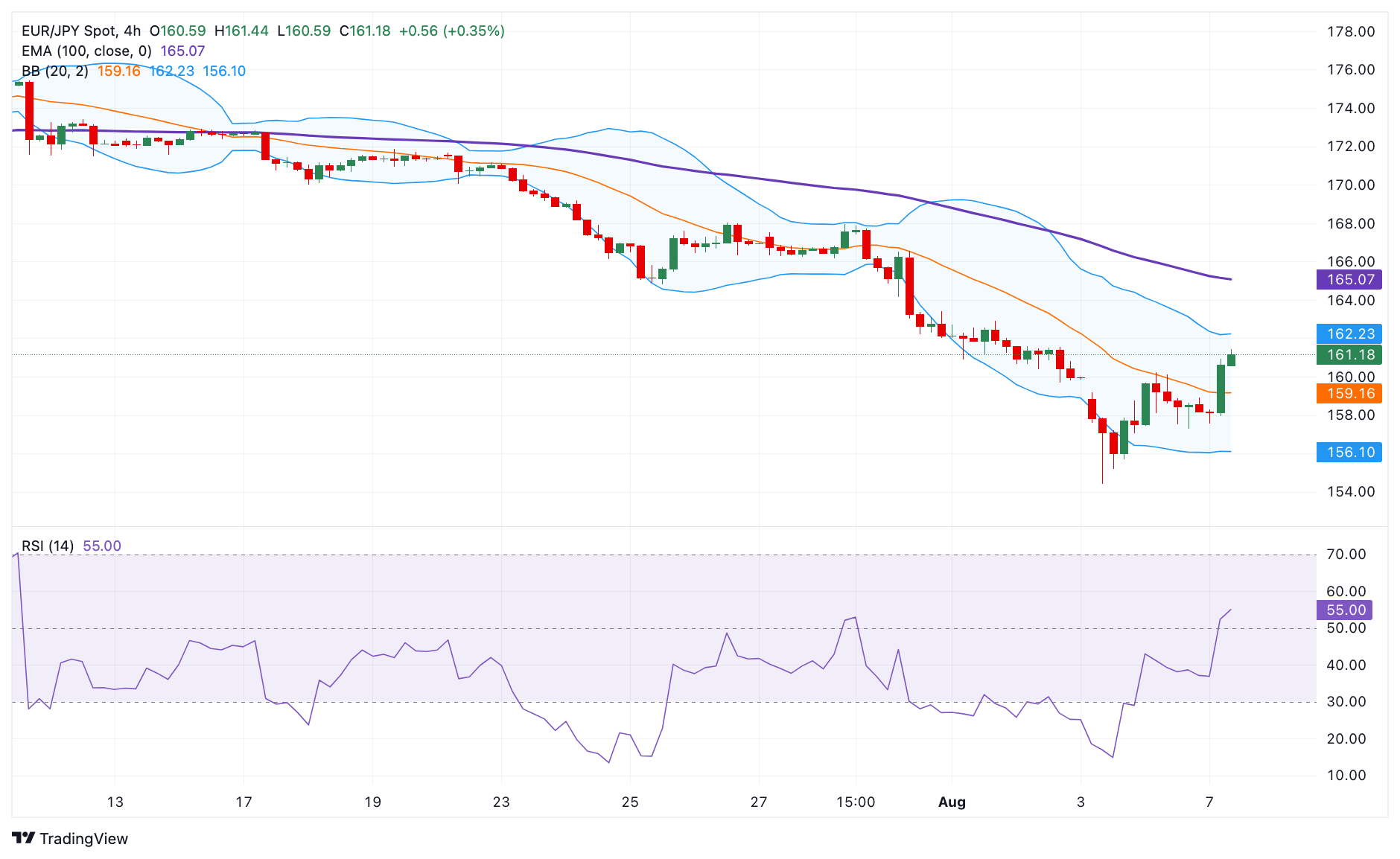
- The bearish picture of the cross remains intact below the 100-period EMA.
- The first upside barrier emerges at 162.18; the initial support level is located at 157.30.

The EUR/JPY cross gathers strength near 161.10, snapping the seven-day losing streak during the early European session on Wednesday. Amidst the volatile session, the Japanese Yen (JPY) loses momentum after the dovish comments from the Japanese official. On Wednesday, Bank of Japan (BoJ) Deputy Governor Shinichi Uchida said that the central bank will not hike rates when markets are unstable.
According to the 4-hour chart, the bearish outlook of EUR/JPY prevails as the cross remains below the key 100-period Exponential Moving Averages (EMA). Nonetheless, the Relative Strength Index (RSI) holds above the midline, near 53.80, suggesting that further upside in the near term looks favorable.
In the bullish event, the first upside target emerges near the upper boundary of the Bollinger Band at 162.18. The next potential resistance level is located in the 162.90-163.00 zone, portraying the confluence of a psychological level and a high of August 1. Extended gains will see a rally to the 100-period EMA at 165.07.
On the downside, the initial support level for EUR/JPY is seen at 157.30, a low of August 6. The additional downside filter to watch is the lower limit of the Bollinger Band of 156.12, followed by a low of August 5 at 154.41.
EUR/JPY 4-hour chart
Bank of Japan FAQs
The Bank of Japan (BoJ) is the Japanese central bank, which sets monetary policy in the country. Its mandate is to issue banknotes and carry out currency and monetary control to ensure price stability, which means an inflation target of around 2%.
The Bank of Japan has embarked in an ultra-loose monetary policy since 2013 in order to stimulate the economy and fuel inflation amid a low-inflationary environment. The bank’s policy is based on Quantitative and Qualitative Easing (QQE), or printing notes to buy assets such as government or corporate bonds to provide liquidity. In 2016, the bank doubled down on its strategy and further loosened policy by first introducing negative interest rates and then directly controlling the yield of its 10-year government bonds.
The Bank’s massive stimulus has caused the Yen to depreciate against its main currency peers. This process has exacerbated more recently due to an increasing policy divergence between the Bank of Japan and other main central banks, which have opted to increase interest rates sharply to fight decades-high levels of inflation. The BoJ’s policy of holding down rates has led to a widening differential with other currencies, dragging down the value of the Yen.
A weaker Yen and the spike in global energy prices have led to an increase in Japanese inflation, which has exceeded the BoJ’s 2% target. With wage inflation becoming a cause of concern, the BoJ looks to move away from ultra loose policy, while trying to avoid slowing the activity too much.
Author

Lallalit Srijandorn
FXStreet
Lallalit Srijandorn is a Parisian at heart. She has lived in France since 2019 and now becomes a digital entrepreneur based in Paris and Bangkok.
















