EUR/GBP rises as ECB holds rates steady, Eurozone PMIs stabilize, UK services falter
- EUR/GBP gains after the European Central Bank leaves rates unchanged and EU PMIs improve.
- Mixed UK PMIs contrast with Eurozone stability, keeping the Bank of England rate path in focus.
- EUR/GBP poised for a breakout amid constructive technical setup with critical resistance in sight.


EUR/GBP is edging higher on Thursday as traders digest economic data from both regions and a measured tone from the European Central Bank (ECB).
At the time of writing, the pair is trading around 0.8685, holding just below key resistance at 0.8738, as attention turns to diverging growth signals and central bank outlooks.
The ECB left interest rates unchanged, holding the Deposit Facility at 2.0%, as widely expected.
President Christine Lagarde reaffirmed the ECB’s commitment to returning inflation to its 2% target. She noted that domestic price pressure is easing, particularly as wage growth slows. Lagarde also highlighted that the Eurozone economy has remained resilient, partly due to the effects of earlier interest rate cuts.
Flash PMIs highlight diverging growth trends between the Eurozone and the United Kingdom
Thursday’s preliminary Purchasing Managers Index (PMI) data for July added further insight into the market’s cautiously optimistic tone. As one of the earliest indicators of economic activity, these forward-looking surveys offered a timely read on conditions across the manufacturing and services sectors.
Their influence on interest rate expectations made them particularly relevant for EUR/GBP, where diverging outlooks between the Eurozone and the UK continue to shape short-term direction.
In the Eurozone, the Services PMI edged up to 51.2, while the Composite PMI rose to 51.0 — both pointing to modest expansion.
In contrast, the UK’s Manufacturing PMI came in slightly above expectations at 48.2 (vs. a forecast of 48.0 and a prior reading of 47.7). However, this was offset by a sharp drop in the Services PMI to 51.2 from 52.8, signaling a potential slowdown in the UK’s dominant services sector.
The overall message was one of greater resilience in the Eurozone, while UK data raised questions about momentum, potentially keeping the BoE cautious.
EUR/GBP poised for a breakout amid constructive technical setup with critical resistance in sight
EUR/GBP is holding firm near 0.8670 and remains within striking distance of its April high at 0.8738 as bulls wait for a catalyst to spark a potential breakout.
Despite recent consolidation, the pair remains well-supported by a rising trendline and the 20-day Simple Moving Average (SMA) at 0.8640, a near-term support level.
The Relative Strength Index (RSI) near 61 reflects a bullish bias without entering overbought territory, suggesting there’s still room for another leg higher.
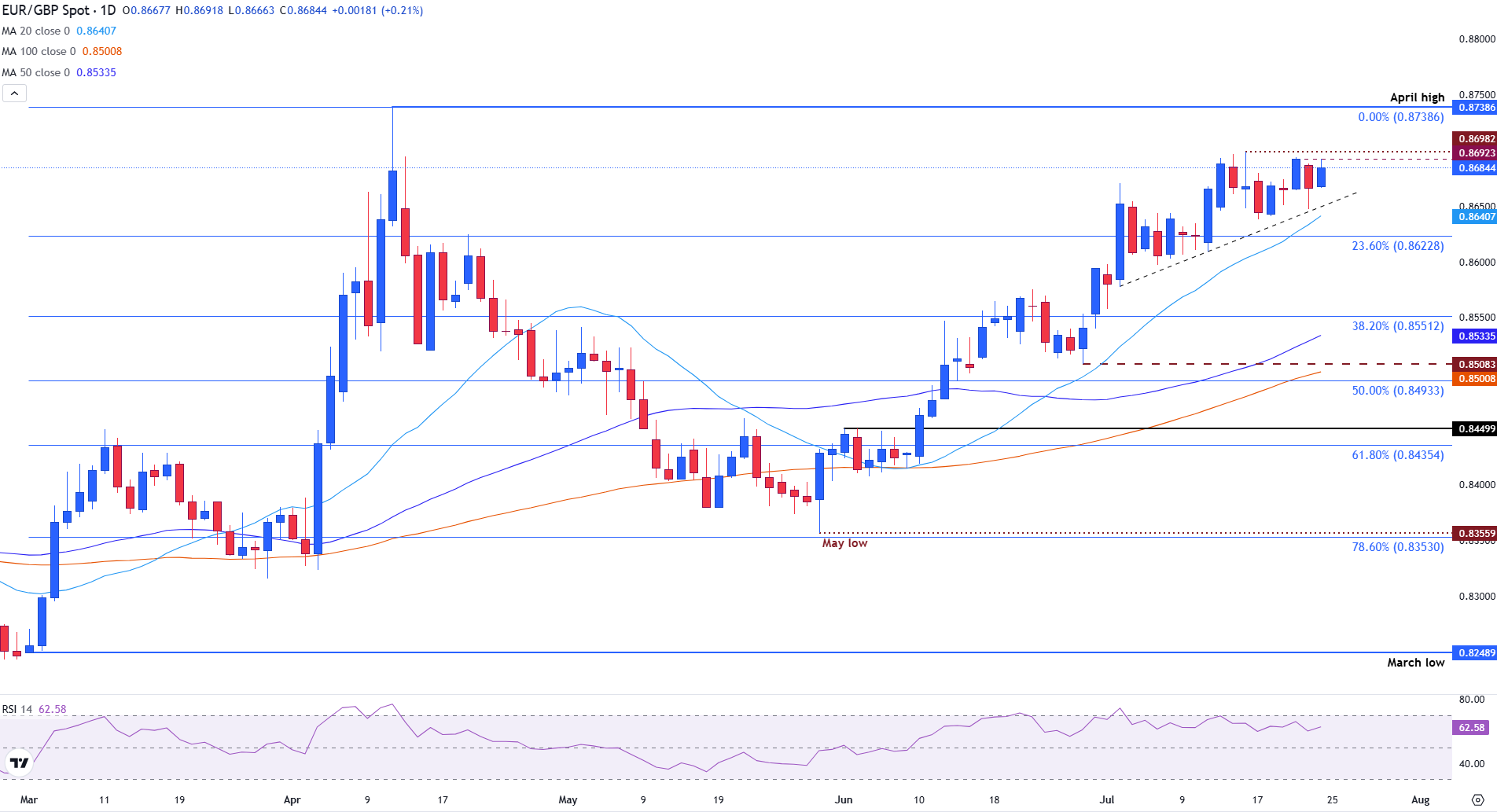
EUR/GBP daily chart
A daily close above 0.8738 would confirm a breakout and could pave the way toward the next psychological target at 0.8800.
On the downside, immediate support lies at 0.8640, while a deeper pullback may find stronger demand near the 0.8550–0.8500 zone. This juncture is critical as it reflects the area where the 38.2% Fibonacci retracement of the March-April move, 50-day SMA, and 100-day SMA converge. As long as price holds above the rising trendline, the broader bias remains constructive, with upcoming Euro and Pound data likely to drive the next directional move.
ECB FAQs
The European Central Bank (ECB) in Frankfurt, Germany, is the reserve bank for the Eurozone. The ECB sets interest rates and manages monetary policy for the region. The ECB primary mandate is to maintain price stability, which means keeping inflation at around 2%. Its primary tool for achieving this is by raising or lowering interest rates. Relatively high interest rates will usually result in a stronger Euro and vice versa. The ECB Governing Council makes monetary policy decisions at meetings held eight times a year. Decisions are made by heads of the Eurozone national banks and six permanent members, including the President of the ECB, Christine Lagarde.
In extreme situations, the European Central Bank can enact a policy tool called Quantitative Easing. QE is the process by which the ECB prints Euros and uses them to buy assets – usually government or corporate bonds – from banks and other financial institutions. QE usually results in a weaker Euro. QE is a last resort when simply lowering interest rates is unlikely to achieve the objective of price stability. The ECB used it during the Great Financial Crisis in 2009-11, in 2015 when inflation remained stubbornly low, as well as during the covid pandemic.
Quantitative tightening (QT) is the reverse of QE. It is undertaken after QE when an economic recovery is underway and inflation starts rising. Whilst in QE the European Central Bank (ECB) purchases government and corporate bonds from financial institutions to provide them with liquidity, in QT the ECB stops buying more bonds, and stops reinvesting the principal maturing on the bonds it already holds. It is usually positive (or bullish) for the Euro.
Author
Tammy Da Costa, CFTe®
FXStreet
Tammy is an economist and market analyst with a deep passion for financial markets, particularly commodities and geopolitics.