EUR/GBP Price Forecast: Potential double top at 0.8740-0.8750
- The Euro remains on its back foot on Monday amid lower hopes of BoE cuts.
- Technical indicators show scope for further Euro decline.
- A double top above 0.8740 anticipates a potential trend shift.

The Euro is trading lower for the third consecutive day on Monday, against a stronger British Pound, which got a boost last week, after the split vote at the Bank of England’s Monetary Policy Meeting prompted investors to dial down hopes for further rate cuts.
The BoE cut rates to 4% from the previous 4.25%, as expected, but the dissenting vote from four policymakers and the unexpectedly hawkish tone, warning about further rapid monetary easing, sent the Pound higher across the board
Technical Analysis: Key support is at 0.8615
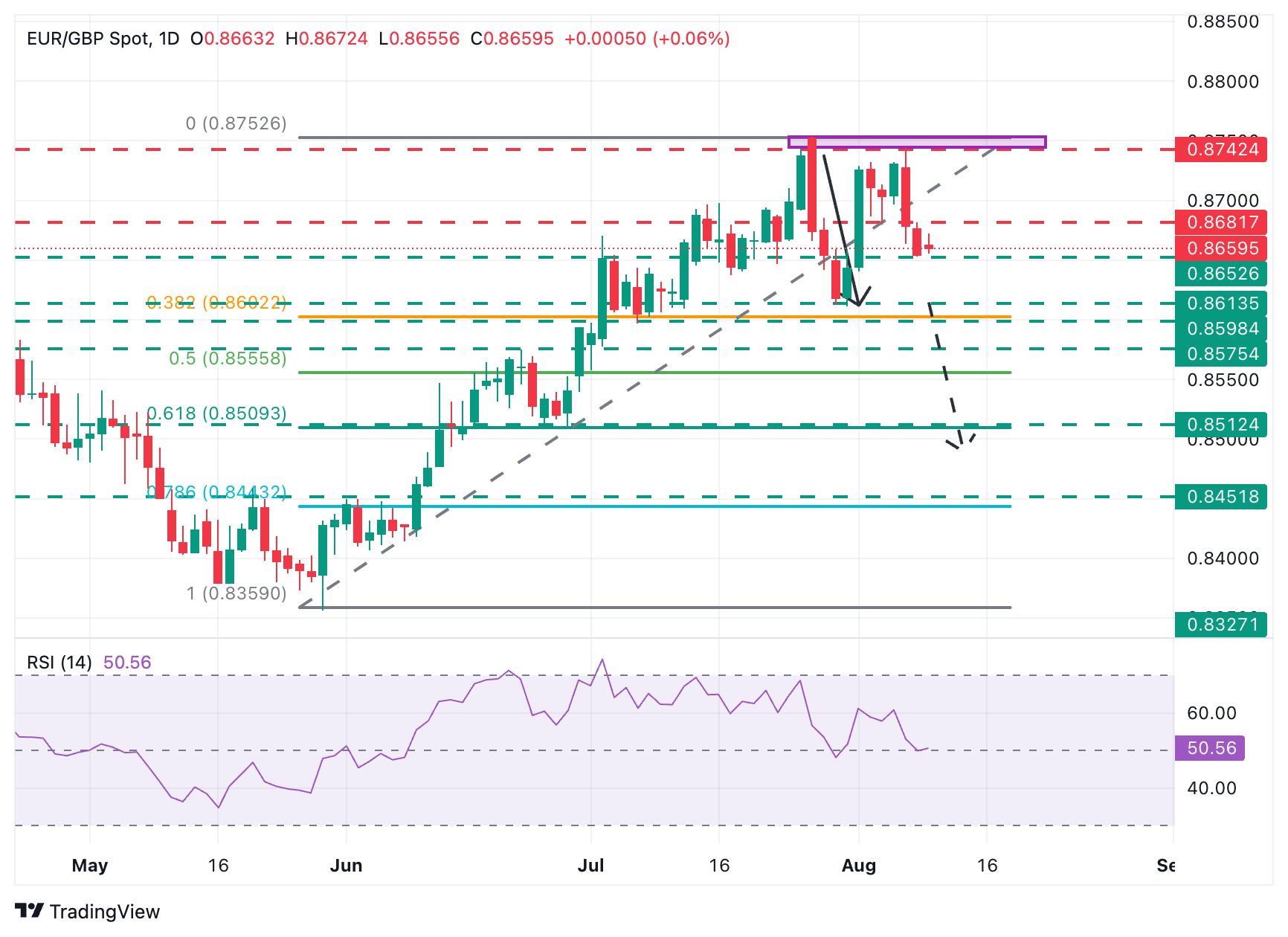
The EUR/USD pair’s immediate trend is bearish. A double top at the 0.8740-08750 area is a common figure from trend shifts, and the impulsive bearish candle on Thursday, coupled with the bearish divergence in the daily chart, suggests that the upside trend from late May lows has come to an end.
The Pair is now testing support at Friday´s low, 0.8655, but the key support area is at 0.8610, the July 30 and 21 lows, and the neckline of the mentioned DT figure and the 38.2% Fibonacci resistance of the mentioned rally at 0.9600. The DT’s measured target is 0-8490.
On the upside, immediate resistance is at Friday’s high of 0.8680. Above here, next is the Area between August 7 and July 28, highs at 0.8740-0.8750 and then, probably around the the 0.8830 area (May 2023 highs).
BoE FAQs
The Bank of England (BoE) decides monetary policy for the United Kingdom. Its primary goal is to achieve ‘price stability’, or a steady inflation rate of 2%. Its tool for achieving this is via the adjustment of base lending rates. The BoE sets the rate at which it lends to commercial banks and banks lend to each other, determining the level of interest rates in the economy overall. This also impacts the value of the Pound Sterling (GBP).
When inflation is above the Bank of England’s target it responds by raising interest rates, making it more expensive for people and businesses to access credit. This is positive for the Pound Sterling because higher interest rates make the UK a more attractive place for global investors to park their money. When inflation falls below target, it is a sign economic growth is slowing, and the BoE will consider lowering interest rates to cheapen credit in the hope businesses will borrow to invest in growth-generating projects – a negative for the Pound Sterling.
In extreme situations, the Bank of England can enact a policy called Quantitative Easing (QE). QE is the process by which the BoE substantially increases the flow of credit in a stuck financial system. QE is a last resort policy when lowering interest rates will not achieve the necessary result. The process of QE involves the BoE printing money to buy assets – usually government or AAA-rated corporate bonds – from banks and other financial institutions. QE usually results in a weaker Pound Sterling.
Quantitative tightening (QT) is the reverse of QE, enacted when the economy is strengthening and inflation starts rising. Whilst in QE the Bank of England (BoE) purchases government and corporate bonds from financial institutions to encourage them to lend; in QT, the BoE stops buying more bonds, and stops reinvesting the principal maturing on the bonds it already holds. It is usually positive for the Pound Sterling.
Author

Guillermo Alcala
FXStreet
Graduated in Communication Sciences at the Universidad del Pais Vasco and Universiteit van Amsterdam, Guillermo has been working as financial news editor and copywriter in diverse Forex-related firms, like FXStreet and Kantox.