|

EUR/GBP Price Forecast: A correction or a reversal of the trend?

  • EUR/GBP recovers from multi-year lows but then pulls back down. 
  • Is the pair about to reverse trend higher or is it still overall bearish?

EUR/GBP gaps higher at the open on Monday and starts climbing again. The pair had been pulling back since the completion of a three-wave, zig-zag-shaped pattern last Thursday. This pattern has been drawn on the chart below with the waves labeled a,b and c. 

EUR/GBP 4-hour Chart 
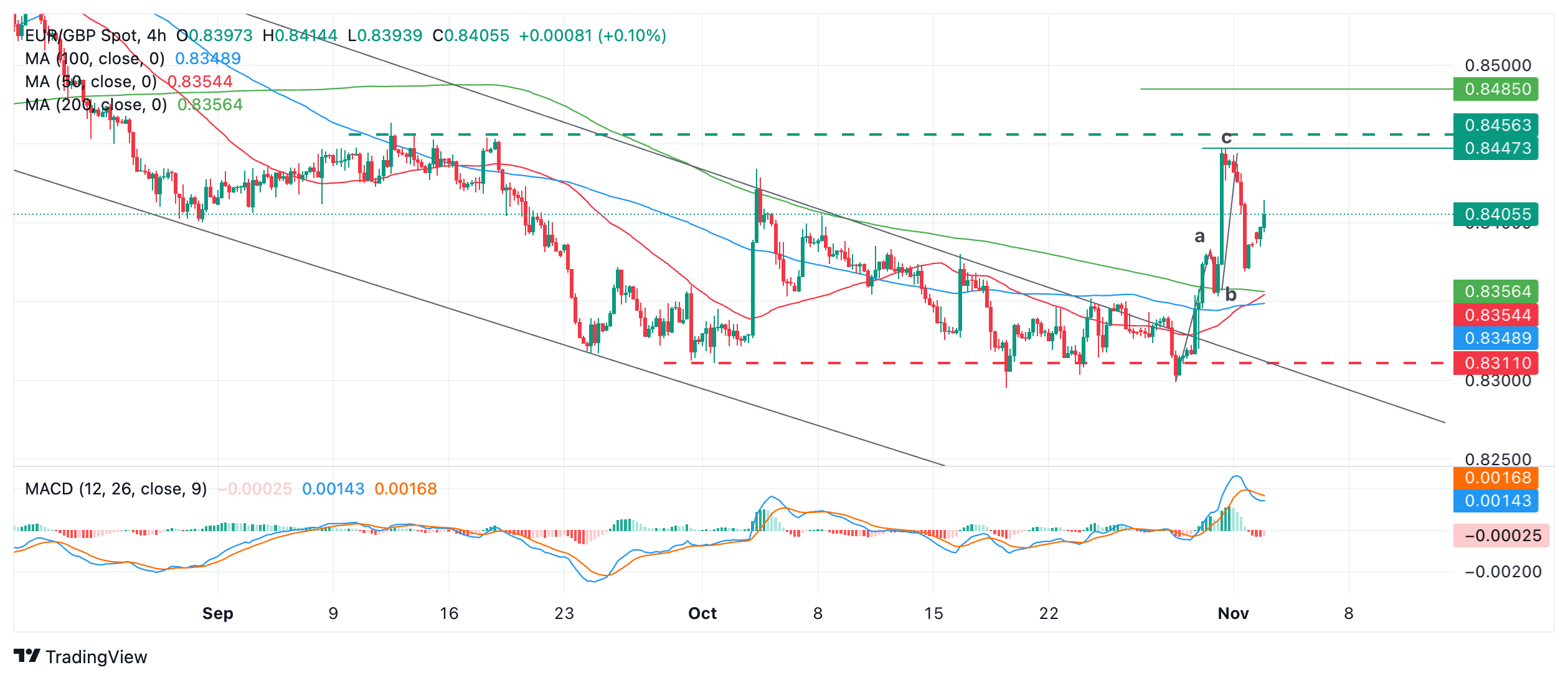
In the very near-term the pair might fall to fill the open gap left after price jumped higher on Monday. Technical analysis theory argues that gaps have a greater tendency of being closed. 

The abc pattern could be either a correction of the overall downtrend or the start of a new short-term uptrend. 

If it is just a correction, the price will probably continue falling in line with the medium and longer-term downtrend, with a target at the 0.8311 multi-year lows. 

If price manages to break above the high of wave c, however, it will have formed a third higher high, thereby establishing a new sequence of rising peaks and troughs. This is a strong indicator of a new uptrend. Give the technical analysis principle that “the trend is your friend” the odds would then favor further upside to come. 

The steepness of the abc pattern strengthens the case of this being a reversal rather than a correction. 

A failure to pierce above the top of wave c would indicate the pair is probably not reversing.  

It would suggest EUR/GBP will probably remain trapped oscillating within the red and green dashed lines on the chart at 0.8311 and 0.8456 respectively. 

Author

Joaquin Monfort

Joaquin Monfort is a financial writer and analyst with over 10 years experience writing about financial markets and alt data. He holds a degree in Anthropology from London University and a Diploma in Technical analysis.


More from Joaquin Monfort
Share:

Editor's Picks

AUD/USD extends the range play above 0.7200 as traders await US inflation data

AUD/USD is seen extending its consolidative price move above 0.7200 during the Asian session on Thursday amid mixed cues. Rising RBA rate-hike bets keep the Aussie close to its highest level since May 14. However, hawkish Fed expectations and escalating US-Iran tensions offer some support to the US Dollar, capping the currency pair as traders await US inflation figures.


USD/JPY consolidates around 153.50 as bears turn cautious ahead of US inflation

USD/JPY stabilizes above 153.50 during the Asian session on Thursday, but remains near a seven-month low set earlier this week as hawkish BoJ repricing continues to underpin the Japanese Yen. Meanwhile, rising September Fed rate-hike bets and escalating US-Iran tensions help ease US Dollar selling pressure, offering some support to the currency pair ahead of US inflation figures.

Gold remains in the red, still below $4,400

Gold maintains an erratic trade so far this week, now slipping back below the key $4,400 mark per troy ounce following the stronger US Dollar and a strong rebound in US Treasury yields across the curve, particularly following US Producer Prices and ahead of Friday’s more relevant US CPI data.

XRP slides amid a fragile crypto market structure
Ripple (XRP) falls for the second straight day, trading at $1.37 on Thursday. The broader cryptocurrency market remains fragile as investors weigh the impact of geopolitical tensions in the Middle East, which triggered persistent increases in Crude Oil prices while restricting shipping through the Straight of Hormuz and the Red Sea.
Jobs opened the door for the Fed — inflation decides whether it walks through
The latest US jobs report did not end the debate over the Federal Reserve’s (Fed) next move. It may have done something more subtle: it gave policymakers permission to keep their options open. After months of softer labour market signals, August delivered a stronger-than-expected rebound.
Venezuela’s 65-billion-barrel Oil deal could reshape America’s inflation fight
The United States (US) has secured unprecedented access to part of Venezuela’s vast Oil reserves. The timing is particularly significant as the war with Iran is disrupting Middle Eastern supplies, keeping energy prices elevated and reviving concerns about inflation.