|

EUR/GBP Price Forecast: A break above October 3 would cement bullish view

  • EUR/GBP has pulled back to key support after rallying sharply on Thursday. 
  • The pair has probably changed trend but a break above the October 3 high would confirm a bullish reversal.

EUR/GBP pulls back down to the base of its multi-month range at 0.8380 after shooting higher on Thursday, October 3, as a result of comments made by the Governor of the Bank of England (BoE) Andrew Bailey.

The pair has probably reversed its prior downtrending bias and is now starting a new short-term uptrend, however, a break above the October 3 high of 0.8434 would provide confirmation of such a reversal, and a probable extension higher thereafter.  

EUR/GBP Daily Chart 
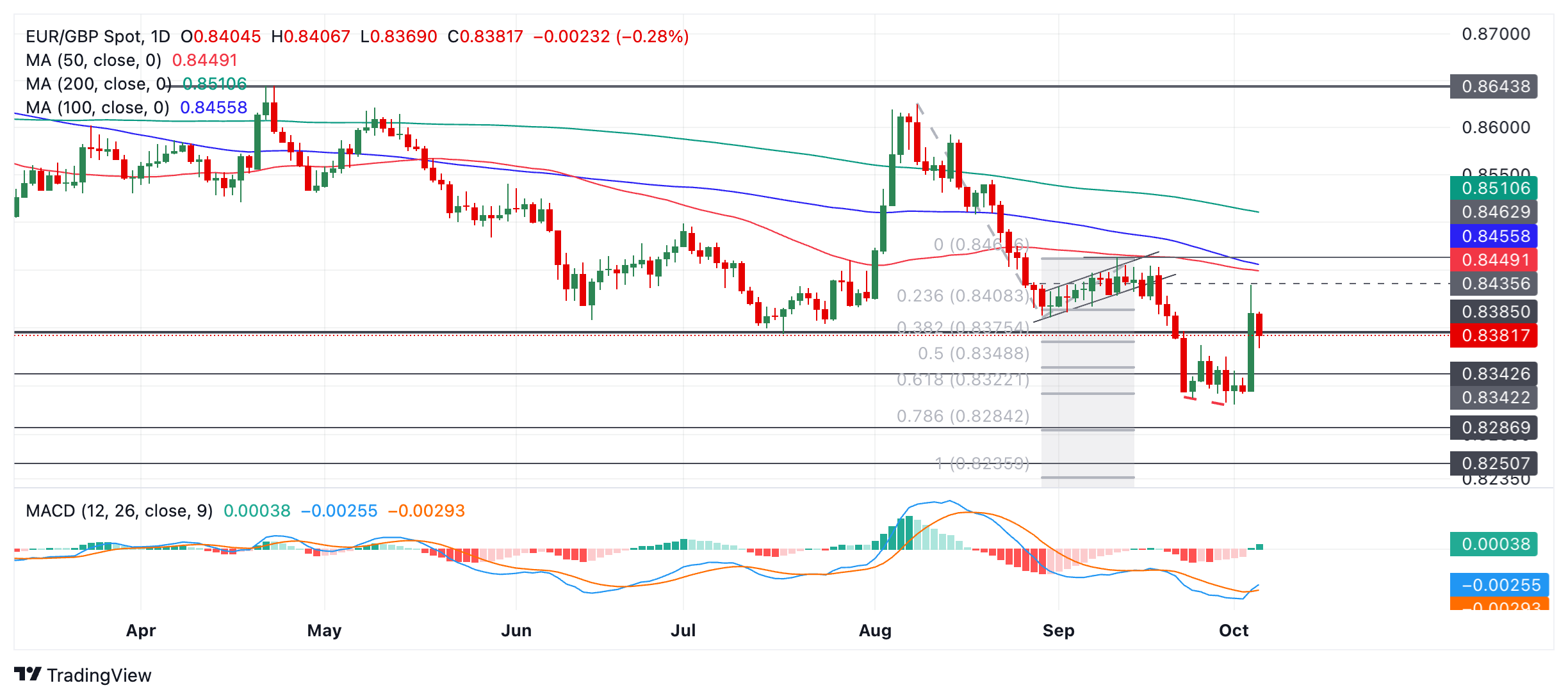
Assuming a bullish scenario, EUR/GBP will probably reach the key resistance level at the cluster of Moving Averages in the 0.8450s, as well as the high of the consolidation channel. The next target above that is the green 200-day Simple Moving Average (SMA) at 0.8510. 

The blue Moving Average Convergence Divergence (MACD) momentum indicator has crossed above its red signal line, further signaling a probable change in the trend.

It would require a break below 0.8311 and the October 1 lows to reconfirm bearish bets and suggest the medium-term bear trend was reasserting itself. Such a move would then be expected to fall to the next downside target at 0.8284 (Fibonacci 78.6% extrapolation of the August decline) followed by 0.8236 (100% extrapolation of the same decline).  


Author

Joaquin Monfort

Joaquin Monfort is a financial writer and analyst with over 10 years experience writing about financial markets and alt data. He holds a degree in Anthropology from London University and a Diploma in Technical analysis.


More from Joaquin Monfort
Share:

Editor's Picks

AUD/USD hits nine-week lows below 0.7000 on RBA Bullock's remarks

AUD/USD reverses a brief uptick and turns lower to hit nine-week lows below 0.7000 in the European morning on Tuesday, as traders digest cautious remarks from Reserve Bank of Australia (RBA) Governor Michele Bullock during the press conference. Earlier on, the RBA raised the cash rate to 4.60%, as widely expected, leaving the door open to further rate hikes if needed.

USD/JPY consolidates near 157.50 as a bullish USD counters intervention risks

USD/JPY struggles to capitalize on the overnight bounce from a one-week low, consolidating around 157.50 in the Asian session on Tuesday. Trump's concerns about the Japanese Yen's weakness fueled speculation about another US-Japan joint intervention. This, along with the hawkish BoJ, underpins the JPY and caps the currency pair. Meanwhile, rising Fed rate-hike bets and oil-driven inflation fears continue to push US bond yields to multi-year highs, keeping the US Dollar pinned near a two-month high and supporting the pair.

Gold regains some traction; focus remains on $4,100

Gold manages to gather some composure and bounces off recent lows near the key $4,100 mark per troy ounce on Tuesday. The move higher in the precious metal comes despite the firmer US Dollar and rising US Treasury yields across the board, while escalating geopolitical tensions appear to limit the downside potential.

Crypto Today: Bitcoin, Ethereum, XRP correct upward amid declining ETF inflows

The cryptocurrency market upholds a neutral-to-bullish bias on Tuesday, with Bitcoin edging closer to a breakout above $84,000. Altcoins mirror BTC’s outlook, with Ethereum holding above $2,700 and Ripple pushing past the reclaimed $1.50 level.

RBA recap: Rate hikes are on the table as demand stays too strong

The Reserve Bank of Australia unanimously tightened monetary policy, warning that inflation remained too high and that several upside risks had begun to materialise. Governor Michele Bullock said the Board would raise rates again if necessary.

Fed vs BoJ: Both hiked. The market only believes one of them – and the chart shows which

The Fed and the BoJ have just done something remarkably similar. Both central banks raised interest rates by 25 bps last week, both are confronting inflation risks, and both signal that future decisions will depend on incoming economic data.