|

EUR/GBP Price Analysis: Bears push down, eyes on support break

  • The EUR/GBP declined towards reaching 0.852 and bears threatened the 0.8500 area.
  • Bearish indicators signal the potential for a downside move.
  • The 0.8500 (20 and 100-day SMA crossover) level remains a critical support to watch.

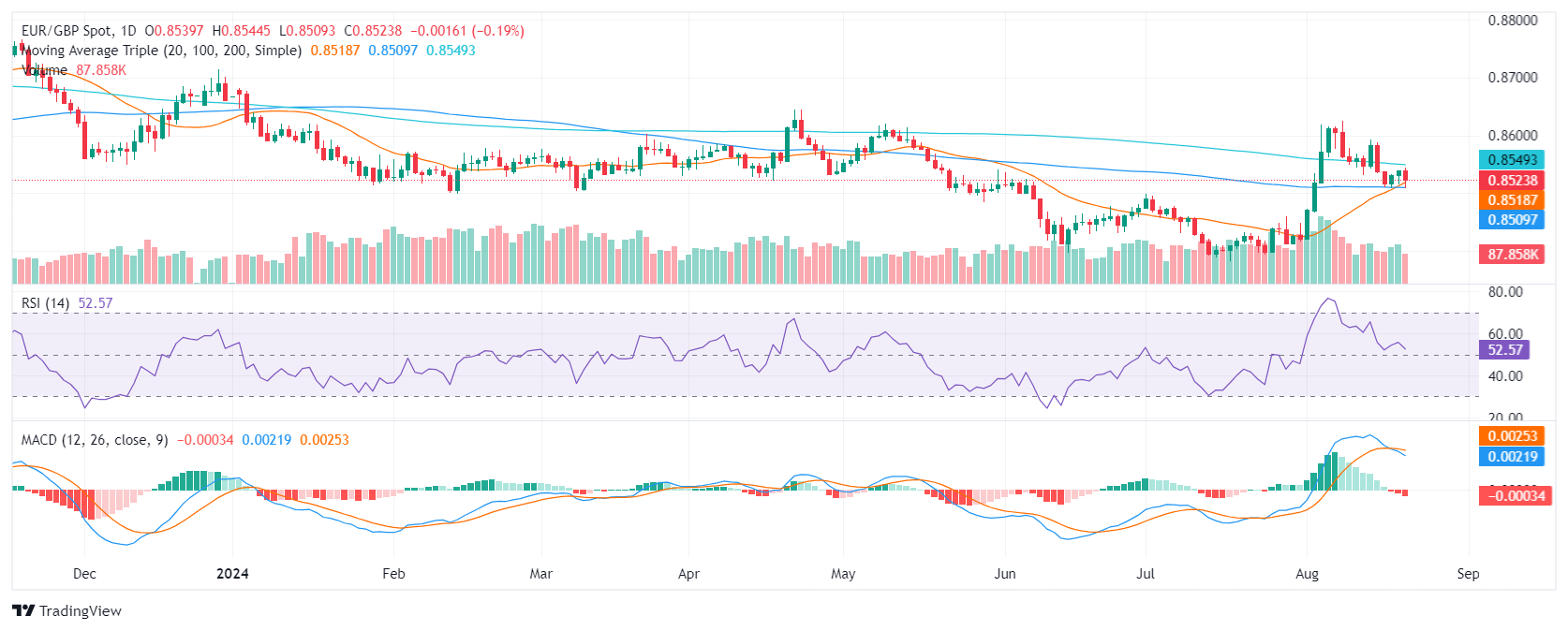
In Wednesday's session, the EUR/GBP resumed its losses, to settle at 0.8520. Technical indicators paint a mixed picture but the sellers appear to be threatening with breaking the 0.8500 support.

The Relative Strength Index (RSI) has fallen to 55, suggesting a decrease in buying pressure, while the Moving Average Convergence Divergence (MACD) is forming rising red bars, indicating growing bearish momentum. Volume patterns have been mixed, with a flat trend in recent sessions.

In summary, the EUR/GBP pair is facing a potential bearish trend, with selling pressure likely to persist. A break below the key 0.8500 support would reinforce the bearish bias and open up the possibility for further downside. On the positive side, the bullish crossover between the 20 and 100-day Simple Moving Averages (SMA) provides strong support

EUR/GBP daily chart
Author

Patricio Martín

Patricio is an economist from Argentina passionate about global finance and understanding the daily movements of the markets.


More from Patricio Martín
Share:

Editor's Picks

AUD/USD hangs near two-month low, below 0.7000 ahead of Australian CPI report

AUD/USD consolidates below 0.7000 during the Asian session on Wednesday, trading near a two-month low as traders look to the Australian CPI report for more cues on the RBA's policy path. Meanwhile, the US Dollar preserves its bullish undertone amid rising Fed rate-hike bets, which, along with oil-driven inflation fears, push US bond yields to multi-year highs. Moreover, the US-Iran standoff underpins the safe-haven buck and acts as a headwind for the currency pair.

USD/JPY trades below 157.50 as Japan's weak data and bullish USD lend support

USD/JPY extends its consolidative price move during the Asian session on Wednesday, trading below mid-157.00s. Hawkish BoJ expectations, along with intervention risks, underpin the Japanese Yen, though dismal domestic data cap gains. Meanwhile, rising Fed rate hike bets and oil-driven inflation fears push US bond yields to fresh multi-year highs. Moreover, the US-Iran standoff supports a bullish US Dollar and acts as a tailwind for the currency pair.

Gold consolidates below $4,200 as bullish USD and Fed hike bets offset softer bond yields

Gold struggles to capitalize on the previous day's recovery from an eight-week low, consolidating below $4,200 during the Asian session on Wednesday. The overnight slide in oil prices eased the US Treasury bond rout, supporting the bullion. However, Fed rate-hike bets and inflationary concerns keep bond yields near multi-year highs. Moreover, geopolitical uncertainties underpin the safe-haven US Dollar, which, in turn, caps the commodity.

Ethereum sees profit-taking near $2,700 ahead of key US economic data
Ethereum (ETH) has shown signs of profit-taking near $2,700 over the past few days, with rising exchange deposits and a slowdown in exchange-traded fund (ETF) inflows ahead of US inflation and labor market data releases. The top altcoin's Exchange Reserves, which track the total amount of a crypto asset held across exchange wallets, have increased by roughly 125K ETH since Friday.
Silver is more volatile than Gold ahead of PCE and NFP. This chart shows the positioning gap
The market’s attention is focused on American data this week, but there’s something only those with a trained eye may be looking at: Gold and Silver positioning gap. Financial markets are moving on fears, mostly related to persistently high energy prices driven by the Middle East war. Sure, the US Dollar (USD) is strong, but at what cost?
Silver is more volatile than Gold ahead of PCE and NFP. This chart shows the positioning gap
The market’s attention is focused on American data this week, but there’s something only those with a trained eye may be looking at: Gold and Silver positioning gap. Financial markets are moving on fears, mostly related to persistently high energy prices driven by the Middle East war. Sure, the US Dollar (USD) is strong, but at what cost?