|

EUR/GBP Price Analysis: Ascends gradually, as bull's eye 0.8750

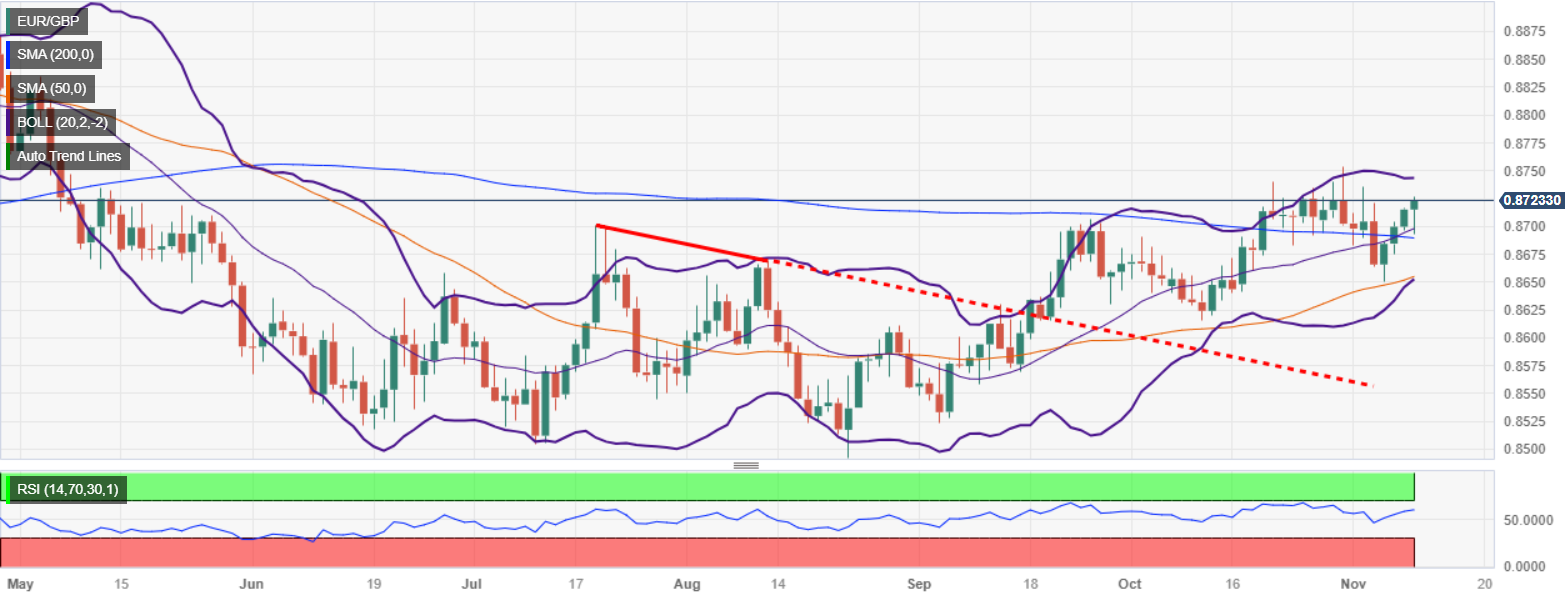
  • EUR/GBP edges higher to 0.8724, marking a slight 0.08% increase, as it sustains momentum above the 200-day moving average.
  • The pair's advance slows, indicated by a lower Average True Range, pointing to decreased market volatility.
  • The next bullish milestones are set at the recent peak of 0.8754 and the psychological 0.8800 level, while a dip below 0.8700 could challenge the 200-DMA support.

The EUR/GBP rallies for the fourth straight day in the mid-North American session, gains a minimal 0.08%, trading at 0.8724 after hitting a daily low of 0.8693.

The cross-pair is upward biased once it reclaimed the 200-day moving average (DMA) at 0.8687. Nevertheless, the uptrend appears to have lost some steam, as the Average True Range (ATR) at 37 pips suggests volatility is shrinking.

For a bullish resumption, EUR/GBP buyers must reclaim the October 11 high at 0.8754, followed by the 0.8800 figure. On the other hand, if sellers’ step in and pull the exchange rate below 0.8700, that would open the door to test the 200-DMA at 0.8687, which would exacerbate a drop to the 50-DMA at 0.8653.

EUR/GBP Price Analysis – Daily Chart
EUR/GBP Technical Levels

EUR/GBP

Overview
Today last price0.8724
Today Daily Change0.0009
Today Daily Change %0.10
Today daily open0.8715
 
Trends
Daily SMA200.8694
Daily SMA500.8652
Daily SMA1000.8619
Daily SMA2000.8691
 
Levels
Previous Daily High0.8717
Previous Daily Low0.8696
Previous Weekly High0.8754
Previous Weekly Low0.8664
Previous Monthly High0.8754
Previous Monthly Low0.8616
Daily Fibonacci 38.2%0.8709
Daily Fibonacci 61.8%0.8704
Daily Pivot Point S10.8702
Daily Pivot Point S20.8689
Daily Pivot Point S30.8681
Daily Pivot Point R10.8723
Daily Pivot Point R20.873
Daily Pivot Point R30.8743

Author

Christian Borjon Valencia

Markets analyst, news editor, and trading instructor with over 14 years of experience across FX, commodities, US equity indices, and global macro markets.


More from Christian Borjon Valencia
Share:

Editor's Picks

AUD/USD softens below 0.7050 on risk-off mood, China's Manufacturing PMI data looms

The AUD/USD pair declines to around 0.7025 during the early Asian session on Monday. The US Dollar strengthens against the Australian Dollar amid elevated geopolitical tensions in the Middle East. China’s RatingDog Manufacturing Purchasing Managers Index report is due later on Monday. Traders will closely monitor the Reserve Bank of Australia interest rate decision on Tuesday.


USD/JPY meets support near 157.00

USD/JPY retreats for the third consecutive day on Friday, revisiting the 157.00 region before attempting some recovery as investors continue to assess the latest BoJ meeting, where the central bank left rates unchanged, as widely anticipated.

Gold sinks to fresh yearly lows despite risk-off mood as Fed rate hike bets weigh

Gold slips to fresh year-to-date lows on Friday. The metal struggles despite a risk-off mood across markets, as expectations of further Federal Reserve (Fed) interest rate hikes continue to dominate price action, leaving Gold on track to end the month in negative territory.


Week ahead: Nonfarm Payrolls and US midterm elections take center stage
The US dollar traded higher against most of its peers this week, beginning the week on a solid footing amid expectations of a hawkish FOMC decision on Wednesday. Although market participants were convinced that a rate hike was off the table, they were on the lookout for clues and hints on whether they were correct in nearly fully pricing in a 25bps rate hike in December.
Middle East War updates: Iran warns of expanded strikes against US despite progress in talks

Here’s a brief recap of the key developments in the Middle East war that occurred over the weekend, which are expected to have a significant impact on markets in the upcoming week.

The 2% inflation target came from a throwaway remark. It now moves trillions
The Federal Reserve's 2% inflation goal grew out of an off-the-cuff remark by a New Zealand politician in 1988. Bond investors still price long-term US debt as if 2% holds, so a change in how the Fed measures inflation would move markets.