|

EUR/CHF price analysis: Cross struggles amid mixed technical signals

  • EUR/CHF was seen around the 0.94 zone on Friday, with minor gains.
  • The cross maintains a bearish bias despite mixed technical signals.
  • Key support is clustered below the 0.9350 level, with resistance near 0.9360.

The EUR/CHF pair is navigating a cautious tone on Friday, hovering around the 0.94 zone with modest gains. Despite the slight recovery, the broader technical outlook remains tilted to the downside, reflecting persistent selling pressure that has kept the pair within a tight range in recent sessions. Mixed signals from momentum indicators suggest a complex short-term outlook, reinforcing the cautious sentiment among traders.

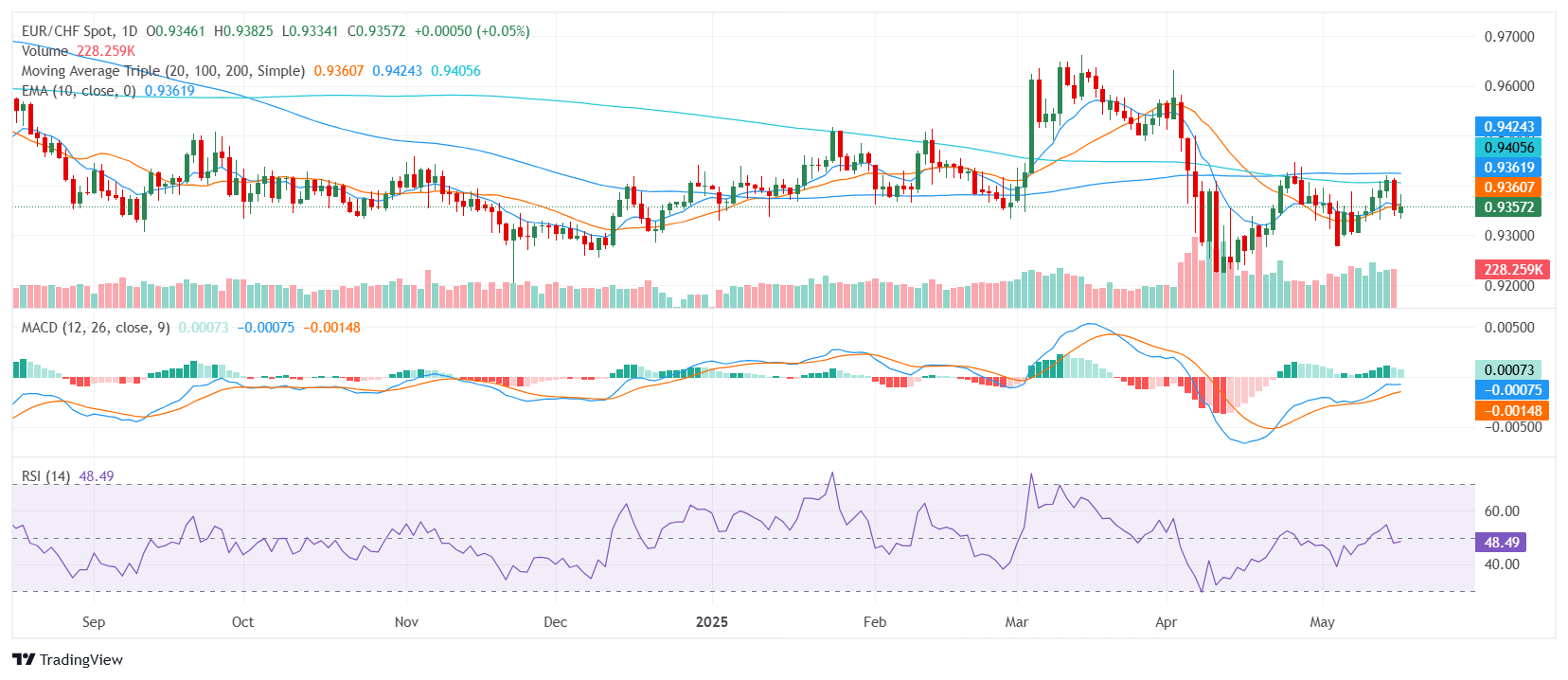
EUR/CHF continues to exhibit a bearish overall structure, as suggested by the alignment of its 20, 100, and 200-day Simple Moving Averages (SMAs), which all point to downward pressure. These longer-term trend indicators confirm the broader selling bias. The Relative Strength Index (RSI) remains in the 40s, reflecting neutral conditions that align with the current sideways price action. Meanwhile, the Moving Average Convergence Divergence (MACD) signals a slight buy momentum, contrasting with the prevailing bearish sentiment.

Adding to the mixed technical landscape, the Momentum (10) indicator hovers around the 0 level, suggesting mild buying interest, while both the Ultimate Oscillator (7, 14, 28) and the Stochastic %K (14, 3, 3) rest in the 50s, indicating a largely neutral stance. This combination of signals underlines the current indecision in the market, as traders weigh the potential for a near-term rebound against the longer-term bearish trend.

For now, immediate support is expected around 0.9353, with additional layers at 0.9341 and 0.9334. On the upside, resistance is likely to emerge around 0.9362, followed closely by 0.9363 and 0.9364, potentially capping any recovery attempts in the near term.

Daily Chart
Author

Patricio Martín

Patricio is an economist from Argentina passionate about global finance and understanding the daily movements of the markets.


More from Patricio Martín
Share:

Editor's Picks

GBP/USD extends the drop to 1.3360

GBP/USD builds on Monday’s decline and briefly clinches five-day lows near 1.3360 on Tuesday. Cable’s extra pullback follows the better tone in the Greenback as uncertainty in the Middle East prompts investors to adopt a cautious stance. Meanwhile, an apathetic UK labour market report also collaborates with the selling pressure on the British Pound.

EUR/USD looks inconclusive near 1.1420

EUR/USD trades in a tight range in the low 1.1400s on Tuesday, struggling to gain momentum amid an equally absence of clear direction in the US Dollar (USD). Uncertainty surrounding the US-Iran conflict is capping the pair’s upside, while traders avoid taking significant positions ahead of Thursday’s ECB gathering.

Middle East crisis intensifies, Gold up

Gold gains ground on Tuesday, reversing Monday’s pessimism and advancing toward the $4,100 mark per troy ounce. Nevertheless, uncertainty surrounding the Middle East conflict and rising expectations for a hawkish Fed policy outlook are expected to limit the precious metal’s bullish momentum in the near term.

XRP extends recovery as on-chain activity grows
Ripple (XRP) ticks up and trades around $1.13 at the time of writing on Tuesday. This rebound aligns with a broader recovery in the cryptocurrency market, attributed to reports that mediators between the United States (US) and Iran are seeking a 10-day cessation of strikes to find a way back to the signed Memorandum of Understanding (MoU).
The Iranian war has again risen
The Iranian war has again risen to the top of the economics factor list. There is no end in sight. Intelligence experts say the current level of offense/retaliation will not change minds in Tehran, while in Washington, Trump fears all-out war, which would mean boots on the ground.
US Dollar mid-year outlook: Exceptional currency, exceptional risks?
The US Dollar enters the second half of 2026 in a markedly different position from a year ago. The King currency has recovered, reflecting persistent US inflation, changing expectations for Fed policy, geopolitical tensions and renewed demand for defensive assets.