|premium|

Emini S&P and Nasdaq June facing resistance, Dow Jones June testing lows [Video]

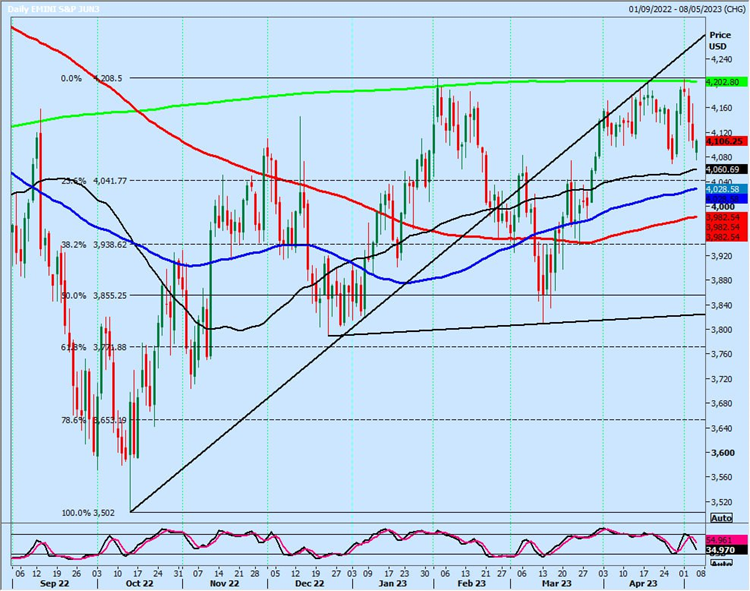
Emini S&P June we got a second chance to sell into shorts at strong resistance at 4200/4210 which are working after yesterday volatile FOMC session.

Nasdaq June could not hold a break above the April high so we have a potential double top sell signal.

We have traded lower but we are still messing about in a sideways range.

Emini Dow Jones June testing last week’s low at 33347 so holding below here today should add pressure to the downside.

Daily analysis
Chart

Emini S&P June shorts at strong resistance at again at 4200/4210 hit my 4130/20 target. A good start to the week. The chart indicates to me that the next big move is likely to be to the downside…as long as we do not remain in this irritating, volatile sideways trend.

The sell levels again is 4200/4210 of course on any bounce, although this time we may not make it that far as I believe pressure is building to the downside – of course we have the FOMC & nonfarm payroll out this week, which will determine market direction.

A break below 4100 today can target last week’s low at 4069 (4075 the overnight low as I write). Further losses today target 4045/35. A break below 4025 is the next sell signal.

We could have minor resistance at 4140/50 on a bounce today but a break above 4165 could retest 4200/4210 for a sell opportunity.

Nasdaq June shot holds the April high so we have a potential double top sell signal as I stated yesterday. If you did try a short, targets of 13220/200 & 13140/120 have been hit. Further losses can target 13000/12950. I would not try a long here myself.

Premium

You have reached your limit of 3 free articles for this month.

Start your subscription and get access to all our original articles.

Subscribe to PremiumSign In

Author

Jason Sen

Jason Sen

DayTradeIdeas.co.uk

Jason Sen began his career in the options pits on the trading floor of LIFFE in 1987 at the age of 19, making markets on his own account. In 2001 when the trading floor closed he successfully made the transition to day trading on computer screens.


More from Jason Sen
Share:

Editor's Picks

USD/JPY stays below 160.50 as markets assess BoJ decision

USD/JPY fluctuates in a relatively narrow range above 160.00 on Tuesday as markets assess the Bank of Japan's (BoJ) decision to raise the policy rate by 25 at the June meeting. Meanwhile, investors keep a close eye on news coming out of the Middle East, while preparing for the critical Fed meeting.

AUD/USD trades in tight channel near 0.7050 despite hawkish RBA message

AUD/USD trades modestly lower on the day at around 0.7050 on Tuesday as markets adopt a cautious stance amid a lack of details surrounding the US-Iran peace agreement. The Reserve Bank of Australia (RBA) left the door open for possible policy tightening after leaving the interest rate unchanged, as expected, at the June meeting but failed to boost the Australian Dollar.

Gold trims gains, approaches $4,300

Gold now surrenders part of its initial advance and recedes to the vicinity of the $4,350 mark per troy ounce on Tuesday. The early enthusiasm sparked by the US-Iran peace deal has faded somewhat, prompting investors to adopt a more prudent stance as they await further details of the agreement and key guidance from the Fed.

Why a hawkish RBA is no longer enough to lift the Australian Dollar

The Reserve Bank of Australia delivered more than what markets expected: a hawkish hold that should have supported the Aussie. But markets widely ignored it.

BoJ just hiked and US-Iran deal is on the table: Why Japanese Yen is still around 160.00

The Bank of Japan lifted interest rates from 0.75% to 1.00%, its highest level in more than three decades. The landmark move aims to stabilize a sharply weakening Japanese Yen, but by looking at the immediate market reaction, it doesn’t look like it’s going to work.

Why a hawkish RBA is no longer enough to lift the Australian Dollar

The Reserve Bank of Australia delivered more than what markets expected: a hawkish hold that should have supported the Aussie. But markets widely ignored it, focusing instead on slowing economic growth and proving that central bank messaging alone isn’t always enough to drive currencies.