Dow Jones struggles near 40,000 as China retaliates, targeting Boeing
- Trump vows new tariffs on pharmaceuticals and warns that the EU “took advantage” of the US.
- China halts Boeing jet deliveries and targets US aircraft parts as the trade war expands beyond electronics.
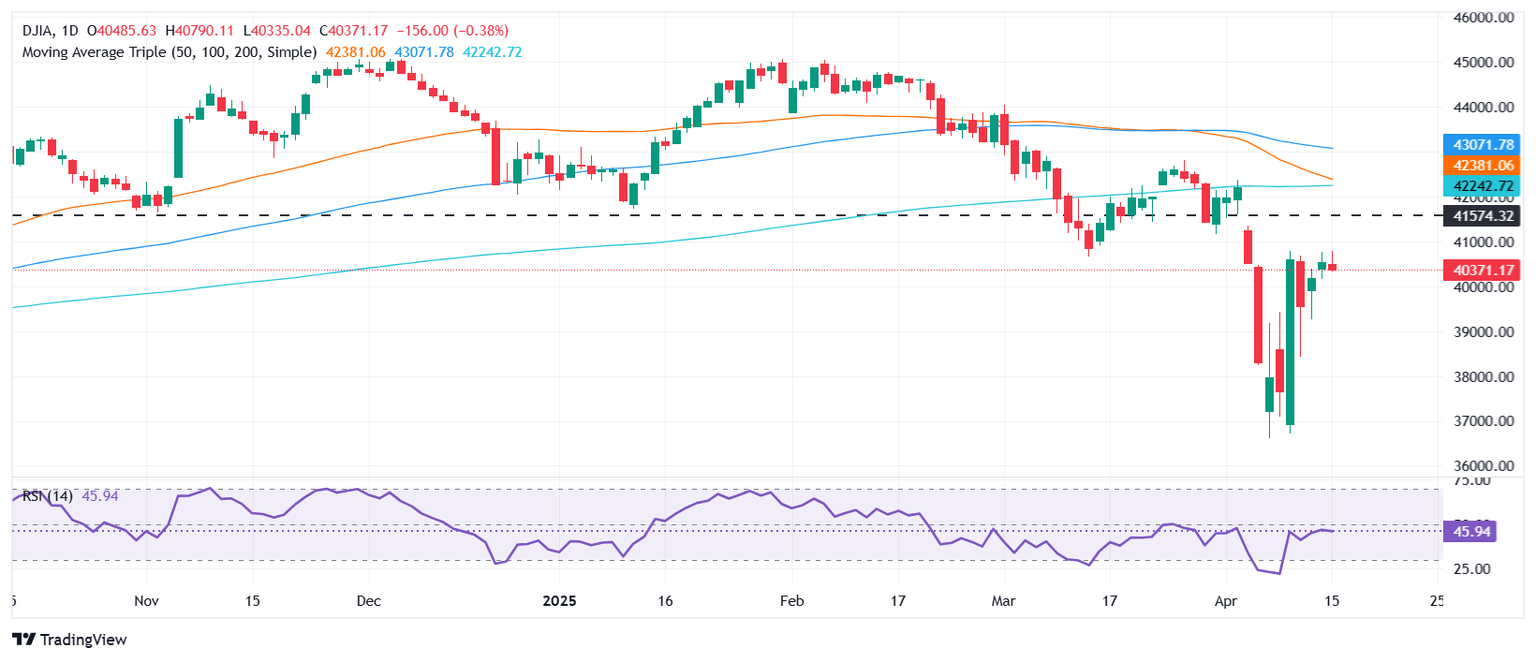
- Dow’s upside capped near 40,500; a drop below 40,000 could expose 39,877 and deepen bearish pressure.


The Dow Jones Industrial Average (DJIA) advanced earlier in the North American session by 0.3% or over 120 points. Nevertheless, optimism among investors faded recently, even though the CBOE Volatility Index (VIX) fell below 30 after spiking to a high near 60 last week.
DJIA trims gains after early rally; volatility eases but trade tensions and tariff risks keep bulls cautious
US President Donald Trump announced that they will soon impose tariffs on imported pharmaceuticals and reiterated that the European Union EU has been taking advantage of the US. Trump added that he is looking to help car companies and that some things will come up.
Meanwhile, China ordered domestic airlines to freeze all new Boeing jet deliveries and halted purchases of US aircraft parts. Last week, Washington excluded major electronic categories and smartphones from the 145% duties on Chinese goods. Nevertheless, comments from US President Trump and Commerce Secretary Howard Lutnick suggested these exemptions might only be temporary.
The US economic docket is light, with Retail Sales expected to be released on Wednesday. Traders should be aware that the trading week will be shortened due to the Easter holiday on Friday.
Dow Jones price forecast
The Dow remains downward biased even though the index has clung to the 40,000 figure, underpinned mainly by an upbeat market mood. However, US President Trump's comments could exert downward pressure and pave the way for a 'bearish' continuation below the 40,000 figure.
A drop below the latter will expose the April 14 low of 39,877, followed by the April 7 swing low of 36,480. On the other hand, if bulls stepped in and push prices past 40,500 the immediate level to challenge will be April 10, high at 40,909. Once cleared, 41,000 is up next.
Dow Jones FAQs
The Dow Jones Industrial Average, one of the oldest stock market indices in the world, is compiled of the 30 most traded stocks in the US. The index is price-weighted rather than weighted by capitalization. It is calculated by summing the prices of the constituent stocks and dividing them by a factor, currently 0.152. The index was founded by Charles Dow, who also founded the Wall Street Journal. In later years it has been criticized for not being broadly representative enough because it only tracks 30 conglomerates, unlike broader indices such as the S&P 500.
Many different factors drive the Dow Jones Industrial Average (DJIA). The aggregate performance of the component companies revealed in quarterly company earnings reports is the main one. US and global macroeconomic data also contributes as it impacts on investor sentiment. The level of interest rates, set by the Federal Reserve (Fed), also influences the DJIA as it affects the cost of credit, on which many corporations are heavily reliant. Therefore, inflation can be a major driver as well as other metrics which impact the Fed decisions.
Dow Theory is a method for identifying the primary trend of the stock market developed by Charles Dow. A key step is to compare the direction of the Dow Jones Industrial Average (DJIA) and the Dow Jones Transportation Average (DJTA) and only follow trends where both are moving in the same direction. Volume is a confirmatory criteria. The theory uses elements of peak and trough analysis. Dow’s theory posits three trend phases: accumulation, when smart money starts buying or selling; public participation, when the wider public joins in; and distribution, when the smart money exits.
There are a number of ways to trade the DJIA. One is to use ETFs which allow investors to trade the DJIA as a single security, rather than having to buy shares in all 30 constituent companies. A leading example is the SPDR Dow Jones Industrial Average ETF (DIA). DJIA futures contracts enable traders to speculate on the future value of the index and Options provide the right, but not the obligation, to buy or sell the index at a predetermined price in the future. Mutual funds enable investors to buy a share of a diversified portfolio of DJIA stocks thus providing exposure to the overall index.
Author
Christian Borjon Valencia
FXStreet
Markets analyst, news editor, and trading instructor with over 14 years of experience across FX, commodities, US equity indices, and global macro markets.