Dow Jones Industrial Average rallies on tariff relief hopes
- The Dow Jones recovered ground on Monday, climbing back to 42,500.
- Equities are broadly gaining ground as investors hope for easing tariff pressures.
- Economic concerns and inflation fears continue to simmer away as data comes in mixed.

The Dow Jones Industrial Average (DJIA) pared recent losses on Monday, climbing back to the 42,500 region as investors hope for more signs that the Trump administration will cave on its own high-tension tariff threats. United States (US) Purchasing Managers Index (PMI) survey results came in mixed for March as industry sectors grapple with an uneasy trade stance.
US equity indexes are broadly higher to kick off the new trading week. The Dow Jones gained around 600 points, adding 1.4% on the day. The Standard & Poor’s 500 (S&P) rose 100 points, gaining 1.7%, and the NASDAQ tech index rallied 400 points to climb 2.2%.
US President Donald Trump hit the ground running on Monday, reiterating his common tariff threats that are slated to kick off April with a wide array of “reciprocal” tariffs. Donald Trump followed his own statements up later in the day, teasing the potential for tariff exemptions as the Trump administration goes for another spin around the now-familiar wheel of tariffs-on, tariffs-off.
US Manufacturing PMI survey results sank faster than expected in March as tariff threats take a bite out of the physical production outlook. The Manufacturing PMI for March sank to a three-month low of 49.8, slipping back into economic contraction territory as businesses grow increasingly worried about the economic landscape. The Services PMI came in better than expected, rising to 54.3, it’s own three-month high as services operators expect to be able to fully pass on tariff cost increases to consumers.
Stocks news
Tesla (TSLA) rallied on Monday, recovering a solid 11.5% to $277 per share as the battered EV maker pares recent losses. It may develop into a dead cat bounce, however: Tesla remains down 37% from the year’s peak near $440. Despite the near-term recovery, Tesla remains steeply overvalued, and the electric car producer is still trading at a P/E ratio of nearly 122.0.
Read more stock news: Boeing holds onto gains from last week
Dow Jones price forecast
Monday’s Dow Jones rally came at the perfect time for equity bulls, sending the major equity index back above the 200-day Exponential Moving Average (EMA) near the 42,000 key handle. The Dow Jones is still stuck trading below the 50-day EMA near 43,000, but the DJIA has recovered nearly 5% from its latest swing low below 40,700.
Dow Jones daily chart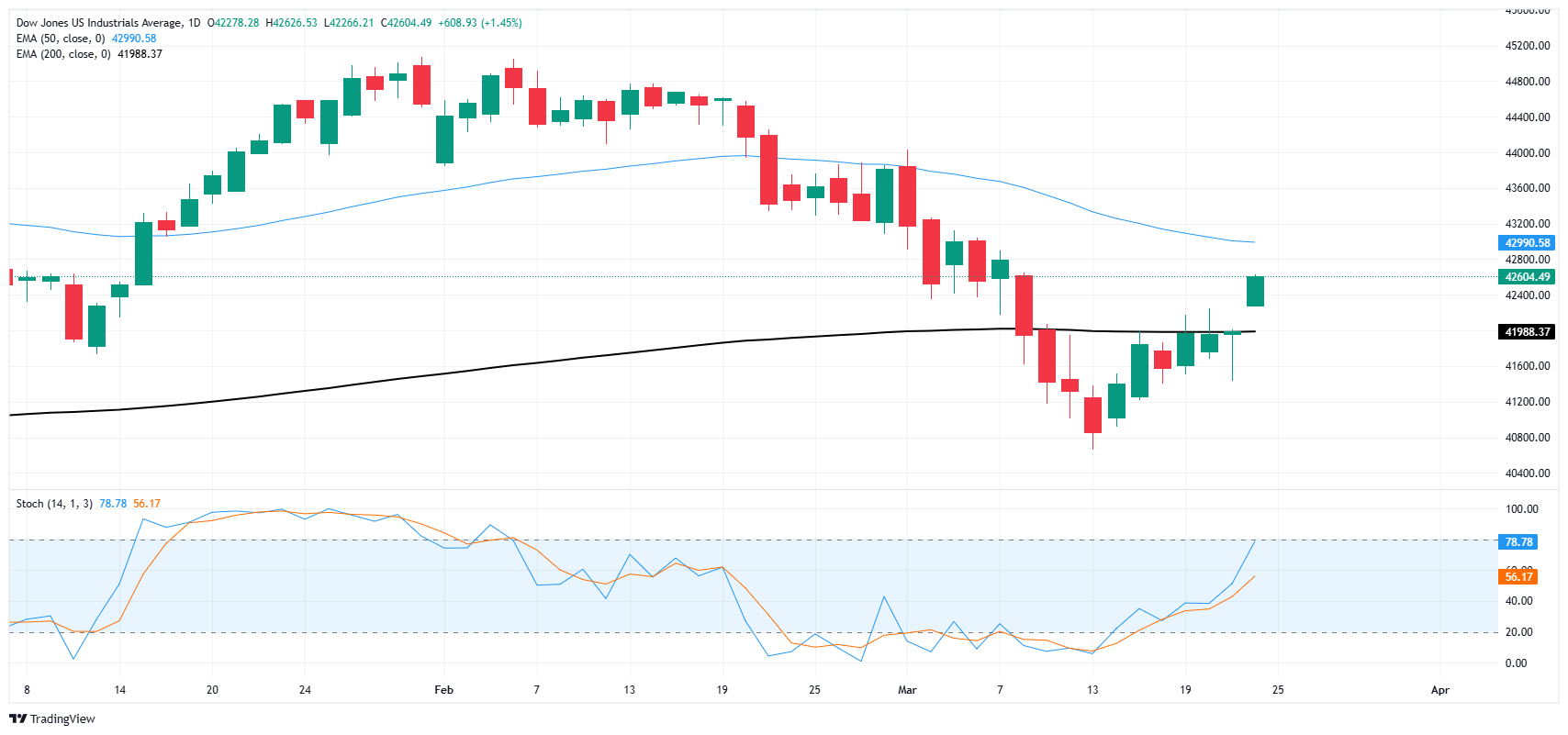
Tariffs FAQs
Tariffs are customs duties levied on certain merchandise imports or a category of products. Tariffs are designed to help local producers and manufacturers be more competitive in the market by providing a price advantage over similar goods that can be imported. Tariffs are widely used as tools of protectionism, along with trade barriers and import quotas.
Although tariffs and taxes both generate government revenue to fund public goods and services, they have several distinctions. Tariffs are prepaid at the port of entry, while taxes are paid at the time of purchase. Taxes are imposed on individual taxpayers and businesses, while tariffs are paid by importers.
There are two schools of thought among economists regarding the usage of tariffs. While some argue that tariffs are necessary to protect domestic industries and address trade imbalances, others see them as a harmful tool that could potentially drive prices higher over the long term and lead to a damaging trade war by encouraging tit-for-tat tariffs.
During the run-up to the presidential election in November 2024, Donald Trump made it clear that he intends to use tariffs to support the US economy and American producers. In 2024, Mexico, China and Canada accounted for 42% of total US imports. In this period, Mexico stood out as the top exporter with $466.6 billion, according to the US Census Bureau. Hence, Trump wants to focus on these three nations when imposing tariffs. He also plans to use the revenue generated through tariffs to lower personal income taxes.
Author

Joshua Gibson
FXStreet
Joshua joins the FXStreet team as an Economics and Finance double major from Vancouver Island University with twelve years' experience as an independent trader focusing on technical analysis.