Dow Jones holds bullish tilt after Trump tariff unveiling
- The Dow Jones rose on Tuesday, climbing 250 points as markets digest tariffs.
- The Trump administration laid out widespread "reciprocal" tariffs.
- Tariff package includes 25% tariffs on automobiles and car parts.

The Dow Jones Industrial Average (DJIA) took a step higher in early Tuesday trading, climbing 350 points and adding 0.85% from the day’s opening bids as investors lean into bets that the Trump administration’s long-awaited “reciprocal” tariffs package will be nowhere near as devastating as US President Donald Trump has been threatening. Donald Trump campaigned on promises of using widespread tariffs against all of the US’s trading partners to force better deals out of the rest of the free world. According to White House personnel, the Trump team's tariffs are set to go into effect on April 5, with reciprocal tariffs set to start on April 9.
April 2: Tariff Day
The Trump administration has been in the White House for 72 days, and is still grappling with how to execute Donald Trump’s “day one” tariffs after several delays. Despite an uptick in volatility and souring risk sentiment in the face of President Trump attempting to kick off a global trade war, markets overall bet that tariffs will be nowhere near as high as President Trump has been threatening. It appears investors were right, as the Trump administration unveiled a flat across-the-board tariff of 10% on all goods imported into the US. The "reciprocal" tariff list has also been published on a per-country basis, where the US administration is charging a proportional counter-tariff of 34% to 50% of the initiating country's import tax.
Read more: Trump announces reciprocal tariffs
Automobile and auto parts tariffs are also set to kick in at midnight EST, putting a flat 25% fee on all vehicles and most car parts imported into the US. Still-looming 25% import tariffs on all goods from Canada and Mexico, which are also slated to kick back in at midnight EST after a month-long extension, are set to continue excluding USMCA-compliant goods, according to White House officials.
ADP Employment Change numbers for March came in much stronger than expected, rising 155K new payroll positions compared to February’s revised print of 84K. The upswing flouts rising fears of a weakening labor market. However, the key labor figure will be Friday’s upcoming Nonfarm Payrolls (NFP). Although the ADP payroll figures have long been held as a “preview” of NFP net job gains, the correlation between the two figures has been broken for years.
Stock news
Equity markets are broadly higher as investors react positively to the Trump administration’s self-styled “Liberation Day”. The Dow Jones added nearly a full percent from Wednesday’s opening bids, while the Standard & Poor’s 500 megacap equity index also rallied 52 points to add 0.85%. The Nasdaq Composite tech-heavy index surged 1.3%, climbing 230 points.
Read more stock news: Tesla stock rallies despite Q1 delivery 'disaster'
Dow Jones price forecast
Wednesday saw a bullish spark from the Dow Jones Industrial Average, with bids pushing back above the 200-day Exponential Moving Average (EMA) near the 42,000 handle. Macro flows are dominating the major equity index on Wednesday, crimping technical readings.
An extended upshot will see the Dow Jones climb back over the 50-day EMA near 42,775. On the low side, a fresh plunge below the 200-day EMA will set up price action for a fresh slide to March’s swing low below 40,800.
Dow Jones daily chart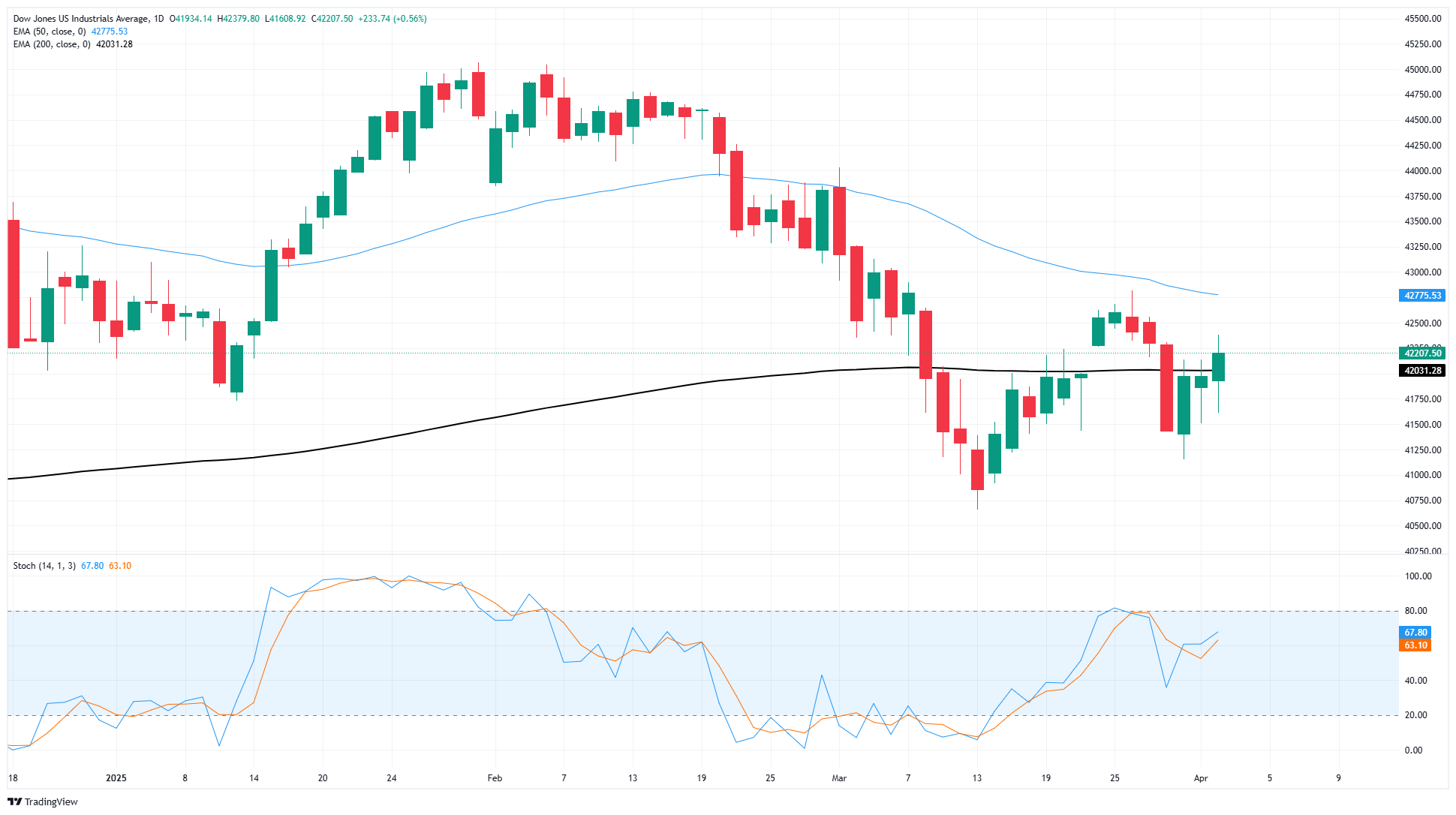
Tariffs FAQs
Tariffs are customs duties levied on certain merchandise imports or a category of products. Tariffs are designed to help local producers and manufacturers be more competitive in the market by providing a price advantage over similar goods that can be imported. Tariffs are widely used as tools of protectionism, along with trade barriers and import quotas.
Although tariffs and taxes both generate government revenue to fund public goods and services, they have several distinctions. Tariffs are prepaid at the port of entry, while taxes are paid at the time of purchase. Taxes are imposed on individual taxpayers and businesses, while tariffs are paid by importers.
There are two schools of thought among economists regarding the usage of tariffs. While some argue that tariffs are necessary to protect domestic industries and address trade imbalances, others see them as a harmful tool that could potentially drive prices higher over the long term and lead to a damaging trade war by encouraging tit-for-tat tariffs.
During the run-up to the presidential election in November 2024, Donald Trump made it clear that he intends to use tariffs to support the US economy and American producers. In 2024, Mexico, China and Canada accounted for 42% of total US imports. In this period, Mexico stood out as the top exporter with $466.6 billion, according to the US Census Bureau. Hence, Trump wants to focus on these three nations when imposing tariffs. He also plans to use the revenue generated through tariffs to lower personal income taxes.
Author

Joshua Gibson
FXStreet
Joshua joins the FXStreet team as an Economics and Finance double major from Vancouver Island University with twelve years' experience as an independent trader focusing on technical analysis.

















