Dow Jones Industrial Average Forecast: DJIA closes with better performance than NASDAQ, S&P 500 on Wednesday
- Dow Jones Industrial Index rose 1.94% last week and has advanced slightly this week as well.
- US Initial Jobless Claims came in well below expectations.
- Durable Goods Orders dropped 5.4% MoM, well below consensus.
- Preliminary Manufacturing and Services PMIs arrive on Friday during a shortened trading session.

The Dow Jones Industrial Average (DJIA) outperformed the NASDAQ Composite (0.46%) and the S&P 500 (0.41%) on Wednesday ahead of the Thanksgiving holiday. The DJIA closed up 0.53% as Microsoft (MSFT) and The Home Depot (HD) both added just under 1.3%.
The DJIA rose 1.94% last week, its third week of gains, and has also been gathering steam this week. Nvidia (NVDA) earnings late Tuesday amounted to an impressive beat, but the premier semiconductor stock closed down 2.5% on Wednesday.
Lower Initial Jobless Claims are demonstrating that the US labor market is not collapsing as some estimated last week, but Durable Goods Orders fell much further than the market expected.
Dow Jones News: Hawkish FOMC Minutes fail to dissuade bulls
Nvidia earnings may not have meant much for Nvidia itself, as expectations were so high, but the market seems to be benefiting from them. All three major Wall Street indices opened higher on Wednesday. CEO Jensen Huang’s company raised its outlook by more than $2 billion for fourth-quarter revenue, an event that seems unlikely if a recession were on the horizon.
Tuesday’s hawkish FOMC Minutes have also failed to alter the market’s bullish foundation. The CME Group FedWatch Tool has placed the odds of an interest rate cut at 62% for the Federal Reserve’s May meeting. The March meeting continues to see odds of a cut near 29%.
The Fed left the door open for more hikes, but the market is not in agreement. The soft landing thesis is still leading the narrative. Initial Jobless Claims for the week ending November 18 arrived at 209K – well below the consensus of 225K. It was still a positive reading as it was a 24K decrease from the previous week’s 233K reading (revised 2K higher). Placid, ho-hum Initial Jobless Claims are what the market wants, however, as it reads as a labor market sustaining its health but low enough not to trigger Fed hawks.
Durable Goods Orders for October fell 5.4% rather than the 3.1% drop that was expected. This could be a seasonal decline, but a large drop below consensus for November could worry the market.
The Michigan Consumer Sentiment Index for November arrived Wednesday morning at 61.3, above the consensus for 60.5 and the previous month’s 60.4 print. S&P Global PMIs for Manufacturing and Services will be released on Friday.
Dow Jones FAQs
What is the Dow Jones?
The Dow Jones Industrial Average, one of the oldest stock market indices in the world, is compiled of the 30 most traded stocks in the US. The index is price-weighted rather than weighted by capitalization. It is calculated by summing the prices of the constituent stocks and dividing them by a factor, currently 0.152. The index was founded by Charles Dow, who also founded the Wall Street Journal. In later years it has been criticized for not being broadly representative enough because it only tracks 30 conglomerates, unlike broader indices such as the S&P 500.
What factors impact the Dow Jones Industrial Average?
Many different factors drive the Dow Jones Industrial Average (DJIA). The aggregate performance of the component companies revealed in quarterly company earnings reports is the main one. US and global macroeconomic data also contributes as it impacts on investor sentiment. The level of interest rates, set by the Federal Reserve (Fed), also influences the DJIA as it affects the cost of credit, on which many corporations are heavily reliant. Therefore, inflation can be a major driver as well as other metrics which impact the Fed decisions.
What is Dow Theory?
Dow Theory is a method for identifying the primary trend of the stock market developed by Charles Dow. A key step is to compare the direction of the Dow Jones Industrial Average (DJIA) and the Dow Jones Transportation Average (DJTA) and only follow trends where both are moving in the same direction. Volume is a confirmatory criteria. The theory uses elements of peak and trough analysis. Dow’s theory posits three trend phases: accumulation, when smart money starts buying or selling; public participation, when the wider public joins in; and distribution, when the smart money exits.
How can I trade the DJIA?
There are a number of ways to trade the DJIA. One is to use ETFs which allow investors to trade the DJIA as a single security, rather than having to buy shares in all 30 constituent companies. A leading example is the SPDR Dow Jones Industrial Average ETF (DIA). DJIA futures contracts enable traders to speculate on the future value of the index and Options provide the right, but not the obligation, to buy or sell the index at a predetermined price in the future. Mutual funds enable investors to buy a share of a diversified portfolio of DJIA stocks thus providing exposure to the overall index.
Dow Jones Industrial Average forecast: Overbought after November rally
The Dow Jones index has risen above the late August highs over the past week and is now gunning to take out the August 1 high sometime in December. That 35,679 high was the highest the index has reached in about 18 months, and a close above that level signifies that the index is back in bullish territory.
In the near term, investors will note that the Relative Strength Index (RSI) has reached overbought levels. Typically, this means that a pullback is in order. If the 35,000 resistance level turns into support, then the 34,300 to 34,700 demand zone could do the trick. Otherwise, the 50-day Simple Moving average (SMA) is hovering just below the early November consolidation just below 33,900.
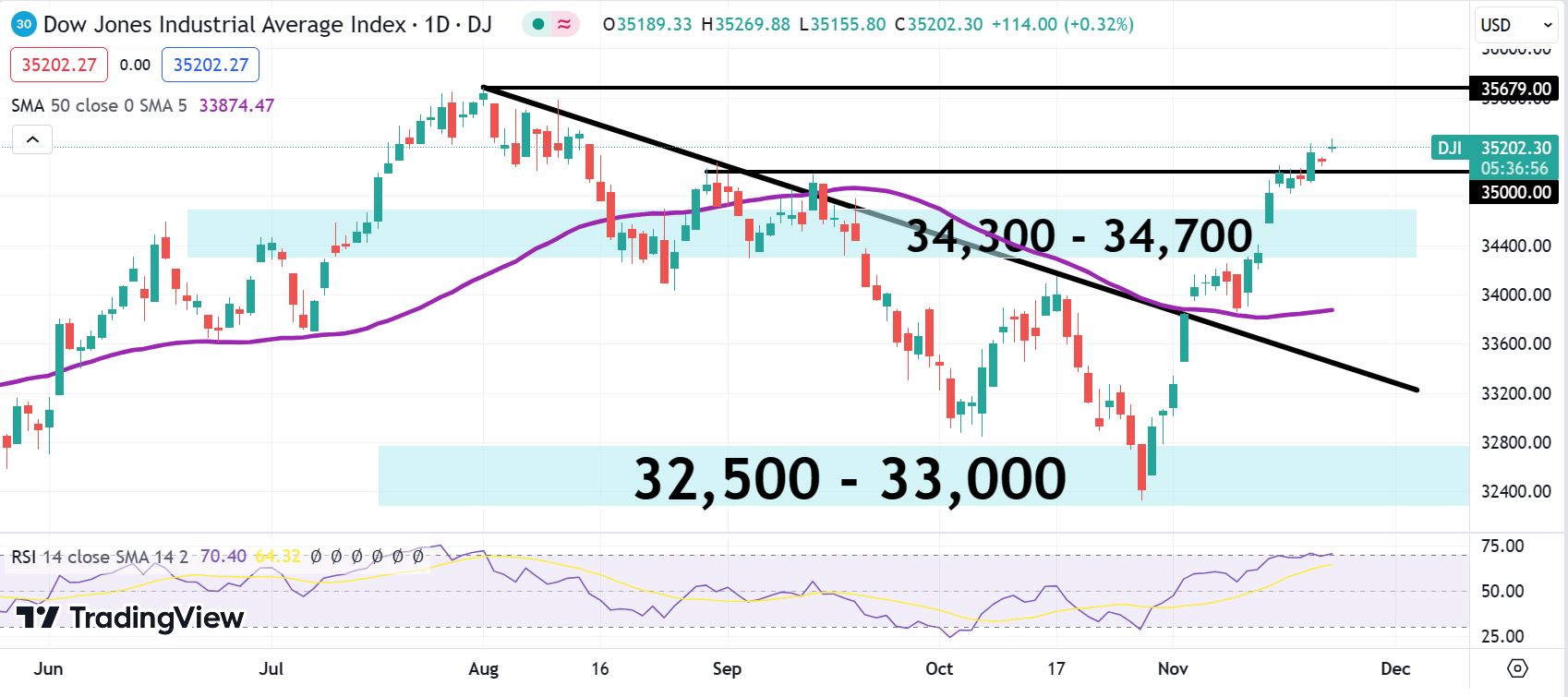
Dow Jones Industrial Average daily chart
Author

Clay Webster
FXStreet
Clay Webster grew up in the US outside Buffalo, New York and Lancaster, Pennsylvania. He began investing after college following the 2008 financial crisis.

















