Dow Jones Industrial Average climbs 120 points after early Tuesday backslide
- The Dow Jones stumbled on Tuesday, weighed down by key losses in Amgen.
- Equities have broadly shrugged off renewed tariff threats from incoming President Donald Trump.
- Key inflation data looms ahead later in the week.

The Dow Jones Industrial Average (DJIA) fell back on Tuesday, shedding over 250 points at its lowest point. Investors shrugged off renewed threats of widespread tariffs on foreign goods from incoming President Donald Trump, but slightly below-expectations results for an experimental diet pill from Amgen (AMGN) dragged the weighted DJIA into the low end for the day. The major equity index recovered its footing heading into the back half of Tuesday's US market session, pushing back into record territory north of 44,800 as investors shrug off headwinds to keep bullish momentum on-balance.
President-elect Donald Trump reiterated his threats to enact sweeping tariffs on all imported goods into the US early Tuesday. Set to return to the White House in January, former President Trump issued a warning on social media that he intends to impose a 25% tariff on all goods coming from Canada and Mexico, with an additional 10% levy aimed at Chinese goods specifically. Investors broadly shrugged off the threat, believing that President Trump will ultimately back down from his plan to impose an import tax across the entire US economy. To investors’ credit, President Trump has walked back his extreme stance on arbitrary tariffs somewhat; the Republican candidate’s initial tariff proposals delivered on the campaign trail included import fees upwards of 65% on all Chinese goods that cross the US border.
According to the Federal Reserve's (Fed) latest Meeting Minutes, members of the Federal Open Market Committee (FOMC) continue to remain cautious about the pace of rate cuts looking forward. Overall the Fed's key group of policymakers seemed to agree that downside risks in the employment landscape and inflation outlook have decreased, but the pace of rate cuts is unlikely to accelerate further unless weak points open up in the jobs market and price growth starts to slump. According to the CME's FedWatch Tool, rate traders have slightly solidified bets of a 25 bps rate trim when the Fed makes its final rate call of 2024 on December 18, with rate markets pricing in 60% odds of a quarter-point rate cut and the remaining 40% expecting a rate hold.
Wednesday will follow up with another update to US Personal Consumption Expenditure Price Index (PCEPI) inflation, a key reading of price increases underpinning the US economy. Wednesday also brings a quarterly update of UIS Gross Domestic Product (GDP) growth. Annualized core PCEPI inflation is set to accelerate again in October and forecast to increase to 2.8% from the previous 2.7%. QoQ US GDP growth in the third quarter is expected to hold steady at 2.8%.
Dow Jones news
Despite equities broadly maintaining an even stance on Tuesday, the Dow Jones suffered an outweighed decline after Amgen reported the latest results from their experimental weight loss drug that undershot investor expectations. Two-thirds of the Dow Jones is leaning into the high side for the day, but Amgen plummeted to a 12% decline at its lowest point after investors soured on the drugmaker’s latest tests.Amgen has recovered some footing and is currently down around 8%, trading around $270 per share.
Dow Jones price forecast
The Dow Jones is treading choppy waters near 44,700 on Tuesday, finding an intraday floor near 44,400 before settling back into the day’s opening bids. The major equity index briefly set another record all-time high bid just above 44,800, but bulls are beginning to show signs of exhaustion.
The immediate floor for any downside pullbacks is priced in at the last swing low, with candle wicks populating territory near 43,200. However, any bearish momentum will quickly run into further technical support from the 50-day Exponential Moving Average (EMA) rising through 42,800.
Dow Jones daily chart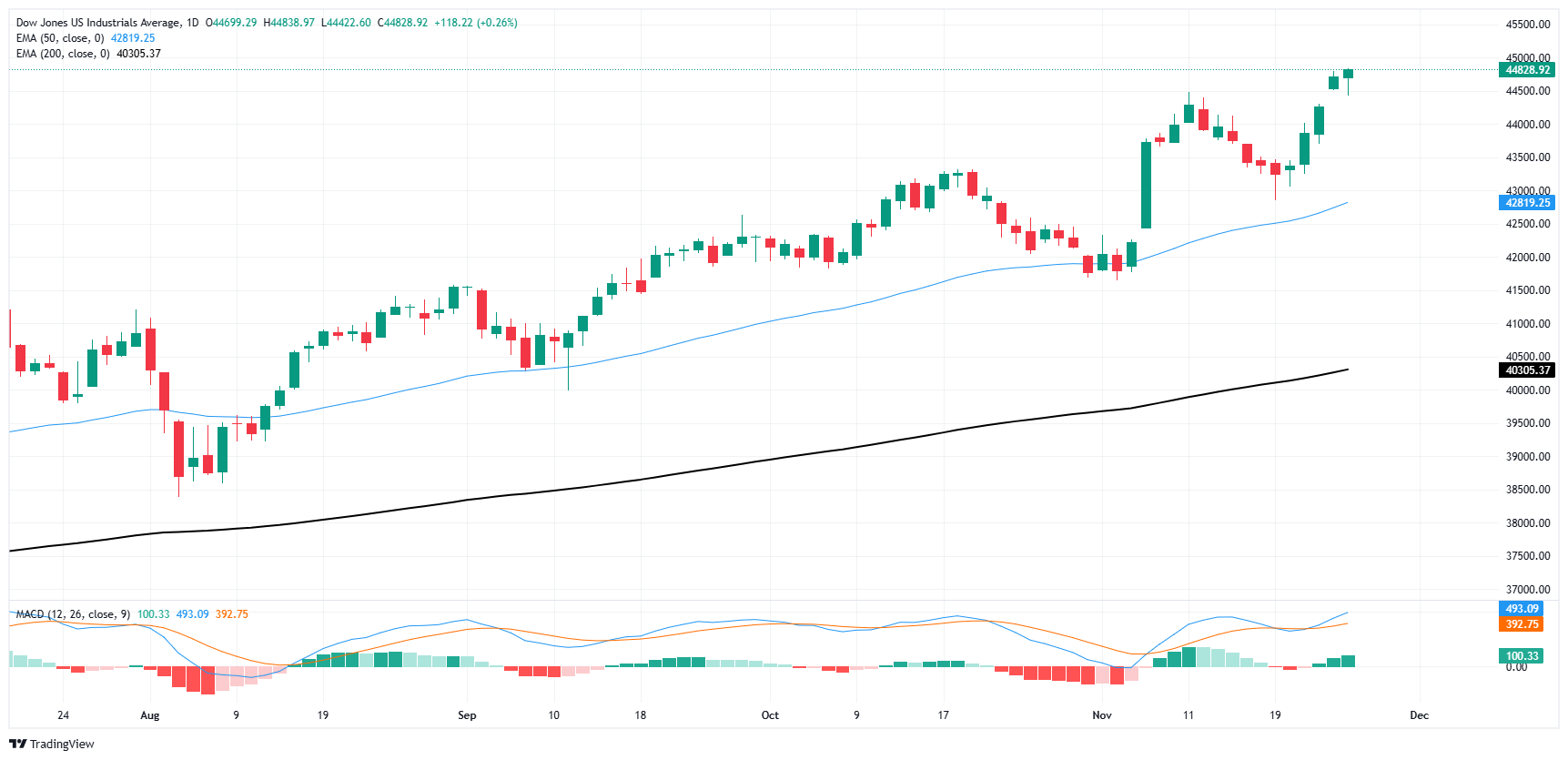
Dow Jones FAQs
The Dow Jones Industrial Average, one of the oldest stock market indices in the world, is compiled of the 30 most traded stocks in the US. The index is price-weighted rather than weighted by capitalization. It is calculated by summing the prices of the constituent stocks and dividing them by a factor, currently 0.152. The index was founded by Charles Dow, who also founded the Wall Street Journal. In later years it has been criticized for not being broadly representative enough because it only tracks 30 conglomerates, unlike broader indices such as the S&P 500.
Many different factors drive the Dow Jones Industrial Average (DJIA). The aggregate performance of the component companies revealed in quarterly company earnings reports is the main one. US and global macroeconomic data also contributes as it impacts on investor sentiment. The level of interest rates, set by the Federal Reserve (Fed), also influences the DJIA as it affects the cost of credit, on which many corporations are heavily reliant. Therefore, inflation can be a major driver as well as other metrics which impact the Fed decisions.
Dow Theory is a method for identifying the primary trend of the stock market developed by Charles Dow. A key step is to compare the direction of the Dow Jones Industrial Average (DJIA) and the Dow Jones Transportation Average (DJTA) and only follow trends where both are moving in the same direction. Volume is a confirmatory criteria. The theory uses elements of peak and trough analysis. Dow’s theory posits three trend phases: accumulation, when smart money starts buying or selling; public participation, when the wider public joins in; and distribution, when the smart money exits.
There are a number of ways to trade the DJIA. One is to use ETFs which allow investors to trade the DJIA as a single security, rather than having to buy shares in all 30 constituent companies. A leading example is the SPDR Dow Jones Industrial Average ETF (DIA). DJIA futures contracts enable traders to speculate on the future value of the index and Options provide the right, but not the obligation, to buy or sell the index at a predetermined price in the future. Mutual funds enable investors to buy a share of a diversified portfolio of DJIA stocks thus providing exposure to the overall index.
Author

Joshua Gibson
FXStreet
Joshua joins the FXStreet team as an Economics and Finance double major from Vancouver Island University with twelve years' experience as an independent trader focusing on technical analysis.