Donald Trump taps CEA Chair Stephen Miran for seat on Fed board

United States (US) President Donald Trump announced on Thursday that he would be selecting Stephen Miran, the current Chair of the US Council of Economic Advisors, to replace recently resigned Federal Reserve (Fed) Board of Governors (BoG) member Adriana Kugler.
Key Highlights
Stephen Miran will be replacing Adriana Kugler as a voting member of the Fed's Board on an interim basis until January 31, 2026. Trump is continuing his trend of appointing team members to multiple roles: Miran already serves as the Chair of the US CEA, a position he was nominated to by Trump at the beginning of his second term.
Stephen Miran is a dyed-in-the-wool protectionist and a strong proponent of using steep tariffs to manipulate trade deficits, specifically to weaken the US Dollar (USD) in an effort to increase the viability of increasing US domestic production and limiting international trade. Miran's notable career stints in major positions include a stint as an economic policy advisor at the US Treasury Department and as a senior strategist at distressed-debt predator Hudson Bay Capital Management. Both positions were brief and lasted less than a year.
Stephen Miran's publicly available policy research is broadly considered a foundational blueprint for the "Mar-a-Lago Accord", an economic and trade policy proposal that seeks to drastically undermine the value and credibility of the Greenback to forcefully reshore US manufacturing at the expense of the broader services economy.
The Trump administration's bizarre decision to include trade deficits in calculations for tariffs is likewise considered to be the brainchild of Miran. As a voting member of the Fed Board, Miran will have a direct say in when, and by how much, the Federal Reserve should move interest rates in its upcoming interest rate decisions. The Fed's next interest rate call is slated for September 17.
Market impact
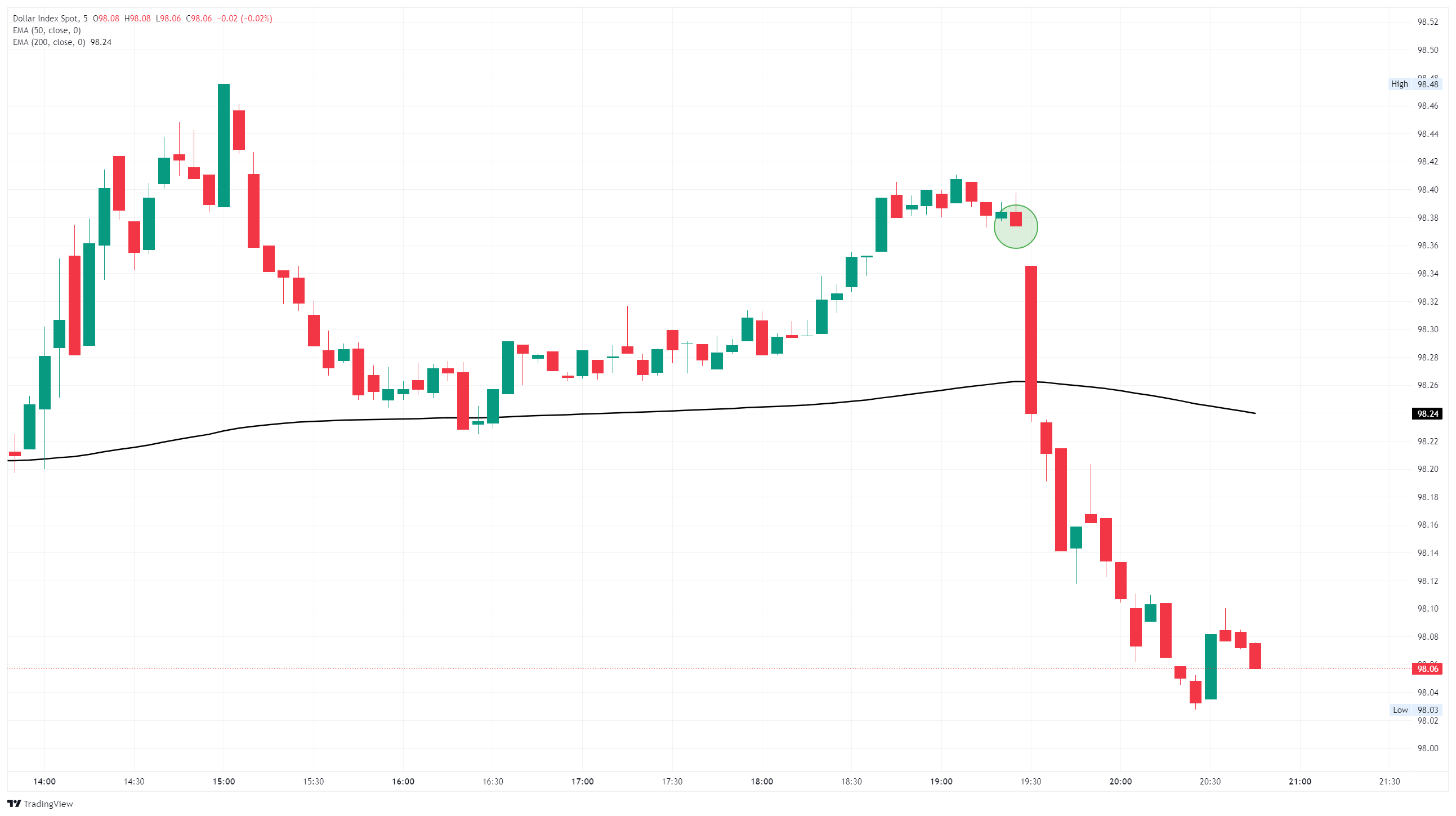
The US Dollar Index (DXY) got knocked sharply lower following the White House's announcement of Miran's selection, falling from the 98.40 region and backsliding to the 98.00 area. The US Dollar basket has fallen for three of the last five sessions, declining 2.3% from a nine-week high of 100.26.
US Dollar Index 5-minute chart
US Dollar FAQs
The US Dollar (USD) is the official currency of the United States of America, and the ‘de facto’ currency of a significant number of other countries where it is found in circulation alongside local notes. It is the most heavily traded currency in the world, accounting for over 88% of all global foreign exchange turnover, or an average of $6.6 trillion in transactions per day, according to data from 2022. Following the second world war, the USD took over from the British Pound as the world’s reserve currency. For most of its history, the US Dollar was backed by Gold, until the Bretton Woods Agreement in 1971 when the Gold Standard went away.
The most important single factor impacting on the value of the US Dollar is monetary policy, which is shaped by the Federal Reserve (Fed). The Fed has two mandates: to achieve price stability (control inflation) and foster full employment. Its primary tool to achieve these two goals is by adjusting interest rates. When prices are rising too quickly and inflation is above the Fed’s 2% target, the Fed will raise rates, which helps the USD value. When inflation falls below 2% or the Unemployment Rate is too high, the Fed may lower interest rates, which weighs on the Greenback.
In extreme situations, the Federal Reserve can also print more Dollars and enact quantitative easing (QE). QE is the process by which the Fed substantially increases the flow of credit in a stuck financial system. It is a non-standard policy measure used when credit has dried up because banks will not lend to each other (out of the fear of counterparty default). It is a last resort when simply lowering interest rates is unlikely to achieve the necessary result. It was the Fed’s weapon of choice to combat the credit crunch that occurred during the Great Financial Crisis in 2008. It involves the Fed printing more Dollars and using them to buy US government bonds predominantly from financial institutions. QE usually leads to a weaker US Dollar.
Quantitative tightening (QT) is the reverse process whereby the Federal Reserve stops buying bonds from financial institutions and does not reinvest the principal from the bonds it holds maturing in new purchases. It is usually positive for the US Dollar.
Author

Joshua Gibson
FXStreet
Joshua joins the FXStreet team as an Economics and Finance double major from Vancouver Island University with twelve years' experience as an independent trader focusing on technical analysis.