Dollar Index softens as markets weigh US-Iran tensions and Fed rate outlook
- The Dollar Index softens as Fed speakers signal a dovish tilt, while tensions in the Middle East rise.
- Fed speaker Michelle Bowman signals potential cut in July ahead of Powell’s testimony on Tuesday.
- The US Dollar Index is rejected by resistance at the 50-day Simple Moving Average (SMA), which is currently above 99.00.
The US Dollar Index (DXY) is edging lower after a strong start on Monday as markets monitor the risks of an Iranian retaliation against the United States (US) and look ahead to Federal Reserve (Fed) Chair Jerome Powell’s upcoming testimony on Tuesday.
Over the weekend, US President Donald Trump confirmed that American forces struck three Iranian nuclear sites, prompting fears of retaliation from Tehran. The possibility that Iran could respond by disrupting Oil traffic through the Strait of Hormuz—a critical maritime chokepoint—has kept risk sentiment on edge.
The Dollar Index, which measures the USD against a basket of major currencies, began the week on a stronger footing, rising above the prior psychological resistance level of 99 before sliding lower.
Adding to the initial upside was Monday’s release of S&P Global’s preliminary Purchasing Managers’ Index (PMI) data for June. The manufacturing index came in at 52, unchanged from May but above consensus expectations of 51. The services component moderated slightly to 53.1 from 53.7 but still indicated expansion. These figures underscored resilience in the US economy, helping to stabilize bond yields and support the US Dollar.
However, during the US session, attention shifted back to monetary policy. Fed Governor Michelle Bowman added to a growing chorus of officials leaning dovish, saying the central bank should stay open to the possibility of a rate cut in July as inflationary pressures ease. Her comments echoed those of Governor Christopher Waller last week, who suggested a cut in July could be warranted if disinflation continues.
With Chair Jerome Powell scheduled to deliver his semi-annual testimony before Congress on Tuesday, traders are preparing for a potentially pivotal update on the Fed’s thinking. Following the Fed’s latest dot plot, which penciled in two cuts for 2025, Powell’s tone on inflation, growth, and global uncertainty will likely shape near-term moves in the US Dollar.
Technical outlook: Dollar Index eases below 99.00
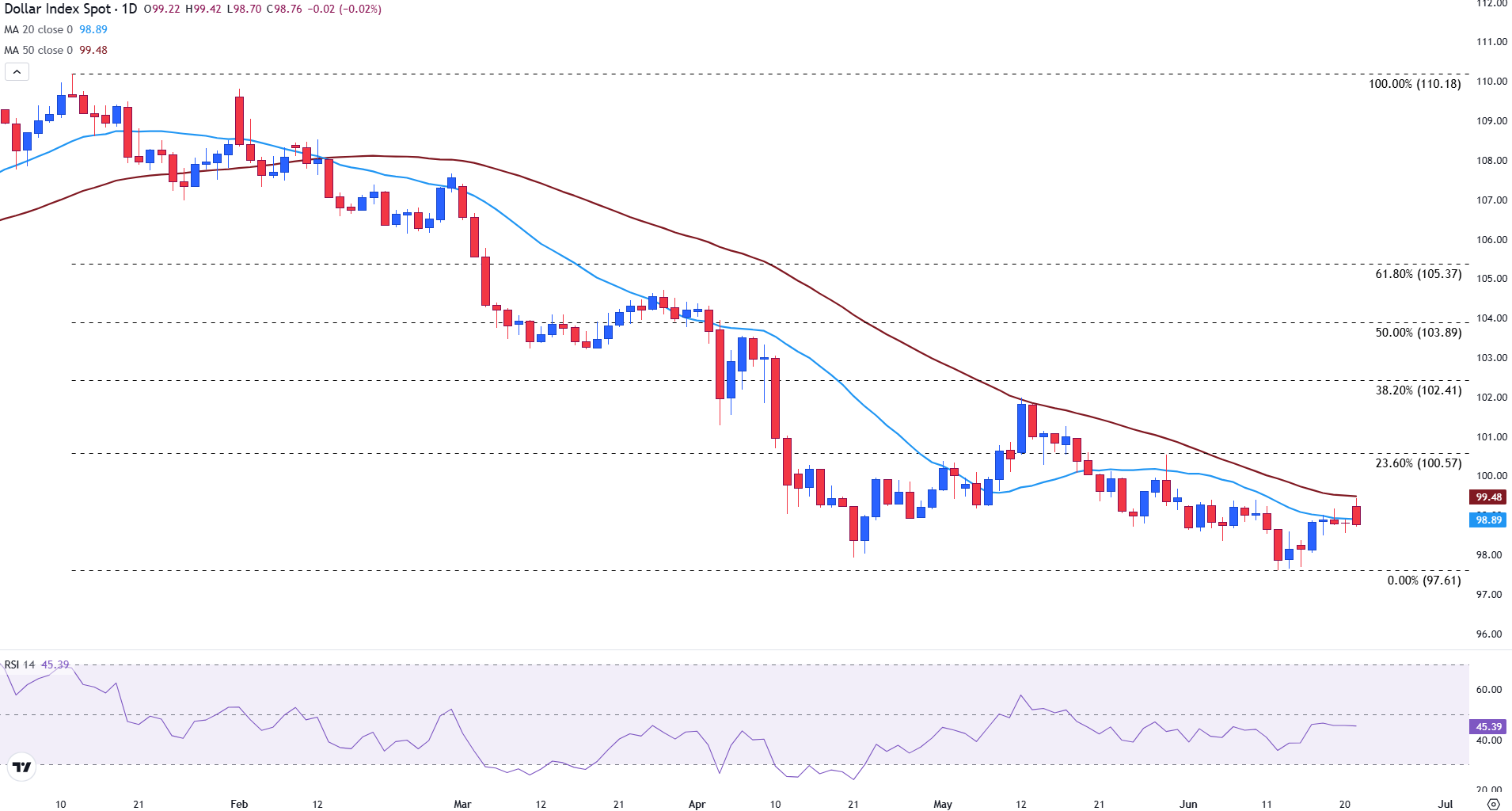
From a technical perspective, the US Dollar Index has bounced from support near 98.00 and attempted to reclaim the 50-day Simple Moving Average (SMA) at 99.48, which remains a major resistance level. With prices currently flirting with the 20-day SMA near 98.89, a move lower could bring the 98.00 psychological support level back into play.
However, if prices do manage to recover above the 50-day SMA, a close above this zone could open a path toward 100.57, the 23.6% Fibonacci retracement of the decline from the January peak to the recent June low. The Relative Strength Index (RSI) near 45 suggests slight bearish momentum.
Fed FAQs
Monetary policy in the US is shaped by the Federal Reserve (Fed). The Fed has two mandates: to achieve price stability and foster full employment. Its primary tool to achieve these goals is by adjusting interest rates. When prices are rising too quickly and inflation is above the Fed’s 2% target, it raises interest rates, increasing borrowing costs throughout the economy. This results in a stronger US Dollar (USD) as it makes the US a more attractive place for international investors to park their money. When inflation falls below 2% or the Unemployment Rate is too high, the Fed may lower interest rates to encourage borrowing, which weighs on the Greenback.
The Federal Reserve (Fed) holds eight policy meetings a year, where the Federal Open Market Committee (FOMC) assesses economic conditions and makes monetary policy decisions. The FOMC is attended by twelve Fed officials – the seven members of the Board of Governors, the president of the Federal Reserve Bank of New York, and four of the remaining eleven regional Reserve Bank presidents, who serve one-year terms on a rotating basis.
In extreme situations, the Federal Reserve may resort to a policy named Quantitative Easing (QE). QE is the process by which the Fed substantially increases the flow of credit in a stuck financial system. It is a non-standard policy measure used during crises or when inflation is extremely low. It was the Fed’s weapon of choice during the Great Financial Crisis in 2008. It involves the Fed printing more Dollars and using them to buy high grade bonds from financial institutions. QE usually weakens the US Dollar.
Quantitative tightening (QT) is the reverse process of QE, whereby the Federal Reserve stops buying bonds from financial institutions and does not reinvest the principal from the bonds it holds maturing, to purchase new bonds. It is usually positive for the value of the US Dollar.
Author

Tammy Da Costa, CFTe®
FXStreet
Tammy is an economist and market analyst with a deep passion for financial markets, particularly commodities and geopolitics.

















