|

DiDi Stock News: DiDi Global Inc tanks further during mixed session for Chinese ADRs

  • NYSE:DIDI fell by 7.65% during Monday’s trading session.
  • Investors continue to receive mixed signals from Didi and the Chinese government.
  • Chinese ADRs had a mixed session as Baba and Nio rose, but JD and PDD fell.

NYSE:DIDI carried over its recent slide from the previous week, and on Monday, its skid hit five consecutive sessions. Shares of DIDI dropped a further 7.65% on Monday and closed the trading day at $3.02. Didi has had one of the more tumultuous stays on the New York Stock Exchange ever since the Chinese ride-hailing giant went public in June of 2021. On Monday, US stocks rose again following their second consecutive positive week. The Dow Jones gained 94 basis points, the benchmark S&P 500 added 0.71%, and the tech-heavy NASDAQ index led the way, jumping higher by 1.31%.


Stay up to speed with hot stocks' news!


Didi Global continues to give mixed signals on what the ultimate goal for the company is. In December, Didi stated that it would be delisting from the US stock market in favor of a listing in Hong Kong. Recently, the Chinese government has axed that plan and it seemed as though it would be providing support for companies listed on foreign exchanges. On Friday, the Chinese government backtracked yet again, calling the reports of abiding by US auditing laws as ‘premature’. Whatever the actual message is, investors have been on a roller coaster ride with Didi since the day it went public.

DIDI stock price
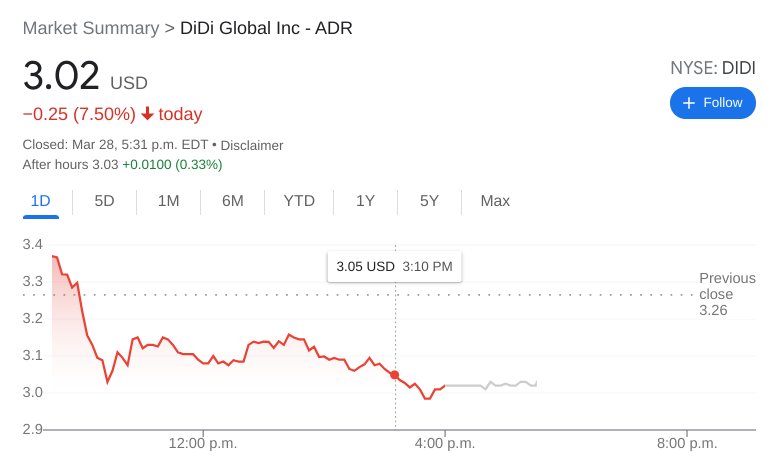
DIDI Stock

Other Chinese ADRs fared better than Didi on Monday, although overall it was a mixed session for the stocks. AliBaba (NYSE:BABA) and Nio (NYSE:NIO) rose, as the latter delivered its first ET7 vehicles, and rebounded from a post-earnings sell off. On the negative side of the action, shares of JD.Com (NASDAQ:JD) and PinDuoDuo (NASDAQ:PDD) both fell to start the week as JD.Com was hit with rumors of mass layoffs of staff and a Series B preferred shares capital raise.

Author

More from Stocks Reporter
Share:

Editor's Picks

AUD/USD bounces back toward 0.6950 on fresh USD supply

AUD/USD bounces back toward 0.6950 in the Asian session on Friday. The US Dollar retreats from 17-month highs as traders take profits off the table ahead of the all-important US Nonfarm Payrolls report. Meanwhile, the Australian Dollar draws support from reviving expectations of a November interest rate hike amid elevated global yields and inflation risks.


USD/JPY struggles near 158.00 as USD retreats ahead of NFP

USD/JPY is struggling for fresh impetus near 158.00, moving away from the top end of its weekly range in the Asian session on Friday, after hotter-than-expected Tokyo CPI and amid a broad US Dollar retreat. Traders reposition themselves ahead of US Nonfarm Payrolls.

Gold fades the earlier optimism; back below $4,200

Gold could not sustain the post-NFP bull run past the $4,200 mark per troy ounce, receding toward the $4,180 region at the end of the week. The precious metal’s inconclusive price action comes amid fresh selling pressure hurting the US Dollar as investors assess the latest NFP data.

Crypto Today: Bitcoin, Ethereum and XRP gains reinforce bullish outlook

Cryptocurrency prices are broadly recovering on Friday, led by Bitcoin moving above $86,000. Ethereum has reaffirmed its bullish outlook, rising above $2,700 while the immediate area at $2,800 caps upside. Meanwhile, Ripple hovers near $1.54.

Week ahead – Fed minutes in the spotlight amid bond market rout

Energy crisis and soaring bond yields to stay in driver’s seat in quiet week. Fed minutes eyed after drop in October rate hike bets. ISM services PMI and Treasury auctions to be watched too. Canadian employment, Japanese wages and ECB minutes also on tap.

The Euro is near a one-year low: Inflation could trigger its rebound, not its fall

EUR/USD has fallen to its lowest level since May 2025. The pair hit 1.1312 on Wednesday and trades well below the January peak of 1.2082. The decline reflects a powerful combination of US Dollar strength, geopolitical uncertainty and renewed concerns about Europe's exposure to higher energy prices.

















