|

DAX dynamics: Unraveling the implications of potential false breakout

Today's technical analysis focuses on the German DAX, an index currently undergoing intriguing movements worth noting. As the new week unfolds, indices globally are taking positive strides. This might be attributable to the correction which began last Friday. To some, like myself, this correction appeared more as a take-profit move following a particularly bleak week. However, current market dynamics show buyers interpreting this as an impetus to push prices higher, especially today.

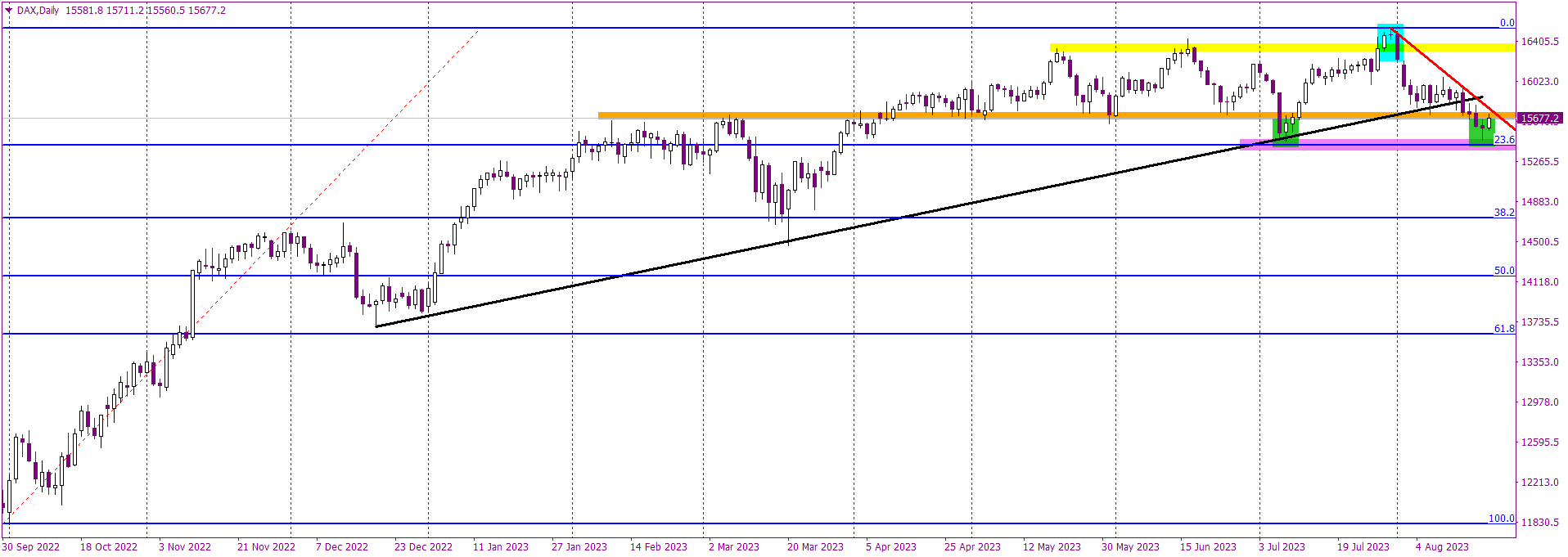
Zooming in on the DAX, the spotlight is on its trajectory towards the 15,700 points resistance, which can be distinctly identified on the chart with an orange hue. This level isn't just another resistance; it's of paramount significance for the DAX. If the price surpasses this region, it might be an indication of another false breakout below this threshold. A similar event transpired in July, identifiable with a green shade on the chart. Should history repeat itself, it will mark yet another episode of false breakouts for the DAX.
DAX

Further amplifying the bullish narrative is the potential breach of the red mid-term downtrend line, which has been holding the reins since August, ensuring the index's decline doesn't spiral out of control. A pivotal observation emerging in this mix is the new support level, aligned with the 23.6% Fibonacci retracement. As days pass, the importance of this Fibonacci level is increasing, overshadowing even the 15,700 points benchmark. This pivot might soon become the primary focal point for traders and analysts alike.

In a nutshell, should the DAX price manage to soar above both the orange resistance and the red downtrend line, it would unmistakably be an invitation for buyers to join the party. Conversely, if the price finds itself repelled from these heights and subsequently breaches the 23.6% Fibonacci level, it would be a clarion call for sellers, marking an optimal short-selling opportunity.

Author

Tomasz Wisniewski

Tomasz Wisniewski

Axiory Global Ltd.

Tomasz was born in Warsaw, Poland on 25th October, 1985.

More from Tomasz Wisniewski
Share:

Editor's Picks

GBP/USD off highs, back to 1.3620

GBP/USD remains slightly on the defensive at the end of the week, receding to the low 1.3600s after hitting fresh tops past 1.3670 earlier in the day. Cable’s correction comes after two daily gains in a row and amid a tepid advance in the Greenback, while poor UK data also accompany the downside.

EUR/USD treads water below 1.1700

EUR/USD now trades with modest losses around 1.1670 following another unsuccessful atempt to advance past 1.1700 the figure in a convincing fashion. The pair’s decline follows a maginal rebound in the US Dollar as market participants continue to assess recent US data as well as developments from the US bond market.

Gold trims gains, recedes to the sub-$4,600 area

Gold rapidly leaves behind Thursday’s inconclusive price action and advances markedly on Friday, briefly surpassing the $4,600 mark per troy ounce to hit three-month peaks. Meanwhile, the precious metal’s solid performance comes despite marginal gains in the buck coupled with another day of rising US Treasury yields across the curve.

Crypto Today: Bitcoin, Ethereum, XRP bulls accelerate rally amid rising ETF inflows

The cryptocurrency market remains bullish on Friday, led by Bitcoin’s surge above $77,000. Altcoins, including Ethereum and Ripple, mirror BTC’s positive outlook, trading near $2,400 and $1.35, respectively.

Week ahead – Fed’s Jackson Hole and Nvidia earnings to dictate markets

Kevin Warsh to make his Jackson Hole debut amid confusing messaging. But a major hawkish surprise unlikely after bond market intervention. Nvidia earnings to also determine market direction as stock rally cools.

$20 billion offered, $2 billion taken: Why Treasury doubled its buyback cap

The US Treasury moved off its own calendar on Wednesday, and that is the part worth sitting with. At 12:32 GMT, the department said it would at least double the size of liquidity support buyback operations in the 10-year to 20-year and 20-year to 30-year sectors, lifting the maximum from $2 billion per operation to at least $4 billion, effective September 9 and running to November 4.