|

Crude Oil getting knocked around on Tuesday, WTI pinned to $85

  • Crude Oil prices are seeing some froth on Tuesday as energies get pulled in multiple directions.
  • WTI barrel bids bounce between $86 and $84.50.
  • Crude supply constraints may not be as bad as originally thought, but geopolitical stress continues to weigh.

West Texas Intermediary (WTI) is seeing some back-and-forth on Tuesday, but remains constrained near the $85.00/bbl price point as energies markets weigh inconsistent outcomes for crude oil markets.

The Israel-Hamas conflict escalation continues to stress out Crude Oil traders, but lack of immediate negative impact is keeping prices capped off. Geopolitical spillover could threaten stability in the nearby Strait of Hormuz, a major energy supply flow-through point that sees nearly a fifth of all global energy trade.

Deep supply cuts from member states of the Organization of the Petroleum Exporting Countries (OPEC) continue to keep crude barrel prices pinned higher, specifically Saudi Arabia and Russia's combined 1.3 million bpd production and export cuts. Despite major supply constraints that threaten to undershoot global demand, China's fossil fuels demand continues to wane as their domestic economy slows down more than expected, leaving more oil barrels on the table.

Iran recently re-entered global oil markets after the US eased export restrictions on the country, and lack of evidence that Iran was directly involved in the recent Israel-Hamas conflict escalation sees the US avoiding re-instating restrictions for the time being.

Hopes for a US-Venezuela crude oil exporting deal remain high with the US reaching a preliminary deal to allow the South American country to return to global oil exporting markets in exchange for a monitored presidential election next year in Venezuela.

A return for Venezuelan crude exports would be a surge for oil markets that already sees crude reserves rebounding firmer and faster than expected as global demand struggles to eat up enough of the already-constrained supply.

WTI Technical Outlook

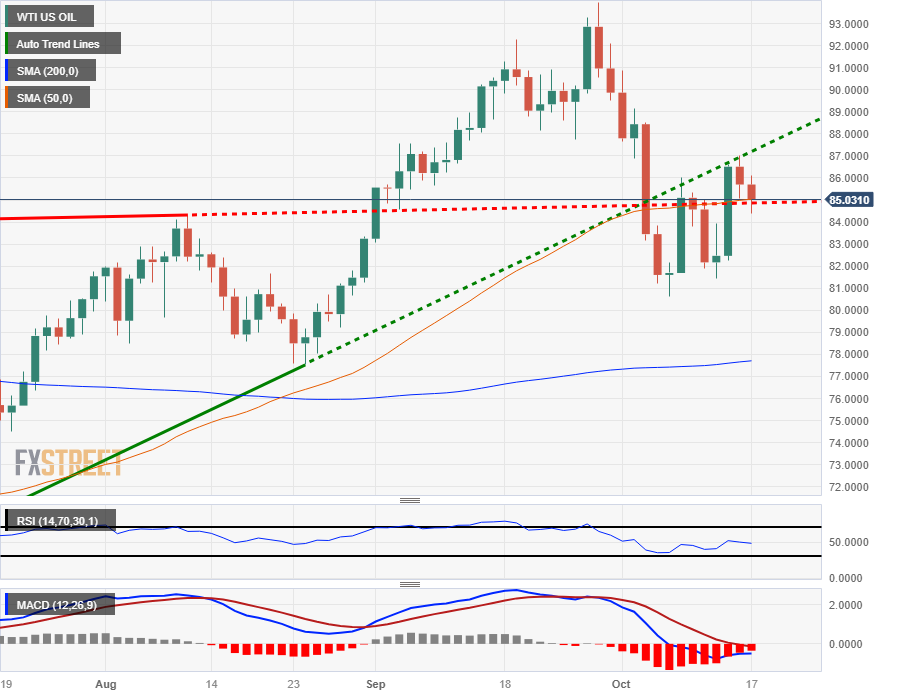
Intraday action on the WTI chart is getting capped off by the 50-hour Simple Moving Average (SMA) near $85.75 as Crude Oil prices struggle to regain last week's late swing into the $87.00 handle, and Tuesday's early push into $86.00 proved to be short-lived as WTI Crude Oil barrels get stuck to the $85.00 level.

Daily candlesticks see WTI bids stuck to the 50-day SMA as energies struggle to push prices in either direction meaningfully. Crude Oil initially rose for four consecutive months from a 2023 low of $64.31 to a thirteen-month high of $93.98, but WTI is set to flub the trend and see softening prices for October as forward-looking supply constraint fears fail to solidify.

WTI Daily Chart
WTI Technical Levels

WTI US OIL

Overview
Today last price85.04
Today Daily Change-0.66
Today Daily Change %-0.77
Today daily open85.7
 
Trends
Daily SMA2087.08
Daily SMA5084.99
Daily SMA10079.34
Daily SMA20077.66
 
Levels
Previous Daily High87.01
Previous Daily Low85.07
Previous Weekly High86.63
Previous Weekly Low81.45
Previous Monthly High93.98
Previous Monthly Low83.09
Daily Fibonacci 38.2%85.81
Daily Fibonacci 61.8%86.27
Daily Pivot Point S184.85
Daily Pivot Point S283.99
Daily Pivot Point S382.91
Daily Pivot Point R186.78
Daily Pivot Point R287.86
Daily Pivot Point R388.72

Author

Joshua Gibson

Joshua joins the FXStreet team as an Economics and Finance double major from Vancouver Island University with twelve years' experience as an independent trader focusing on technical analysis.


More from Joshua Gibson
Share:

Editor's Picks

AUD/USD remains depressed near 0.6950 after RBA minutes

AUD/USD attracts follow-through selling during Tuesday’s Asian session, looking to extend the overnight rejection slide from 0.7000, or a two-week top, following the release of RBA meeting Minutes. The US Dollar retains a bullish undertone near its highest level since April 2025 as energy-driven inflation risks keep December Fed rate hike bets firmly on the table. Adding to this, geopolitical risks further underpin the safe-haven USD.

USD/JPY eases from two-week top, hovers near 158.50 amid looming intervention risk

USD/JPY edges lower during the Asian session on Tuesday, snapping a two-day winning streak and pulling back from an over two-week top touched the previous day, despite Japan's soft PPI print. Bulls turn cautious amid speculation that authorities will step in to prop up the Japanese Yen, which, in turn, weighs on the currency pair. The downside, however, seems limited as the US Dollar stands firm near its highest level since April 2025, bolstered by the hawkish Fed and geopolitical uncertainties.

Gold struggles above $4.150 as bullish USD and elevated bond yields weigh

Gold remains depressed during the Asian session on Tuesday as elevated US Treasury yields and a hawkish Fed keep the US Dollar near its highest level since April 2025. Adding to this, persistent geopolitical uncertainties stemming from Middle East conflicts continue to underpin the safe-haven buck, which, in turn, is seen as weighing on the bullion. Traders now look to US inflation figures for some impetus ahead of Fed Chair Kevin Warsh's appearance on Friday.

Bitcoin shows bottoming signs despite recent macro pressures

Bitcoin remained range-bound above $82,000 on Monday as upcoming US economic data and onchain indicators weigh on market sentiment. Crypto trading firm QCP Group stated in its Monday report that Bitcoin has maintained a firmer footing a year after the market’s largest single-day liquidation event.

Earnings preview US and Europe: Can the stock market rally continue?
Stocks have been remarkably resilient this year. They have navigated geopolitical turmoil, an energy price spike and surging global bond yields which is rapidly pushing up the cost of borrowing. US blue chip stocks are now in their 4th year of a bull market, however, they now face their toughest test of Q4 so far, the latest earnings updates.
Has Bitcoin really escaped the macro forces it was built to fight?
Over 17 years ago, Satoshi Nakamoto designed Bitcoin (BTC) on the back of a global financial crisis as an alternative to the global monetary system outside the control of central banks, governments and traditional intermediaries. This raises a key question: has Bitcoin really become independent of the macroeconomic forces it was built to challenge?















