Crude Oil pares back some incurred losses after Trump won the majority of votes to become President
- Crude Oil recovers from an earlier 3% drop on the back of the US presidential election falling in favor of Trump.
- Tropical storm Rafael's impact for the Gulf fades into the background while Trump secures a new term as US President.
- The US Dollar Index rallies firmly and gains nearly 2% on Wednesday.

Crude Oil steadies off session's low this Wednesday following the US presidential election outcome, which came out in favor of former President Donald Trump. One of Trump’s promises in the campaign running up to the election was to support and open up more drilling for Oil to become a bigger net producer. This would create another imbalance in the markets between supply and demand, with Oil prices likely to trade lower than current levels.
The US Dollar Index (DXY), which tracks the performance of the Greenback against six other currencies, rallies and gains nearly 2% on Wednesday, not only on the back that Donald Trump has secured a fresh term. The fact that the Republicans have a chance of controlling the House of Representatives after getting control of the Senate means that Trump would have complete control of the decision system and could get several packages, reforms, and tariff implementations done without any issues.
At the time of writing, Crude Oil (WTI) trades at $71.26 and Brent Crude at $74.79
Oil news and market movers: Storm Rafael looks to be forgotten
- Tropical storm Rafael is on a path that could intersect in the next five days with BP, Shell, Occidental, and Chevron rigs in the US Gulf region, based on data from the Bureau of Ocean Energy Management and the National Hurricane Center. Bloomberg calculates that roughly 1.7 million barrels would be taken out of production daily.
- Russian data show crude production in October was almost in line with its target under the OPEC+ agreement, according to people familiar with figures from the Energy Ministry, Bloomberg reports.
- Saudi Arabia lowered its Oil prices for buyers in Asia for December after members of the OPEC+ producers group said on Sunday they will delay production increases by one month, Reuters reports.
- At 15:30 GMT, the Energy Information Administration (EIA) will release its weekly crude report for the week ending on November 1. Expectations are for a build of 1.8 million barrels compared to the previous draw of 0.515 million barrels.
Oil Technical Analysis: OPEC will look to question Trump's next moves
Crude Oil prices edge lower on Wednesday since former US President Donald Trump emerged as the winner of the US presidential election. In one of his last rallies, Trump confirmed that he wants to boost drilling and mining in the US again. That would mean that more Oil supply is set to hit markets and create another break in balance, with more supply than demand at hand.
On the upside, the hefty technical level at $74.30, with the 100-day Simple Moving Average (SMA) and a few pivotal lines, is the next big hurdle ahead. The 200-day SMA at $76.85 is still quite far off, although it could get tested in case tensions in the Middle East arise.
The 55-day SMA at $70.87, has lost control of the situation and is no longer supporting prices that have drifted too far off. Traders need to look much lower at $67.12, a level that supported the price in May and June 2023. In case that level breaks, the 2024 year-to-date low emerges at $64.75 followed by $64.38, the low from 2023.
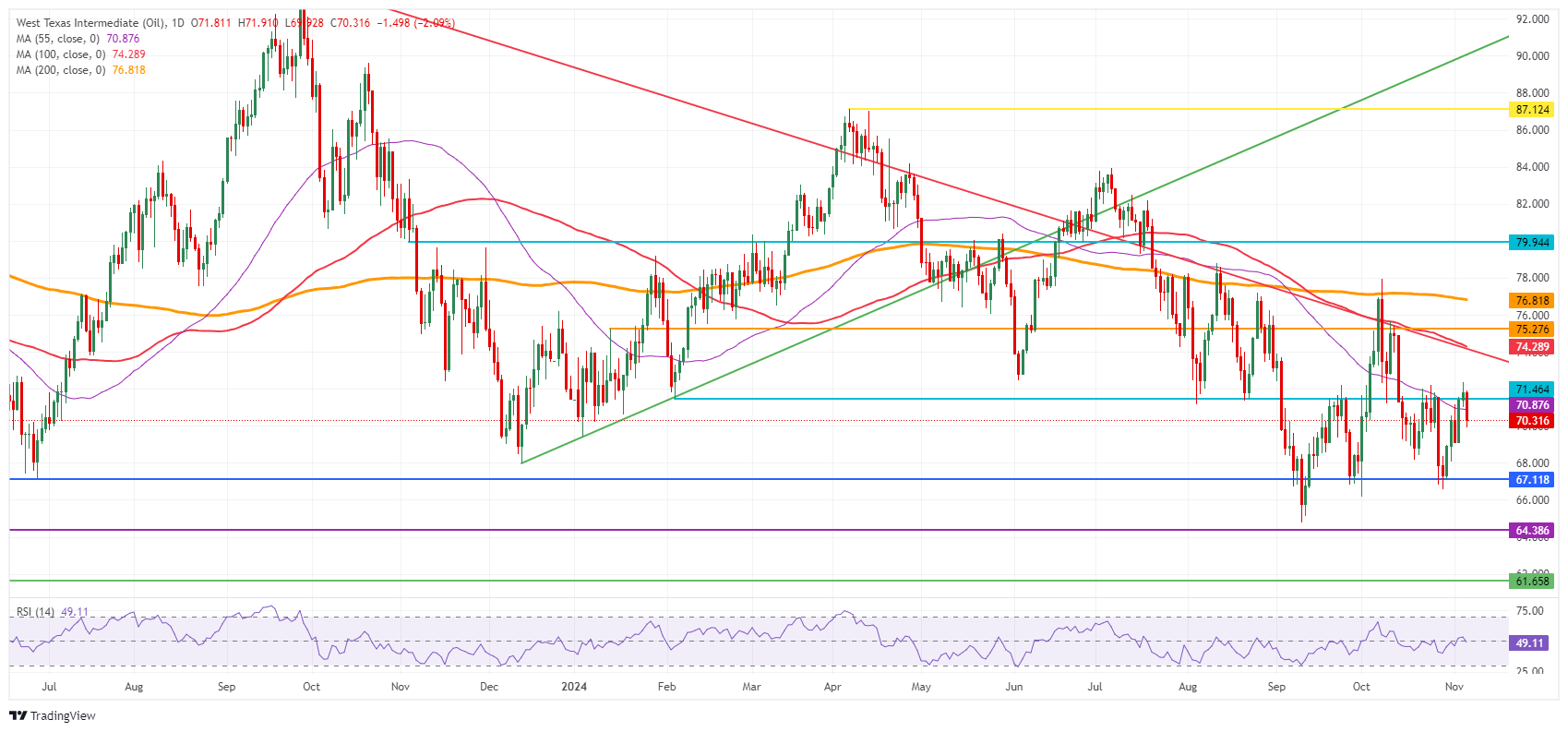
US WTI Crude Oil: Daily Chart
WTI Oil FAQs
WTI Oil is a type of Crude Oil sold on international markets. The WTI stands for West Texas Intermediate, one of three major types including Brent and Dubai Crude. WTI is also referred to as “light” and “sweet” because of its relatively low gravity and sulfur content respectively. It is considered a high quality Oil that is easily refined. It is sourced in the United States and distributed via the Cushing hub, which is considered “The Pipeline Crossroads of the World”. It is a benchmark for the Oil market and WTI price is frequently quoted in the media.
Like all assets, supply and demand are the key drivers of WTI Oil price. As such, global growth can be a driver of increased demand and vice versa for weak global growth. Political instability, wars, and sanctions can disrupt supply and impact prices. The decisions of OPEC, a group of major Oil-producing countries, is another key driver of price. The value of the US Dollar influences the price of WTI Crude Oil, since Oil is predominantly traded in US Dollars, thus a weaker US Dollar can make Oil more affordable and vice versa.
The weekly Oil inventory reports published by the American Petroleum Institute (API) and the Energy Information Agency (EIA) impact the price of WTI Oil. Changes in inventories reflect fluctuating supply and demand. If the data shows a drop in inventories it can indicate increased demand, pushing up Oil price. Higher inventories can reflect increased supply, pushing down prices. API’s report is published every Tuesday and EIA’s the day after. Their results are usually similar, falling within 1% of each other 75% of the time. The EIA data is considered more reliable, since it is a government agency.
OPEC (Organization of the Petroleum Exporting Countries) is a group of 12 Oil-producing nations who collectively decide production quotas for member countries at twice-yearly meetings. Their decisions often impact WTI Oil prices. When OPEC decides to lower quotas, it can tighten supply, pushing up Oil prices. When OPEC increases production, it has the opposite effect. OPEC+ refers to an expanded group that includes ten extra non-OPEC members, the most notable of which is Russia.
Author

Filip Lagaart
FXStreet
Filip Lagaart is a former sales/trader with over 15 years of financial markets expertise under its belt.