|

Copper Price Analysis: Sinks almost 3%, eyeing a fall towards $3.2505 ahead of YTD lows

  • Copper futures are nosediving due to fears of a worldwide economic slowdown, weighed by China’s PMI and other lockdowns in a 21.1 million city.
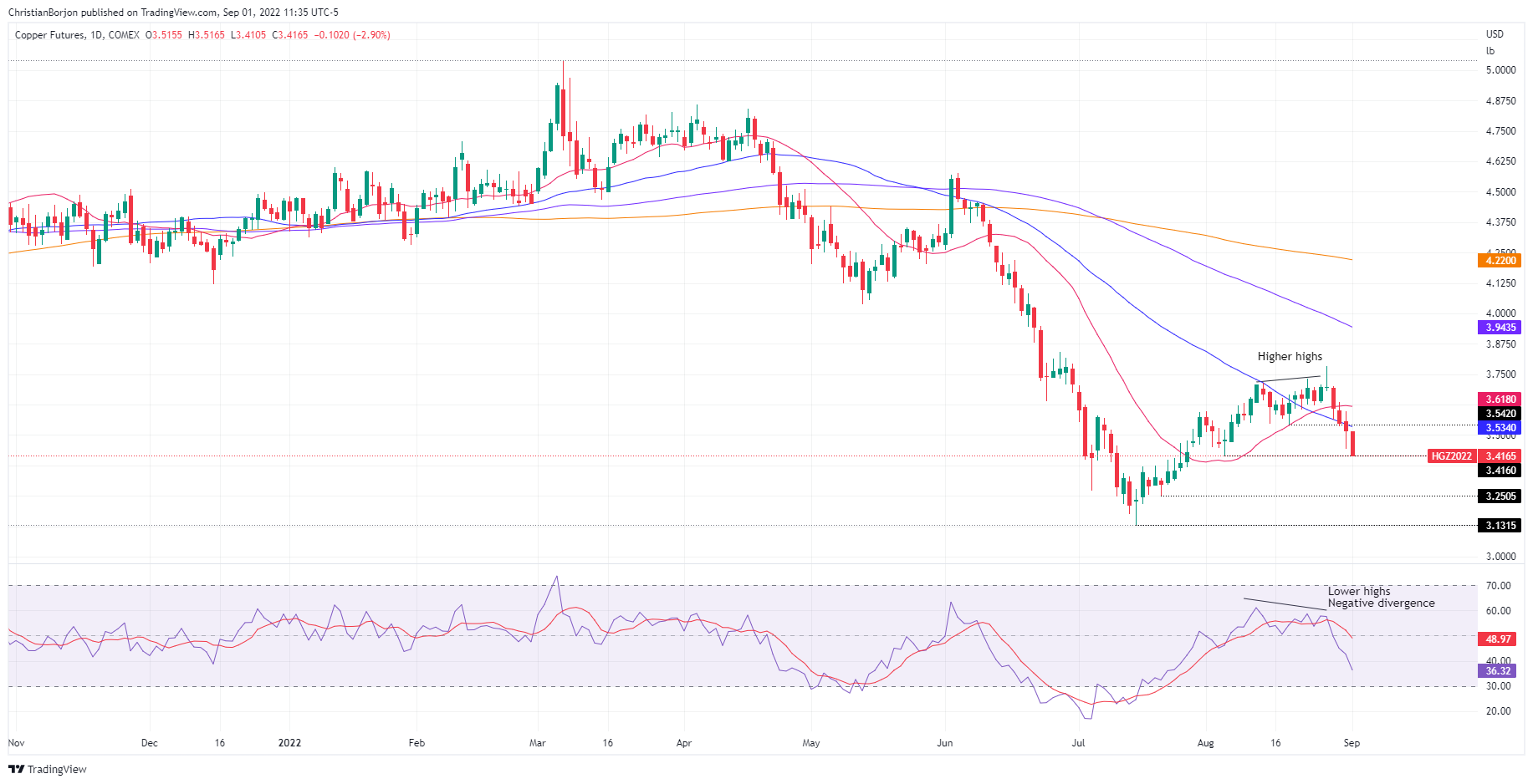
  • Negative divergence in Copper’s daily chart, alongside fundamental, sent prices below the 20 and 50-DMA.

Copper futures are dropping to two-month lows at $3.4165, down almost 3%, on fears that China’s manufacturing activity contracted for the first time in three months, alongside expectations of a US economic deceleration prompted by the US Federal Reserve tightening monetary policy conditions.

Additionally, broad US dollar strength, alongside newswires that China’s Chengdu announced a lockdown of its 21.2 million residents, is a headwind for the red metal.

Also read: Copper drops from two-month highs due to global economic slowdown, speculators’ shorts

Copper Price Analysis: Technical outlook

The Copper daily chart depicts the pair as neutral-to-downward biased. It’s worth noting that the last copper article that I wrote noted that “the Relative Strength Index (RSI) recorded a successive series of lower highs, contrary to price action, meaning that prices are about to edge lower.” Since then, Copper tumbled below the 20 and 50-day EMAs, from around $3.6970. to $3.4105.

If Copper achieves a daily close below the August 4 daily low at 3.4160, it could send the red metal towards the July 21 swing low at $3.2505, followed by the YTD low at $3.1315. On the flip side, if Copper buyers reclaim the 50-day EMA at $3.6340, a re-test of the 20-day EMA at $3.6175 is on the cards.
Author

Christian Borjon Valencia

Markets analyst, news editor, and trading instructor with over 14 years of experience across FX, commodities, US equity indices, and global macro markets.


More from Christian Borjon Valencia
Share:

Editor's Picks

AUD/USD flirts with 0.7000, lowest since early August amid bullish USD

AUD/USD hits a fresh low since early August during the Asian session on Friday and looks vulnerable near 0.7000 after breaking below the 200-day SMA overnight. Against the backdrop of the hawkish Fed, a two-day rally in oil prices revives inflation fears and continues to push US bond yields to multi-year highs. Adding to this, geopolitical risks lift the US Dollar to a two-month high, overshadowing RBA rate hike bets and weighing on the pair.

USD/JPY pulls back from three-week high after failing near 159.00

USD/JPY edges lower during the Asian session on Friday, stalling its recent strong move to a three-week high of 159.00 as Japanese Yen bears turn cautious amid intervention fears. Meanwhile, the US Dollar retains a strong bullish undertone as the Fed's hawkish outlook and oil-driven inflation fears continue to push US bond yields to multi-year peaks. Furthermore, the BoJ's dovish rate hike last week might cap JPY and support spot prices.

Gold eyes worst week in a month amid hawkish Fed outlook

Gold is extending Thursday’s late rebound from the weekly low of $4,244 into Asia on Friday, but remains below $4,300. The bullion is headed for its worst week in four weeks amid a hawkish US Federal Reserve outlook and deepening global bond rout.

Ripple, Cardano, Solana: ETF inflows and whale demand signal further rally
Ripple (XRP), Cardano (ADA), and Solana (SOL) continue to experience a steady recovery with double-digit gains so far this month. Ripple and Solana experience firm institutional demand, while the percentage of ADA supply in profit rises, underpinned by interest from large-wallet investors, commonly referred to as whales.
Treasury yields at 2007 highs

The combination of energy prices rising back above $100 a barrel, US PMI’s topping multi-year indexes and FOMC members taking tough tones when discussing future rate paths have all led Treasuries at both ends of the curve with higher yields. Treasury Notes account for close to 52% of all marketable Treasuries, so movements in yields are especially painful for the US fiscal outlook.

BoJ Recap: Not as hawkish as expected

The Bank of Japan (BoJ) raised its short-term interest-rate target to 1.25% from 1.00% in a 7-2 vote, marking another step in the normalisation of monetary policy and widely matching what everyone has been expecting for weeks.