|

Cisco (CSCO) ended a bearish cycle and it should continue with rally

Cisco Systems, Inc., commonly known as Cisco (CSCO), is an American- based multinational digital communications technology conglomerate corporation headquartered in San Jose, California. Cisco develops, manufactures, and sells networking hardware, software, telecommunications equipment and other high-technology services and products. Cisco specializes in specific tech markets such as: the Internet of Things (IoT), domain security, videoconferencing, and energy management with leading products including Webex, OpenDNS, Jabber, Duo Security, and Jasper.

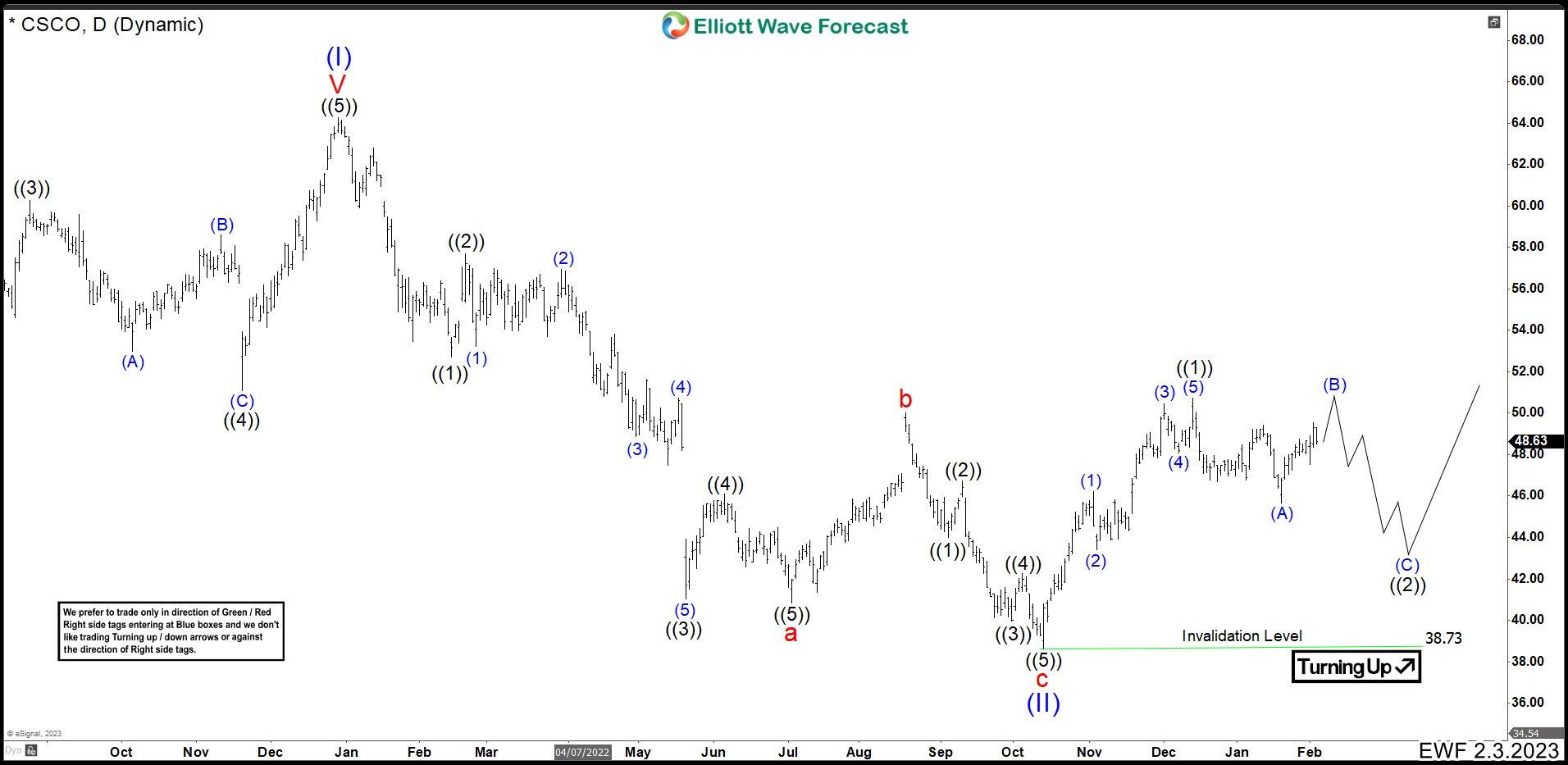
CSCO daily chart February 2023
Chart

At the end of 2021, Cisco finished an impulsive structure at 64.33 which we called wave (I). From this high, CSCO has been down nearly a year. We can see a zig zag 5-3-5 structure. The first bearish impulse ended at 40.81 as wave a. Wave b bounced and ended at 50.05. To complete the corrective structure, we had another push that fell to 38.73 to complete wave c and wave (II). (If you want to learn more about Elliott Wave Theory, please follow these links: Elliott Wave Education and Elliott Wave Theory).

In October 2022, CSCO had a strong bullish reaction even breaking above 50.05. Therefore, this rupture of wave b makes us to think that the cycle that began at the  high of 2021 ended as wave (II). Up from 38.73, we can see 5 waves which ended at 50.74 and we label it as wave ((1)). Here, we see 3 swings down which form wave (A) at 45.65. From this level, CSCO can continue the rally without any problem. However, market conditions should keep the stock lower, so we are calling a flat 3-3-5 correction. The flat correction should end wave ((2)) above 38.73 and continue the bullish move.

Author

Elliott Wave Forecast Team

Elliott Wave Forecast Team

ElliottWave-Forecast.com

More from Elliott Wave Forecast Team
Share:

Editor's Picks

AUD/USD turns lower toward 0.7000 after mixed Australian jobs data

AUD/USD is losing ground toward 0.7000 in the Asian session on Thursday, following the release of the Australian August jobs report, which showed that the Unemployment Rate rose to 4.6% versus 4.5% expected, while Employment Change beat estimates, arriving at 39.5K. Traders also remain unnerved ahead of the critical Trump-Xi meeting.

USD/JPY keeps the red near 158.00 as Japanese Yen firms up

USD/JPY retreats from three-week highs and holds losses near 158.00 in the Asian session on Thursday. Surging Japanese bond yields lift the Yen amid looming intervention risks, while the US Dollar preserves overnight gains to a two-month high amid hawkish Fed bets and elevated US bond yields.

Gold struggles near one-week low as traders await Trump-Xi meeting amid Fed hike bets

Gold sticks to a negative bias for the second straight day, trading below the $4,300 mark or a one-week low during the first half of the European session as traders await a crucial meeting between US President Donald Trump and his Chinese counterpart Xi Jinping. Expectations for a major announcement are low, though market players will look for any progress on rare earths, technology restrictions, and an extension of the current US-China truce.

Bitcoin slips to $84,000 on rate hike bets – Worldcoin, Pepe lead losses
Bitcoin (BTC) price trades below $84,000 on Thursday, extending losses after a 2% decline the previous day. The pullback aligns with renewed inflation and rate-hike concerns, as US composite and services PMIs rose to 58.4 and 58.7 in September. Worldcoin (WLD) and Pepe (PEPE) recorded double-digit losses over the last 24 hours, emerging as the worst performers.
SNB leaves interest rates unchanged at 0%

Swiss National Bank leaves its key policy rates unchanged at 0%, as expected by market particiapnts. The key highlights of SNB’s monetary policy assessment are as followed: Banks' sight deposits held at the SNB will be remunerated at the SNB policy rate up to a certain threshold. SNB sees 2026 inflation at 0.7% (previous forecast was for 0.6%). The main risk to the economic outlook for Switzerland stems from developments in the global economy.

BoJ Recap: Not as hawkish as expected

The Bank of Japan (BoJ) raised its short-term interest-rate target to 1.25% from 1.00% in a 7-2 vote, marking another step in the normalisation of monetary policy and widely matching what everyone has been expecting for weeks.