China Consumer Price Index a touch lower than estimates, AUD eyed for reaction

The Consumer Price Index released by the National Bureau of Statistics of China has been released as follows:
- China January CPI +0.8% from previous month (Reuters poll +0.7%).
- China January CPI +2.1% from a year ago (Reuters poll +2.2%).
AUD/USD update
Despite the Aussie calendar events today, including the Reserve Bank of Australia's hawkish Monetary Policy Statement, AUD/USD is staying around flat for the day so far following the Chinese data.
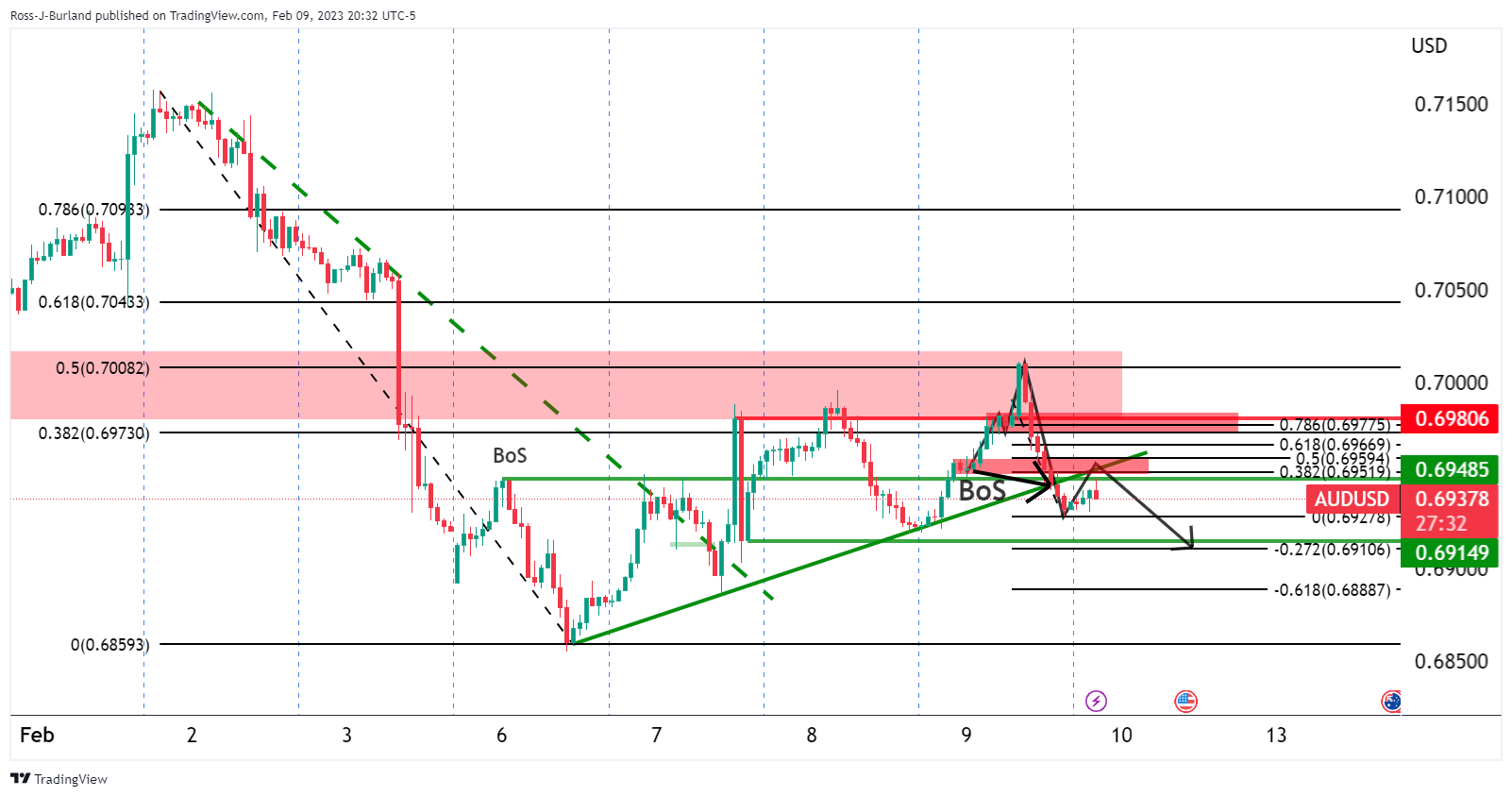
AUD/USD, and currency markets in general, are moving sideways at the start of the new day as the US Dollar stays on the bid near hourly resistance as per the DXY index. This is making for a consolidative environment in forex in general and AUD is stuck in familiar tight short-term ranges. Nevertheless, the Chinese data might be a relief for risk appetite in otherwise cautious market conditions concerned with inflation pressures and inflationary data.
On the data, Reuters reported that ''China's January factory gate prices fell more than economists expected, suggesting that flashes of domestic demand that had stoked consumer prices after the zero-COVID policy ended are not yet strong enough to rekindle upstream sectors.''
Additionally, the Producer Price Index (PPI) was down 0.8% on a year earlier, extending the 0.7% drop the prior month and faster than the 0.5% fall tipped in a Reuters poll.
''Economists expect the cost of living in China will pick up over the coming months, with inflation approaching the target of about 3% that the government set last year,'' Reuters reported.
About the Consumer Price Index
The Consumer Price Index is released by the National Bureau of Statistics of China. It is a measure of retail price variations within a representative basket of goods and services. The result is a comprehensive summary of the results extracted from the urban consumer price index and rural consumer price index. The purchasing power of the CNY is dragged down by inflation.
The CPI is a key indicator to measure inflation and changes in purchasing trends. A substantial consumer price index increase would indicate that inflation has become a destabilizing factor in the economy, potentially prompting The People’s Bank of China to tighten monetary policy and fiscal policy risk. Generally speaking, a high reading is seen as positive (or bullish) for the CNY, while a low reading is seen as negative (or Bearish) for the CNY.
Author

Ross J Burland
FXStreet
Ross J Burland, born in England, UK, is a sportsman at heart. He played Rugby and Judo for his county, Kent and the South East of England Rugby team.
















