Cheap AI is a boon: Here are five companies that can benefit
Key points
-
Cheaper AI will accelerate adoption – New AI models like DeepSeek are making AI more affordable, allowing companies across industries to expand automation, personalization, and efficiency at a faster pace.
-
Winners are already using AI – Companies like Meta, Walmart, Netflix, Salesforce, and Intuitive Surgical have already started to monetize AI, and cheaper models could supercharge their growth by unlocking new capabilities.
-
China’s AI giants are rising – Alibaba, Lenovo, Xiaomi, Baidu, and Tencent are rapidly advancing AI in e-commerce, cloud computing, smart devices, and automation, positioning them as major players in the AI revolution.
AI has already reshaped industries, but until now, cutting-edge models have been expensive and limited to tech giants. That is changing fast. With new AI models like DeepSeek offering performance comparable to OpenAI’s GPT-4 at a fraction of the cost, the barriers to AI adoption are collapsing.
For companies that have already figured out AI, this shift could be transformational. Lower AI costs mean faster innovation, wider adoption, and entirely new ways to scale automation, personalization, and efficiency.
Here are five companies that have already embraced AI and are set to benefit even more as it gets cheaper.
1. Meta Platforms (technology & social media)
Meta has built AI into everything from content recommendations and ad targeting to automated moderation and AI-powered chatbots. With cheaper AI, Meta could accelerate AI-driven experiences in the metaverse, improve virtual assistants, and enhance its generative AI-powered search tools across Facebook, Instagram, and WhatsApp.
2. Walmart (retail & logistics)
Walmart has been one of the biggest retail adopters of AI, using it for inventory management, supply chain logistics, and customer service chatbots. With AI costs dropping, Walmart could push automation even further, enhancing cashier-less checkout, refining real-time demand forecasting, and rolling out more AI-driven personalized shopping experiences.
3. Netflix (entertainment & streaming)
Netflix’s AI-powered recommendation engine has been key to keeping users engaged. As AI becomes more affordable, Netflix could refine personalization further, improve AI-powered dubbing and translations, and even use AI to assist in content production, reducing costs and making its platform even more engaging.
4. Salesforce (business software & CRM)
Salesforce has embedded AI into its platform with Einstein AI, helping businesses automate workflows, predict sales trends, and personalize customer interactions. Cheaper AI could allow Salesforce to expand its AI-driven analytics and automation tools to smaller businesses that previously couldn’t afford them, unlocking a massive new customer base.
5. Intuitive Surgical (healthcare & robotic surgery)
Intuitive Surgical is leading the way in AI-powered robotic surgery with its da Vinci Surgical System. AI helps enhance real-time data analysis during procedures, improve surgical precision, and assist in surgeon training simulations. As AI costs drop, Intuitive Surgical could develop even more advanced real-time analytics, predictive patient outcomes, and smarter robotic assistance, potentially making high-precision surgery more widely available.
China’s AI-powered tech giants are gaining ground
In addition to the above US companies, China’s tech sector is also poised to make major moves as AI becomes cheaper and more accessible. Companies like Alibaba, Lenovo, and Xiaomi have already integrated AI into their products, and lower AI costs could further fuel their expansion.
1. Alibaba (E-commerce & cloud computing)
Alibaba is using AI in multiple areas, from AI-powered product recommendations on its shopping platforms to AI-driven logistics and supply chain optimization. The company’s Alibaba Cloud division is one of the largest cloud providers in China, offering AI-as-a-service to businesses. With cheaper AI, Alibaba could expand these offerings, making AI tools more accessible to millions of companies using its ecosystem.
2. Lenovo (technology & consumer electronics)
Lenovo has been embedding AI across its product lines, from AI-powered PCs to smart assistants. The company’s AI Buddy prototype demonstrates its push into AI-driven user experiences. As AI becomes more affordable, Lenovo could expand these innovations, offering more personalized and efficient devices to consumers and businesses alike.
3. Xiaomi (consumer electronics & smart devices)
Xiaomi is leveraging AI in its smartphones and smart home devices, using intelligent features and automation to enhance user experiences. As AI costs decline, Xiaomi could further develop its AI capabilities, bringing advanced functionalities to a broader range of products—strengthening its position in the global smart device market.
4. Baidu (AI & search engine)
Often referred to as "China's Google," Baidu has been investing heavily in AI, particularly in autonomous driving and generative AI. With lower-cost AI, Baidu could expand its self-driving technology, improve AI-powered search, and deploy advanced AI assistants on a wider scale.
5. Tencent (technology & entertainment)
Tencent, known for its dominance in gaming and social media, has developed multiple versions of its AI model, Hunyuan. One version released in November has shown significant advancements. With decreasing AI costs, Tencent could further integrate AI into its vast ecosystem, enhancing user experiences across its platforms and services.
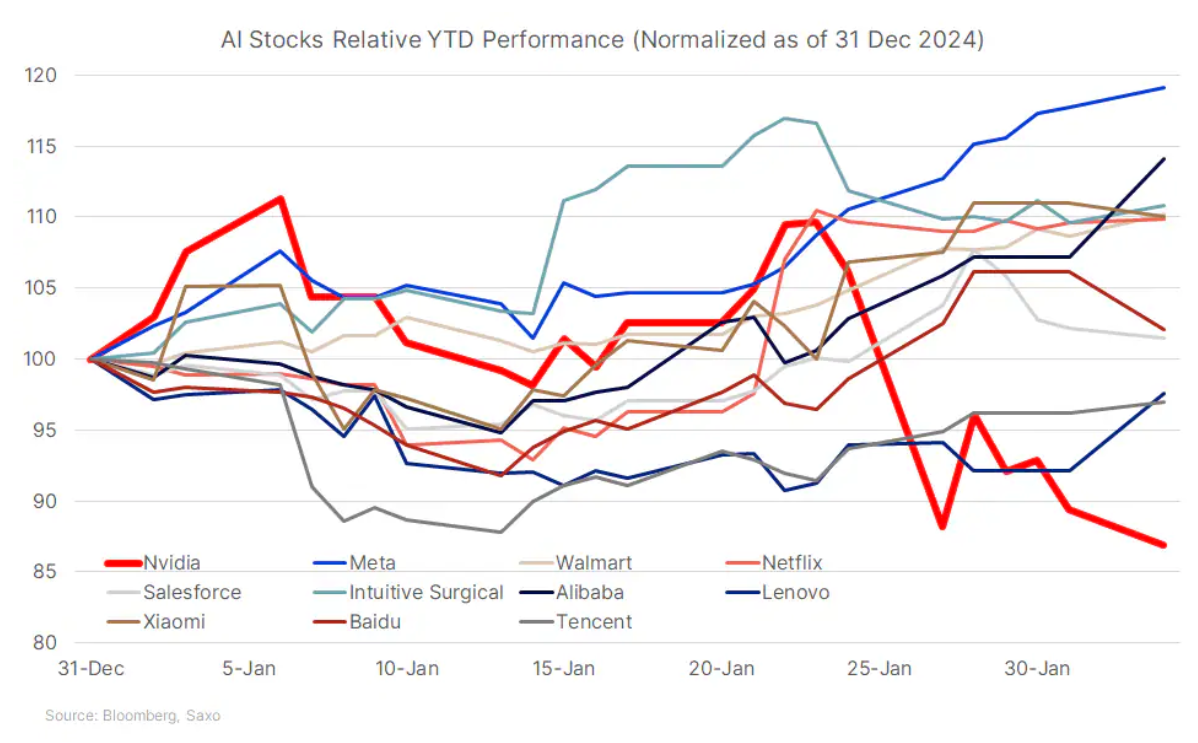
Nvidia has underperformed other AI-related stocks YTD.
Read the original analysis: Cheap AI is a boon: Here are five companies that can benefit
Author

Saxo Research Team
Saxo Bank
Saxo is an award-winning investment firm trusted by 1,200,000+ clients worldwide. Saxo provides the leading online trading platform connecting investors and traders to global financial markets.