Canadian Dollar struggles to end bearish slide on Thursday
- The Canadian Dollar held near steady against the US Dollar on Thursday.
- Loonie markets have struggled to clamp down on bearish flows through November.
- Canadian PMI data did little to support an already-battered Canadian Dollar.

The Canadian Dollar (CAD) continues to hold on the weak side against the US Dollar (USD) on Thursday, finding the brakes enough to slow a near-term one-sided backslide, but not enough to stage a meaningful technical recovery.
Canadian Ivey Purchasing Managers Index (PMI) figures from October did little to support the Canadian Dollar, with the aggregated survey results showing an even sharper decline in month-to-month business operator sentiment than expected. Despite October’s Ivey PMI landing firmly within recent volatility, the sharp downturn is a stark reminder for CAD-focused investors that economic activity north of the 49th parallel remains constrained.
Daily digest market movers: Canadian Dollar struggles against the tide
- The Canadian Dollar slowed its recent declines, but a bullish turnaround is not yet forthcoming.
- The Loonie has lost 1.81% top-to-bottom against the Greenback over the past six straight trading days.
- Canadian Ivey PMI survey results fell to 52.4, an even steeper contraction than the expected fall from 59.8 to 55.2. However, the figure is still well within recent volatility, and mostly serves as a soft reminder that the Canadian economy is struggling to find its feet in the face of steep tariff impacts.
- The US saw one of its worst non-Covid-pandemic Challenger Job Cuts reports ever recorded, showing a net 153K job cuts in October.
- Private data survey tends to be too volatile to share a meaningful correlation with official datasets from one release to the next; however, the steep job cuts figure is still facing additional scrutiny and shaking out investors who are lacking valuable official datasets during the longest US government shutdown in history.
Canadian Dollar price forecast
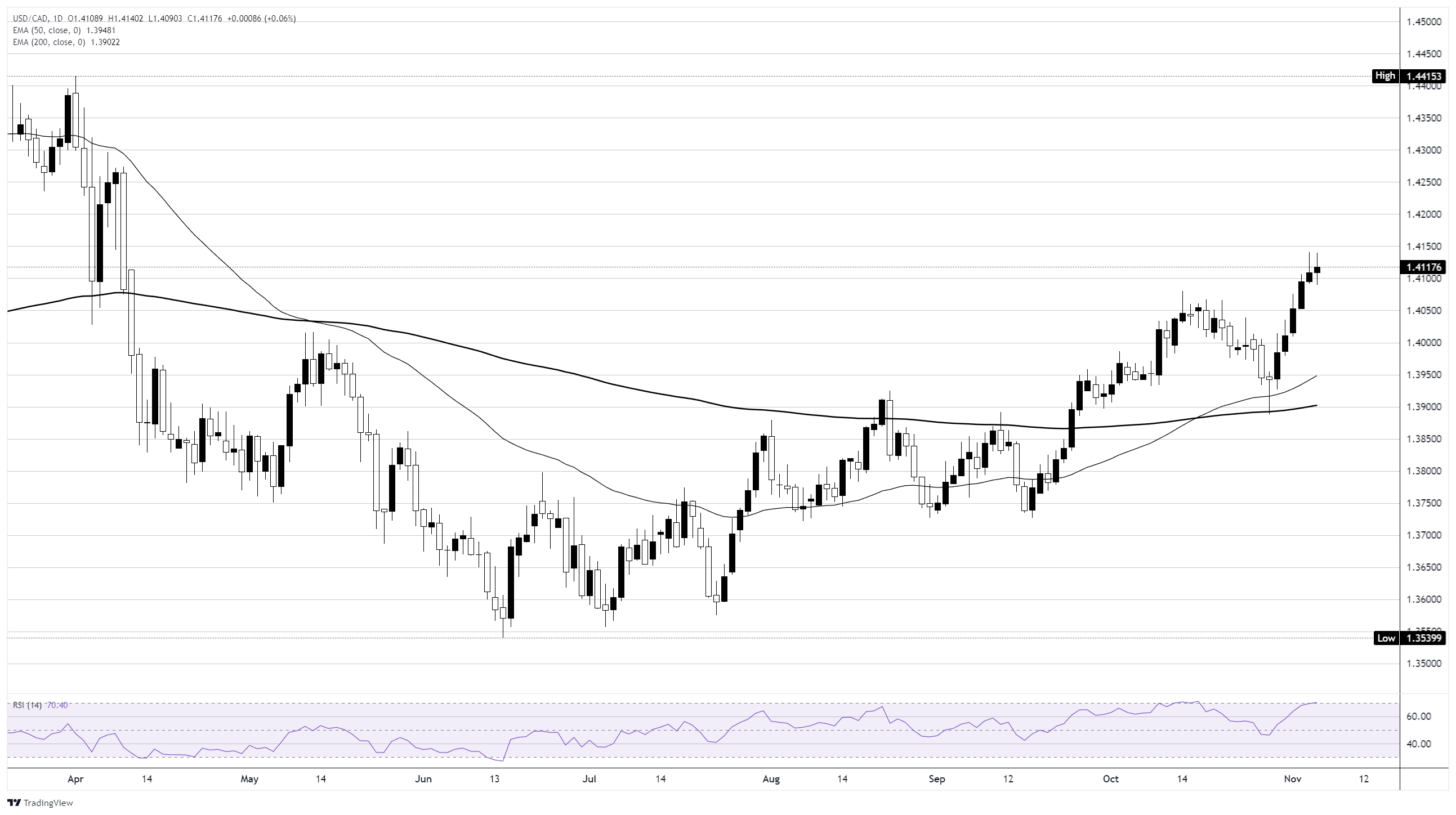
USD/CAD continues its strong advance, closing near 1.4120 after a one-sided bull run following a technical bounce from the 200-day Exponential Moving Average (EMA) near 1.3900. The pair has posted a steady sequence of higher highs and higher lows since late September, reflecting firm U.S. dollar demand against the Canadian dollar.
Momentum is stretched with the daily RSI hovering around 70, signaling overbought conditions that could invite short-term profit-taking. Initial support is seen near 1.4000, followed by 1.3900 at the 200-day EMA. Resistance sits at 1.4150, with the next key high at 1.4415.
Traders are watching whether the pair can hold above the 1.41 area to confirm continued bullish momentum into mid-November.
USD/CAD daily chart
Canadian Dollar FAQs
The key factors driving the Canadian Dollar (CAD) are the level of interest rates set by the Bank of Canada (BoC), the price of Oil, Canada’s largest export, the health of its economy, inflation and the Trade Balance, which is the difference between the value of Canada’s exports versus its imports. Other factors include market sentiment – whether investors are taking on more risky assets (risk-on) or seeking safe-havens (risk-off) – with risk-on being CAD-positive. As its largest trading partner, the health of the US economy is also a key factor influencing the Canadian Dollar.
The Bank of Canada (BoC) has a significant influence on the Canadian Dollar by setting the level of interest rates that banks can lend to one another. This influences the level of interest rates for everyone. The main goal of the BoC is to maintain inflation at 1-3% by adjusting interest rates up or down. Relatively higher interest rates tend to be positive for the CAD. The Bank of Canada can also use quantitative easing and tightening to influence credit conditions, with the former CAD-negative and the latter CAD-positive.
The price of Oil is a key factor impacting the value of the Canadian Dollar. Petroleum is Canada’s biggest export, so Oil price tends to have an immediate impact on the CAD value. Generally, if Oil price rises CAD also goes up, as aggregate demand for the currency increases. The opposite is the case if the price of Oil falls. Higher Oil prices also tend to result in a greater likelihood of a positive Trade Balance, which is also supportive of the CAD.
While inflation had always traditionally been thought of as a negative factor for a currency since it lowers the value of money, the opposite has actually been the case in modern times with the relaxation of cross-border capital controls. Higher inflation tends to lead central banks to put up interest rates which attracts more capital inflows from global investors seeking a lucrative place to keep their money. This increases demand for the local currency, which in Canada’s case is the Canadian Dollar.
Macroeconomic data releases gauge the health of the economy and can have an impact on the Canadian Dollar. Indicators such as GDP, Manufacturing and Services PMIs, employment, and consumer sentiment surveys can all influence the direction of the CAD. A strong economy is good for the Canadian Dollar. Not only does it attract more foreign investment but it may encourage the Bank of Canada to put up interest rates, leading to a stronger currency. If economic data is weak, however, the CAD is likely to fall.
Author

Joshua Gibson
FXStreet
Joshua joins the FXStreet team as an Economics and Finance double major from Vancouver Island University with twelve years' experience as an independent trader focusing on technical analysis.