Canadian Dollar snaps losing streak on volatile NFP Friday
- The Canadian Dollar caught a much-needed boost against the US Dollar on Friday.
- Bearish Loonie flows reversed direction after the US Dollar took a hit post-NFP.
- Souring US jobs data has knocked the Greenback sharply lower.

The Canadian Dollar (CAD) came out on top after a messy US Nonfarm Payrolls (NFP) release shattered global positioning in the US Dollar (USD) on Friday. The Greenback fell across the board after US net job additions fell well short of expectations, with previous months facing sharp downside revisions. The Loonie has pared some losses against the USD, but still remains down sharply for the week.
Canadian Dollar positioning is entirely at the mercy of US-based market positioning and risk sentiment on Friday. US jobs numbers are getting retroactively downgraded as the US labor landscape shifts beneath investors’ feet. The Federal Reserve (Fed) signaled this week that it would need inflation data to remain stable and the US labor market to show signs of weakness. The second of those two flags suddenly materialized on Friday, prompting a sharp rebalancing of Fed rate cut expectations.
Daily digest market movers: Canadian Dollar catches a leg up on Greenback weakness
- The Canadian Dollar saw messy chart action on Friday before catching a rise against a waffling Greenback.
- USD/CAD has been pushed back below 1.3800 following six straight days of USD gains.
- US NFP figures came in below expectations in July, sinking to 73K versus the expected 110K.
- Investor focus was on steep downside revisions to previous NFP releases, with May and June shedding a cumulative 258K in headline revisions as US hiring sours.
- Despite getting his wish for the economic conditions that could spark interest rate cuts from the Fed, President Donald Trump fired the head of the Bureau of Labor Statistics’ labor data department following Friday’s NFP rout.
- According to the CME’s FedWatch Tool, rate traders have pivoted to 80% odds of a rate cut on September 17, up sharply from the 40-45% odds priced in before Friday’s jobs report release.
Canadian Dollar price forecast
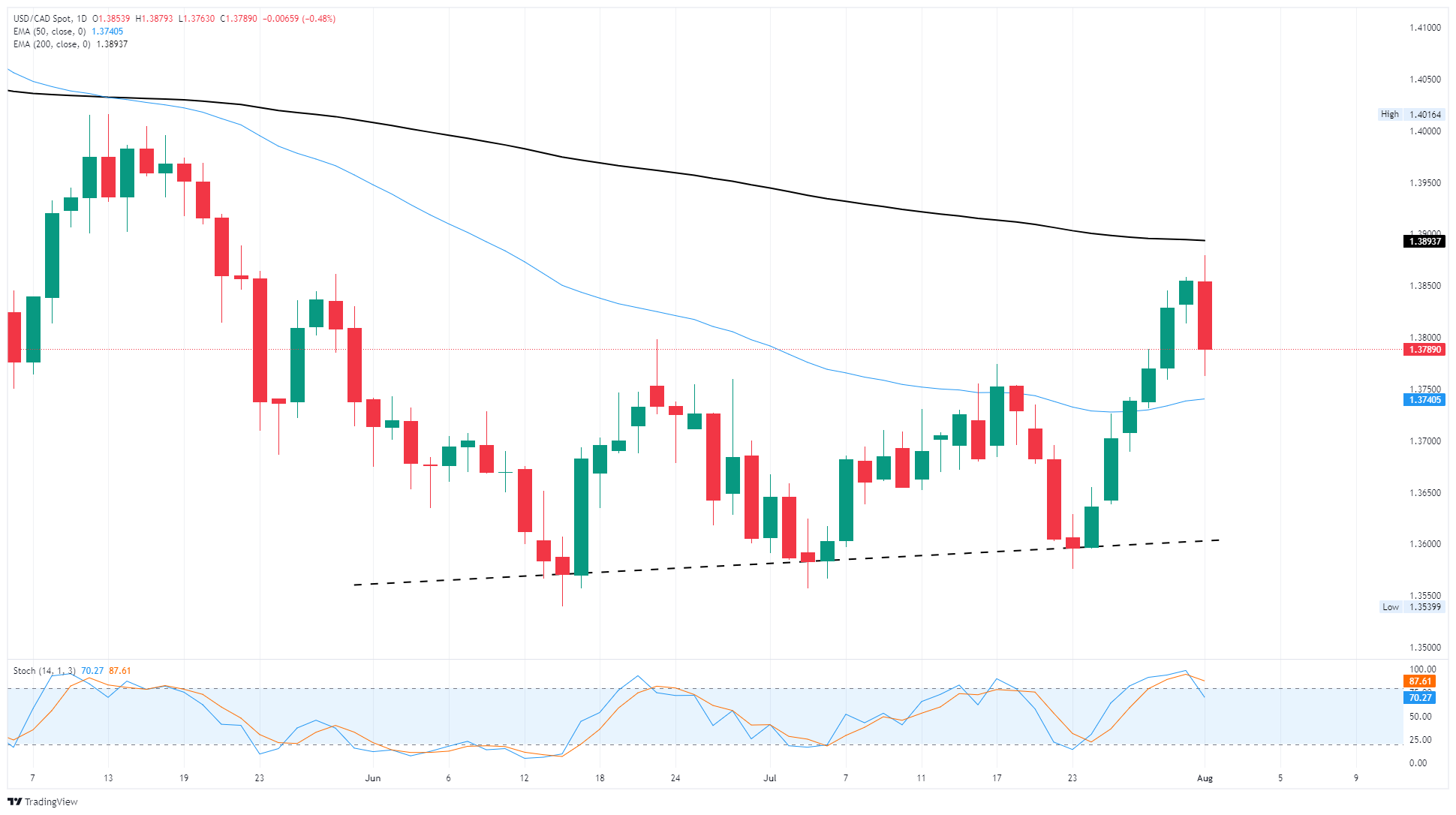
USD/CAD got stuck in a volatility trap on Friday, briefly testing territory north of 1.3850 before taking a sharp step lower. The pair has ended a six-day winning streak for the Greenback, giving the Canadian Dollar a much-needed breather from bearish flows.
The Dollar-Loonie pair is now hamstrung in no-man’s land between the 200-day and 50-day Exponential Moving Averages (EMA), trapped between key technical levels between 1.3900 and 1.3750.
USD/CAD daily chart
Economic Indicator
Nonfarm Payrolls
The Nonfarm Payrolls release presents the number of new jobs created in the US during the previous month in all non-agricultural businesses; it is released by the US Bureau of Labor Statistics (BLS). The monthly changes in payrolls can be extremely volatile. The number is also subject to strong reviews, which can also trigger volatility in the Forex board. Generally speaking, a high reading is seen as bullish for the US Dollar (USD), while a low reading is seen as bearish, although previous months' reviews and the Unemployment Rate are as relevant as the headline figure. The market's reaction, therefore, depends on how the market assesses all the data contained in the BLS report as a whole.
Read more.Last release: Fri Aug 01, 2025 12:30
Frequency: Monthly
Actual: 73K
Consensus: 110K
Previous: 147K
Source: US Bureau of Labor Statistics
America’s monthly jobs report is considered the most important economic indicator for forex traders. Released on the first Friday following the reported month, the change in the number of positions is closely correlated with the overall performance of the economy and is monitored by policymakers. Full employment is one of the Federal Reserve’s mandates and it considers developments in the labor market when setting its policies, thus impacting currencies. Despite several leading indicators shaping estimates, Nonfarm Payrolls tend to surprise markets and trigger substantial volatility. Actual figures beating the consensus tend to be USD bullish.
Canadian Dollar FAQs
The key factors driving the Canadian Dollar (CAD) are the level of interest rates set by the Bank of Canada (BoC), the price of Oil, Canada’s largest export, the health of its economy, inflation and the Trade Balance, which is the difference between the value of Canada’s exports versus its imports. Other factors include market sentiment – whether investors are taking on more risky assets (risk-on) or seeking safe-havens (risk-off) – with risk-on being CAD-positive. As its largest trading partner, the health of the US economy is also a key factor influencing the Canadian Dollar.
The Bank of Canada (BoC) has a significant influence on the Canadian Dollar by setting the level of interest rates that banks can lend to one another. This influences the level of interest rates for everyone. The main goal of the BoC is to maintain inflation at 1-3% by adjusting interest rates up or down. Relatively higher interest rates tend to be positive for the CAD. The Bank of Canada can also use quantitative easing and tightening to influence credit conditions, with the former CAD-negative and the latter CAD-positive.
The price of Oil is a key factor impacting the value of the Canadian Dollar. Petroleum is Canada’s biggest export, so Oil price tends to have an immediate impact on the CAD value. Generally, if Oil price rises CAD also goes up, as aggregate demand for the currency increases. The opposite is the case if the price of Oil falls. Higher Oil prices also tend to result in a greater likelihood of a positive Trade Balance, which is also supportive of the CAD.
While inflation had always traditionally been thought of as a negative factor for a currency since it lowers the value of money, the opposite has actually been the case in modern times with the relaxation of cross-border capital controls. Higher inflation tends to lead central banks to put up interest rates which attracts more capital inflows from global investors seeking a lucrative place to keep their money. This increases demand for the local currency, which in Canada’s case is the Canadian Dollar.
Macroeconomic data releases gauge the health of the economy and can have an impact on the Canadian Dollar. Indicators such as GDP, Manufacturing and Services PMIs, employment, and consumer sentiment surveys can all influence the direction of the CAD. A strong economy is good for the Canadian Dollar. Not only does it attract more foreign investment but it may encourage the Bank of Canada to put up interest rates, leading to a stronger currency. If economic data is weak, however, the CAD is likely to fall.
Author

Joshua Gibson
FXStreet
Joshua joins the FXStreet team as an Economics and Finance double major from Vancouver Island University with twelve years' experience as an independent trader focusing on technical analysis.