Canadian Dollar slips to 2-year low as markets drop the Loonie further
- The Canadian Dollar stumbled into a fresh 25-month low against the Greenback.
- Canada is thinly-represented on the economic calendar this week and next.
- A lack of meaningful Canadian data and a surging US Dollar keep the Loonie pinned.

The Canadian Dollar (CAD) continued to shed weight against the Greenback, testing a fresh 25-month low against the globally-dominant US Dollar as Loonie traders continue to lose interest in the CAD. The economic calendar remains suppressively thin on the Canadian side, and a broad-market rally underpinning the Greenback has bolstered the USD/CAD pair into multi-year highs and inching toward 1.4000.
With Canada mostly absent from the economic data docket this week, Loonie traders will be forced to the sidelines as Greenback flows take over market momentum. Canadian Consumer Price Index (CPI) inflation figures are on the docket for next week, but not until Tuesday.
Daily digest market movers: Canadian Dollar sheds value as Greenback climbs
- The Canadian Dollar is poised to backslide another fifth of a percent against the US Dollar on Tuesday.
- A lack of CAD-centric economic calendar activity this week has the Loonie playing second fiddle to the Greenback.
- The US economic calendar is equally thin on Tuesday, though markets are gearing up for Wednesday’s US Consumer Price Index (CPI) inflation update.
- Headline US CPI is expected to rise to 2.6% YoY from 2.4%, core CPI forecast to hold steady at 3.3% YoY.
- An upswing in US consumer-level inflation could rattle market confidence in one last rate cut from the Federal Reserve (Fed) in 2024.
Canadian Dollar price forecast
The Canadian Dollar (CAD) is poised to return to its losing ways against the US Dollar this week; after snapping a five-week losing streak by closing slightly higher last Friday, weakness has returned to Loonie flows. The Greenback is mounting the steps into a multi-year high, sending the USD/CAD pair into a 25-month peak bid 1.3970.
Despite a brief test into multi-year highs, USD/CAD bidders haven’t yet managed to break free of near-term consolidation as price action waffles near 1.3950. Short interest still has time to collect from here and send the pair into a fresh leg down back toward the 200-day Exponential Moving Average (EMA) near 1.3660.
USD/CAD daily chart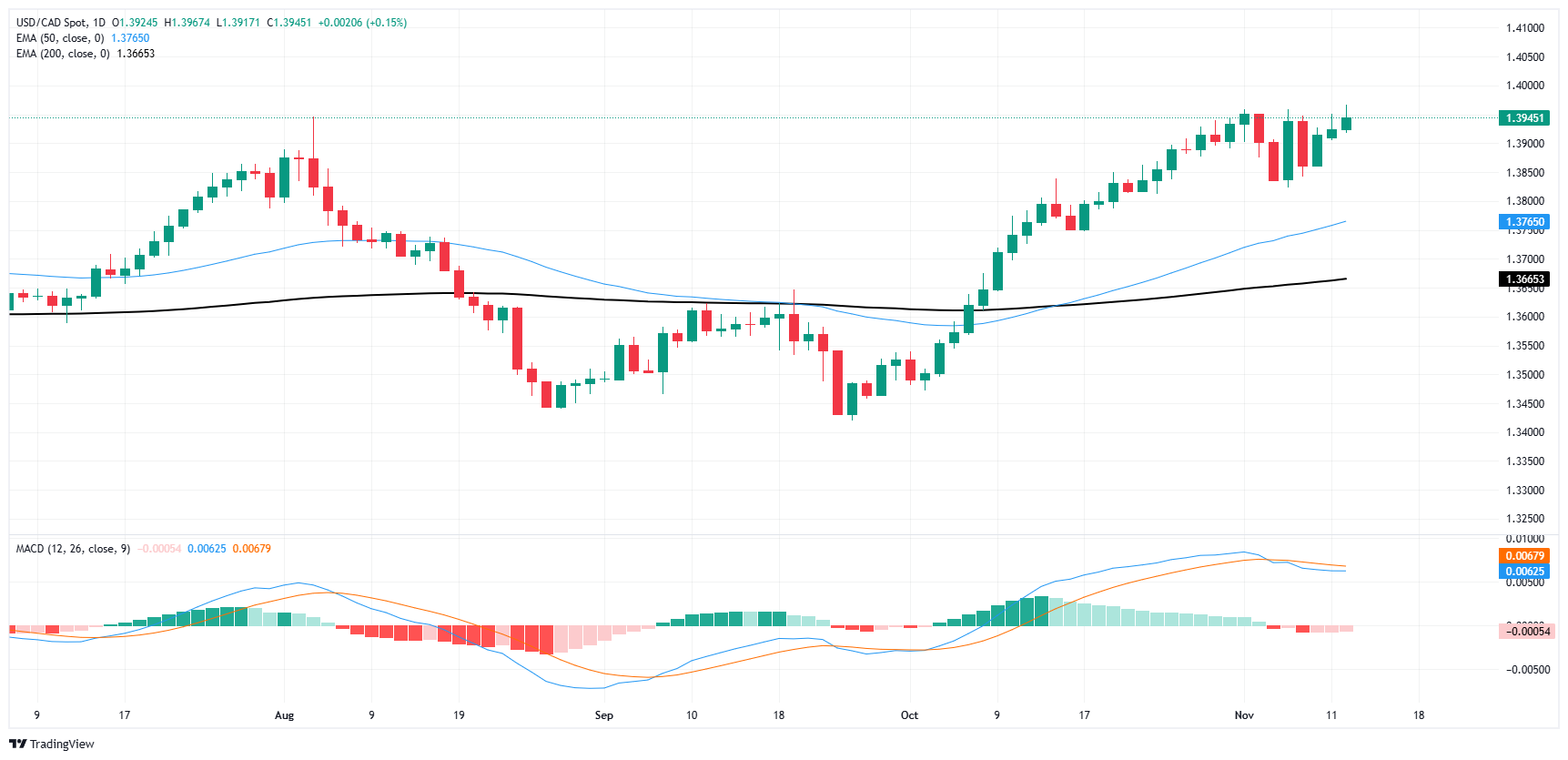
Inflation FAQs
Inflation measures the rise in the price of a representative basket of goods and services. Headline inflation is usually expressed as a percentage change on a month-on-month (MoM) and year-on-year (YoY) basis. Core inflation excludes more volatile elements such as food and fuel which can fluctuate because of geopolitical and seasonal factors. Core inflation is the figure economists focus on and is the level targeted by central banks, which are mandated to keep inflation at a manageable level, usually around 2%.
The Consumer Price Index (CPI) measures the change in prices of a basket of goods and services over a period of time. It is usually expressed as a percentage change on a month-on-month (MoM) and year-on-year (YoY) basis. Core CPI is the figure targeted by central banks as it excludes volatile food and fuel inputs. When Core CPI rises above 2% it usually results in higher interest rates and vice versa when it falls below 2%. Since higher interest rates are positive for a currency, higher inflation usually results in a stronger currency. The opposite is true when inflation falls.
Although it may seem counter-intuitive, high inflation in a country pushes up the value of its currency and vice versa for lower inflation. This is because the central bank will normally raise interest rates to combat the higher inflation, which attract more global capital inflows from investors looking for a lucrative place to park their money.
Formerly, Gold was the asset investors turned to in times of high inflation because it preserved its value, and whilst investors will often still buy Gold for its safe-haven properties in times of extreme market turmoil, this is not the case most of the time. This is because when inflation is high, central banks will put up interest rates to combat it. Higher interest rates are negative for Gold because they increase the opportunity-cost of holding Gold vis-a-vis an interest-bearing asset or placing the money in a cash deposit account. On the flipside, lower inflation tends to be positive for Gold as it brings interest rates down, making the bright metal a more viable investment alternative.
Author

Joshua Gibson
FXStreet
Joshua joins the FXStreet team as an Economics and Finance double major from Vancouver Island University with twelve years' experience as an independent trader focusing on technical analysis.
















