Canadian Dollar remains in steady range on Tuesday
- The Canadian Dollar remained tepid against the Greenback on Tuesday.
- Housing Starts in Canada rose in December, but data impact is low.
- Markets are brushing off the latest tariff tirade from President Trump.


The Canadian Dollar (CAD) continues to hold within it’s medium-term technical range against the US Dollar (USD), keeping the USD/CAD pair pinned near 1.4300 after a firm recovery from multi-decade lows last week. Canadian economic data is thin and strictly low-tier this week, and the market is taking US President Donald Trump’s latest trade wear rhetoric in stride as a full walk back is expected once again.
Canada saw a firm rebound in issued Building Permits in December, reversing a previous cyclical contraction. However the data is back-dated too far to be of any significance, providing only thin support for the Loonie. President Trump’s latest threat to impose a flat 25% tariff on all imported steel and aluminum into the US has been kicked down the road to March 12, leading markets to believe that this is just the next iteration of empty threats that will result in more headlines than actual action on US trade policies.
Daily digest market movers: Canadian Dollar holds steady, markets brush off tariff talk
- The Canadian Dollar traded within one-tenth of one percent of Tuesday’s opening bids against the Greenback.
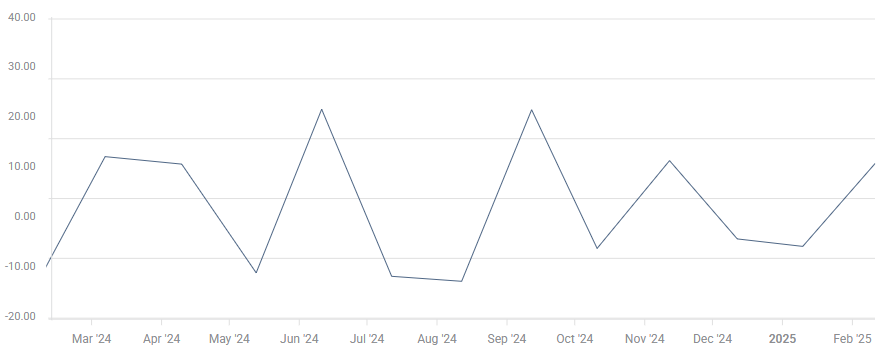
- Canadian Building Permits rebounded to 11.0% in December, up from November's revised -5.6% contraction.
- Investors hoping for signals of incoming rate cuts were likely disappointed by Federal Reserve (Fed) Chair Jerome Powell’s testimony before the US Senate Banking Committee.
- Jerome Powell Testimony Live: Not for the Fed to comment on tariff policy
- President Trump signed executive orders calling for 25% tariffs on steel and aluminum imports starting on March 12, but investors expect another last-minute pivot from the Trump administration.
- Within less than 24 hours, President Trump’s latest tariff issuance has gone from no exemptions and no exclusions to include possible exemptions for Australia and China.
- Global markets will be keeping a close eye on Wednesday’s US Consumer Price Index (CPI) inflation print, which is expected to show US inflation remaining stuck near 2.9% YoY.
Canadian Dollar price forecast
The Canadian Dollar (CAD) remains buried within consolidation against the Greenback. The Loonie briefly fell to its lowest point in two decades against the US Dollar last week, sending USD/CAD to its highest bids since 2002, but a walkback of President Trump’s tariff threats last week crippled any chance of a meaningful shift in the pair’s dynamic.
Near-term price action remains hobbled at the 50-day Exponential Moving Average (EMA) near the 1.4300 handle. Markets are awaiting a reason to risk betting on momentum in either direction, though Loonie bulls will have an eye on the 200-day EMA drifting toward 1.4000.
USD/CAD daily chart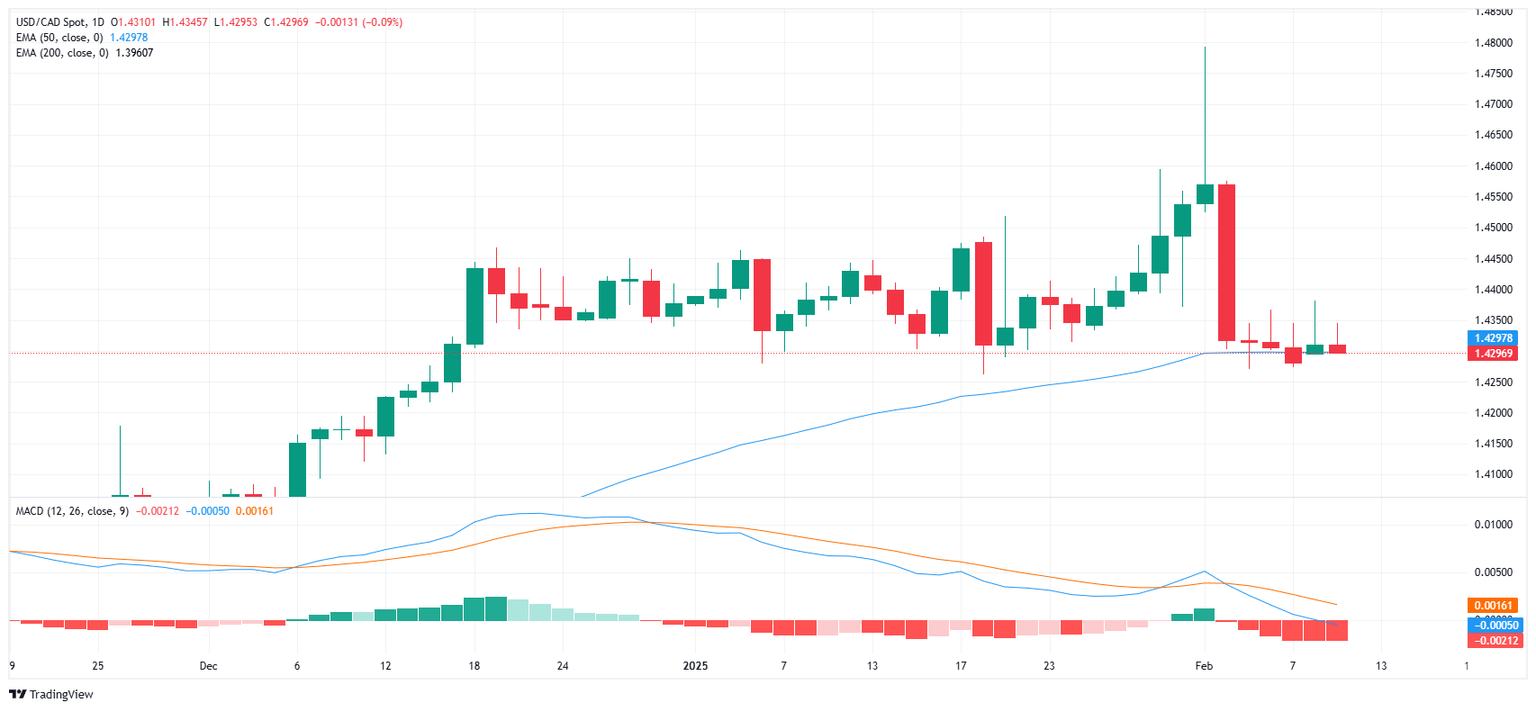
Canadian Dollar FAQs
The key factors driving the Canadian Dollar (CAD) are the level of interest rates set by the Bank of Canada (BoC), the price of Oil, Canada’s largest export, the health of its economy, inflation and the Trade Balance, which is the difference between the value of Canada’s exports versus its imports. Other factors include market sentiment – whether investors are taking on more risky assets (risk-on) or seeking safe-havens (risk-off) – with risk-on being CAD-positive. As its largest trading partner, the health of the US economy is also a key factor influencing the Canadian Dollar.
The Bank of Canada (BoC) has a significant influence on the Canadian Dollar by setting the level of interest rates that banks can lend to one another. This influences the level of interest rates for everyone. The main goal of the BoC is to maintain inflation at 1-3% by adjusting interest rates up or down. Relatively higher interest rates tend to be positive for the CAD. The Bank of Canada can also use quantitative easing and tightening to influence credit conditions, with the former CAD-negative and the latter CAD-positive.
The price of Oil is a key factor impacting the value of the Canadian Dollar. Petroleum is Canada’s biggest export, so Oil price tends to have an immediate impact on the CAD value. Generally, if Oil price rises CAD also goes up, as aggregate demand for the currency increases. The opposite is the case if the price of Oil falls. Higher Oil prices also tend to result in a greater likelihood of a positive Trade Balance, which is also supportive of the CAD.
While inflation had always traditionally been thought of as a negative factor for a currency since it lowers the value of money, the opposite has actually been the case in modern times with the relaxation of cross-border capital controls. Higher inflation tends to lead central banks to put up interest rates which attracts more capital inflows from global investors seeking a lucrative place to keep their money. This increases demand for the local currency, which in Canada’s case is the Canadian Dollar.
Macroeconomic data releases gauge the health of the economy and can have an impact on the Canadian Dollar. Indicators such as GDP, Manufacturing and Services PMIs, employment, and consumer sentiment surveys can all influence the direction of the CAD. A strong economy is good for the Canadian Dollar. Not only does it attract more foreign investment but it may encourage the Bank of Canada to put up interest rates, leading to a stronger currency. If economic data is weak, however, the CAD is likely to fall.
Author
Joshua Gibson
FXStreet
Joshua joins the FXStreet team as an Economics and Finance double major from Vancouver Island University with twelve years' experience as an independent trader focusing on technical analysis.