Canadian Dollar makes fresh headway following another Fed rate cut
- The Canadian Dollar climbed 0.4% against the US Dollar on Wednesday.
- The Loonie is hitting its stride against a weakening Greenback, testing 11-week highs.
- A third straight Fed rate cut plus no rate moves from the BoC bolstered the Canadian Dollar.
The Canadian Dollar (CAD) found fresh 11-week highs against the US Dollar (USD) on Wednesday. The Bank of Canada (BoC) held interest rates steady, while the Federal Reserve (Fed) delivered its third straight interest rate cut, propping up the Loonie and sending the Greenback lower.
The BoC held rates flat once again, with BoC Governor Tiff Macklem reiterating patience-based rhetoric that pushed back on market expectations for possible interest rate cuts in the future. Despite markets clamoring for cheaper funding costs through lower interest rates, the BoC remains leery of dropping interest rates any further.
The Fed delivered a third straight interest rate cut, giving investors what they wanted, however Fed Chair Jerome Powell cautioned against expectations for further rate moves in the near term, with the Federal Open Market Committee (FOMC) broadly seeing room for only 50 basis points in further rate reductions across 2026 and 2027.
Daily digest market movers: Canadian Dollar climbs on Fed rate cuts
- The Canadian Dollar’s midweek gains pushed the USD/CAD pair into an eleven-week low, testing below 1.3800 for the first time since September.
- The BoC held interest rates at 2.25%, while the Fed eased its policy rate band to 3.75-4.00%.
- The Fed also announced an uptick in Quantitative Easing (QE) programs including bond purchasing.
- The BoC’s stubborn rate announcement comes the week before key Canadian Consumer Price Index (CPI) inflation figures are due. Next Monday, Loonie traders will get to see how right the BoC was to keep rates on hold.
- Despite a third straight interest rate cut, Fed Chair Jerome Powell cautioned markets against hoping for any further extreme moves from the Fed, at least as long as he’s still the Chair, which ends early next year.
Canadian Dollar price forecast
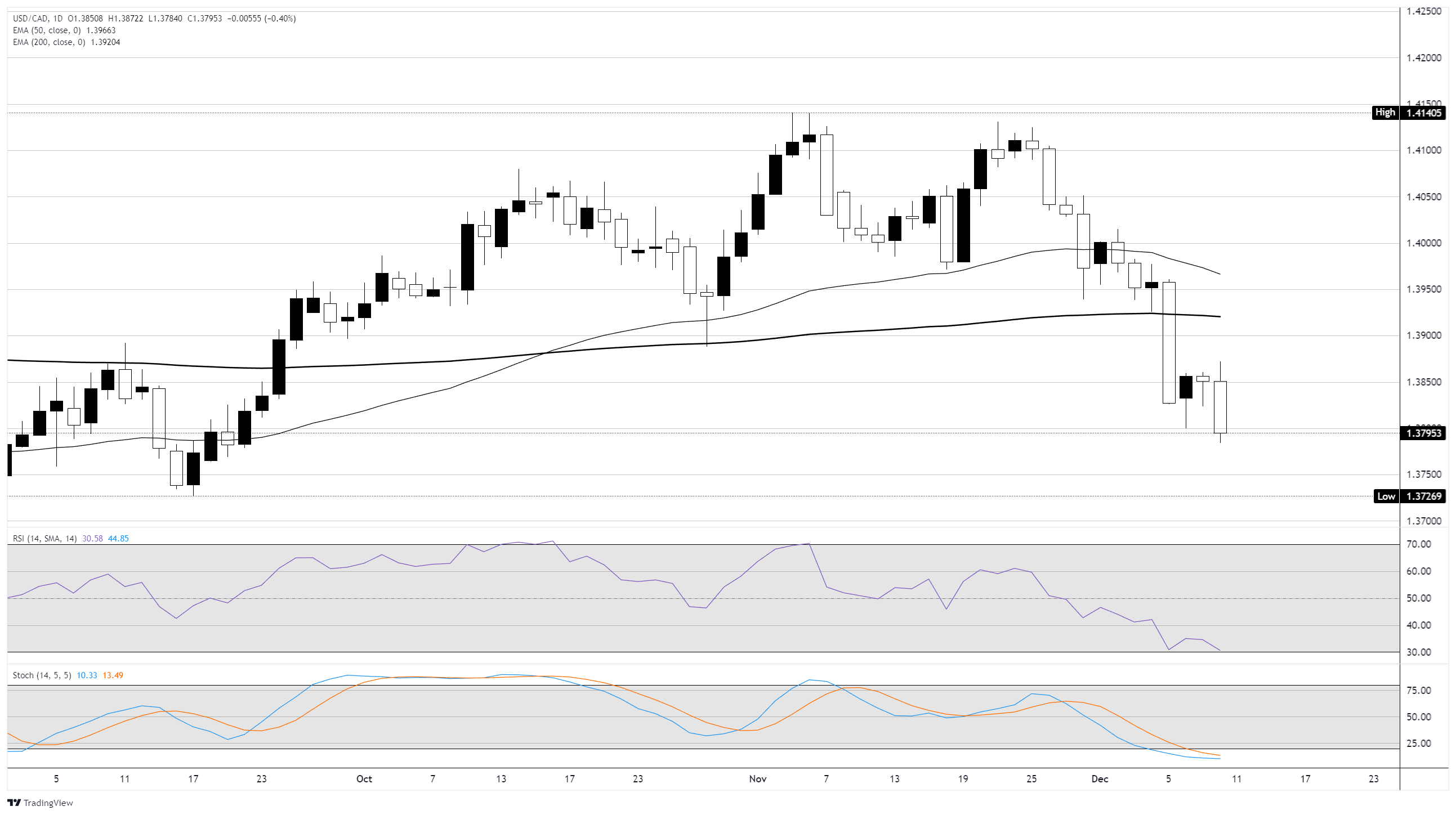
From the momentum perspective, USD/CAD is showing clear downside pressure. Price has broken below both the 50-day and 200-day EMAs, and the recent candles indicate strong bearish follow-through after the rejection near the 1.41 resistance zone. Momentum indicators support this shift: RSI has fallen into the mid-40s and continues trending lower, signaling weakening bullish strength, while Stochastics sits near oversold levels but has not yet shown a decisive bullish crossover. This combination typically reflects a market where sellers remain in control, even if short-term bounces occur.
The next key level visible on the chart is the support zone around 1.379–1.372, highlighted by the recent low and historical price reactions. A sustained break below that range would signal continued trend weakness, while a stabilization above it—paired with a momentum reversal on RSI or Stochastics—would hint at potential consolidation rather than a full trend shift. For now, momentum remains tilted to the downside, and traders often watch for whether oversold indicators start firming up or whether price continues to accelerate lower.
USD/CAD daily chart
Canadian Dollar FAQs
The key factors driving the Canadian Dollar (CAD) are the level of interest rates set by the Bank of Canada (BoC), the price of Oil, Canada’s largest export, the health of its economy, inflation and the Trade Balance, which is the difference between the value of Canada’s exports versus its imports. Other factors include market sentiment – whether investors are taking on more risky assets (risk-on) or seeking safe-havens (risk-off) – with risk-on being CAD-positive. As its largest trading partner, the health of the US economy is also a key factor influencing the Canadian Dollar.
The Bank of Canada (BoC) has a significant influence on the Canadian Dollar by setting the level of interest rates that banks can lend to one another. This influences the level of interest rates for everyone. The main goal of the BoC is to maintain inflation at 1-3% by adjusting interest rates up or down. Relatively higher interest rates tend to be positive for the CAD. The Bank of Canada can also use quantitative easing and tightening to influence credit conditions, with the former CAD-negative and the latter CAD-positive.
The price of Oil is a key factor impacting the value of the Canadian Dollar. Petroleum is Canada’s biggest export, so Oil price tends to have an immediate impact on the CAD value. Generally, if Oil price rises CAD also goes up, as aggregate demand for the currency increases. The opposite is the case if the price of Oil falls. Higher Oil prices also tend to result in a greater likelihood of a positive Trade Balance, which is also supportive of the CAD.
While inflation had always traditionally been thought of as a negative factor for a currency since it lowers the value of money, the opposite has actually been the case in modern times with the relaxation of cross-border capital controls. Higher inflation tends to lead central banks to put up interest rates which attracts more capital inflows from global investors seeking a lucrative place to keep their money. This increases demand for the local currency, which in Canada’s case is the Canadian Dollar.
Macroeconomic data releases gauge the health of the economy and can have an impact on the Canadian Dollar. Indicators such as GDP, Manufacturing and Services PMIs, employment, and consumer sentiment surveys can all influence the direction of the CAD. A strong economy is good for the Canadian Dollar. Not only does it attract more foreign investment but it may encourage the Bank of Canada to put up interest rates, leading to a stronger currency. If economic data is weak, however, the CAD is likely to fall.
Author

Joshua Gibson
FXStreet
Joshua joins the FXStreet team as an Economics and Finance double major from Vancouver Island University with twelve years' experience as an independent trader focusing on technical analysis.