Canadian Dollar hits two-decade low as tariff battle heats up
- The Canadian Dollar dipped to its lowest value in over two decades.
- Canada immediately hit back against Trump’s import tariffs with their own export tariffs.
- Markets have moderated Loonie selling, but the CAD remains at multi-year lows.

The Canadian Dollar (CAD) plummeted to its lowest bids against the US Dollar (USD) in 21 years at the outset of the trading week after the US and Canada went tit-for-tat on trade tariffs that will pulverize key aspects of both economies. Overall market sentiment recovered ground after Mexico was able to negotiate a one-month ceasefire on US tariffs targeting goods imported from Mexico, but the Loonie is still testing its lowest bids since 2020.
The US imposed a flat 25% import tariff on all goods crossing the border from Canada over the weekend, though US President Donald Trump caved on pressure to reduce tariffs on Canadian-sourced Crude Oil to 10%. Canada immediately responded with their own export taxes on goods and energy sold to the US, daring President Trump to follow through with his threat to double import fees on Canadian goods if Canada retaliated against his tariffs. According to some analysts, the tit-for-tat trade spat between the US and Canada could add another 0.7% to underlying core demand-led inflation in the US.
Daily digest market movers: Trade war 2.0 underway as US bills its own businesses
- The Canadian Dollar hit 1.4800 against the US Dollar for the first time in over two decades.
- Markets have recovered their footing, but USD/CAD is still testing into pandemic highs as market sentiment keeps the Greenback bid.
- A one-month reprieve on the US’ tariffs on Mexico has been granted as Mexican President Claudia Sheinbaum agrees to trade negotiations with President Trump’s cavalcade of appointees with very important jobs but little practical experience. Canada opted to retaliate with export fees on the exact same goods that the US will be charging import taxes on.
- President Trump promised to double tariffs if either Canada or Mexico retaliated.
- Donald Trump’s tariffs are broadly expected to crunch the Canadian economy, as well as contribute to targeted joblessness within the US and contribute meaningfully to core US inflation metrics.
- Jumpstarting inflation and a possible rise in US Crude Oil costs is a poor way to get rate cuts from the Federal Reserve (Fed).
Canadian Dollar price forecast
The Canadian Dollar came within a stone’s throw of 1.4800 against the US Dollar early Monday before markets were able to pump the brakes. The Loonie has recovered some footing after falling to 21-year lows, in tandem with a slight easing in the Greenback.
USD/CAD is still trading into almost five-year highs near the 1.4600 handle as the Greenback accelerates into a sixth straight gaining session against the Loonie. USD/CAD has risen over 10% bottom-to-top from its low of 1.3420 last September.
USD/CAD daily chart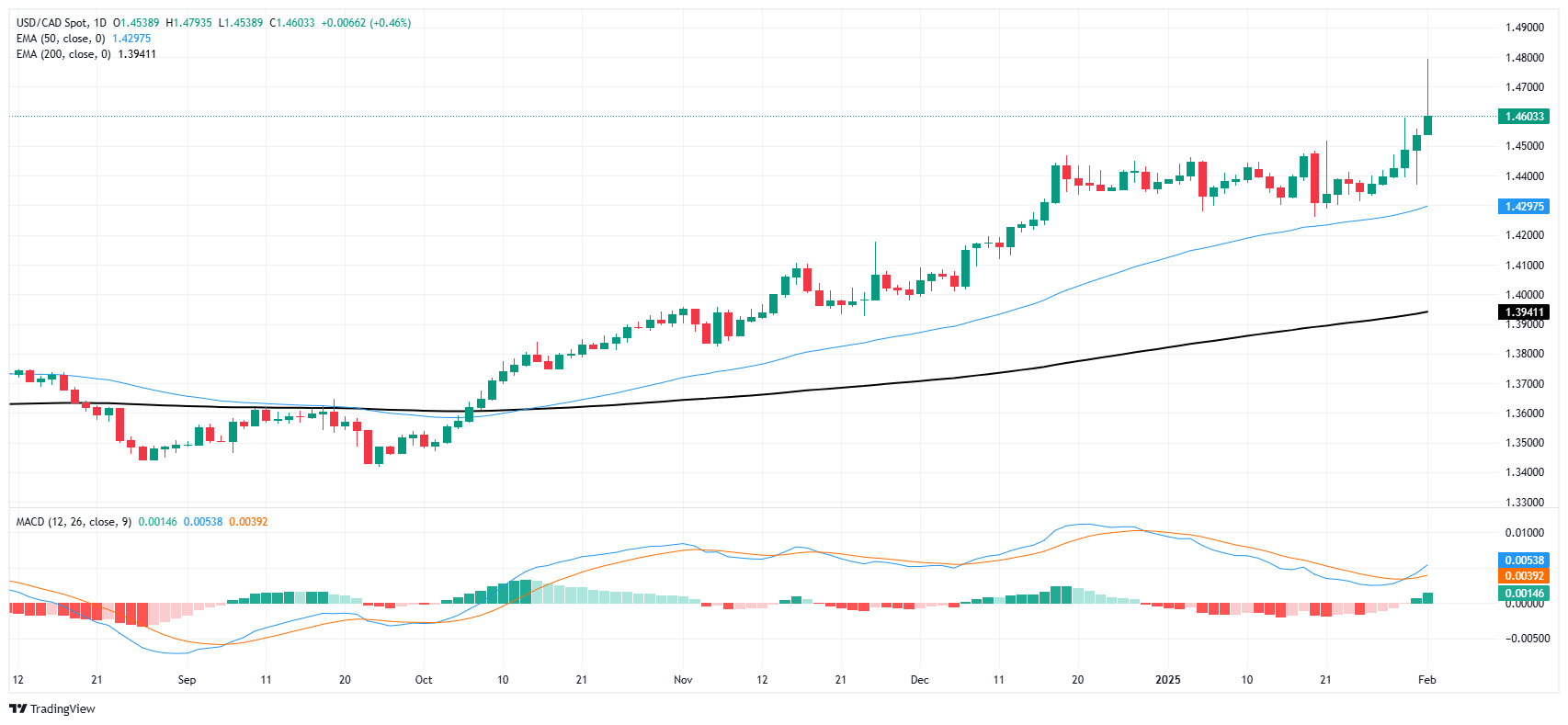
Tariffs FAQs
Tariffs are customs duties levied on certain merchandise imports or a category of products. Tariffs are designed to help local producers and manufacturers be more competitive in the market by providing a price advantage over similar goods that can be imported. Tariffs are widely used as tools of protectionism, along with trade barriers and import quotas.
Although tariffs and taxes both generate government revenue to fund public goods and services, they have several distinctions. Tariffs are prepaid at the port of entry, while taxes are paid at the time of purchase. Taxes are imposed on individual taxpayers and businesses, while tariffs are paid by importers.
There are two schools of thought among economists regarding the usage of tariffs. While some argue that tariffs are necessary to protect domestic industries and address trade imbalances, others see them as a harmful tool that could potentially drive prices higher over the long term and lead to a damaging trade war by encouraging tit-for-tat tariffs.
During the run-up to the presidential election in November 2024, Donald Trump made it clear that he intends to use tariffs to support the US economy and American producers. In 2024, Mexico, China and Canada accounted for 42% of total US imports. In this period, Mexico stood out as the top exporter with $466.6 billion, according to the US Census Bureau. Hence, Trump wants to focus on these three nations when imposing tariffs. He also plans to use the revenue generated through tariffs to lower personal income taxes.
Author

Joshua Gibson
FXStreet
Joshua joins the FXStreet team as an Economics and Finance double major from Vancouver Island University with twelve years' experience as an independent trader focusing on technical analysis.