Canadian Dollar gains further ground as market flows continue to reverse
- The Canadian Dollar gained another 0.66% on Friday.
- Market flows are reversing out of the Greenback, pushing Loonie bids higher.
- BoC rate call due next week, markets wait to see if BoC will continue to deliver last-minute rate cuts.
The Canadian Dollar (CAD) rose on Friday, jumping two-thirds of a percent against the US Dollar as global market flows continue to reverse out of the safe haven Greenback. Trade war pressures have been relieved somewhat after the Trump administration pivoted away from its own lopsided “reciprocal” tariffs following a last-minute 90-day delay, opting for a 10% across-the-board replacement tariff. Coupled with 145% import fees on all goods from China, trade war tensions will keep investors with one eye on geopolitical headlines for the foreseeable future.
The Bank of Canada (BoC) is set to deliver its latest rate call next week, and key Canadian Consumer Price Index (CPI) inflation figures are also due next Tuesday. The pressure is on for the BoC as markets await to see if they will hold off on rate changes for the time being after a long-run series of rate cuts, or if BoC Governor Tiff Macklem will try to squeeze one more rate slash in before economic impacts from US tariffs begin to take hold on the Canadian economy.
Daily digest market movers: Canadian Dollar climbs on Greenback weakness
- The Canadian Dollar rose to a 22-week high against the US Dollar on Friday.
- Tariff and trade war tensions remain elevated, but markets continue to tilt back into risk appetite regardless.
- Key US data showed a further decline in US Producer Price Index (PPI) inflation in March, but tariffs could cut that progress short.
- US consumer sentiment figures have also collapsed, and US consumers also expect both near-term and long-term inflation to soar, also thanks to tariffs.
- Canadian CPI inflation is due next Tuesday, which could inform the BoC’s next rate call, slated for next Wednesday.
Canadian Dollar price forecast
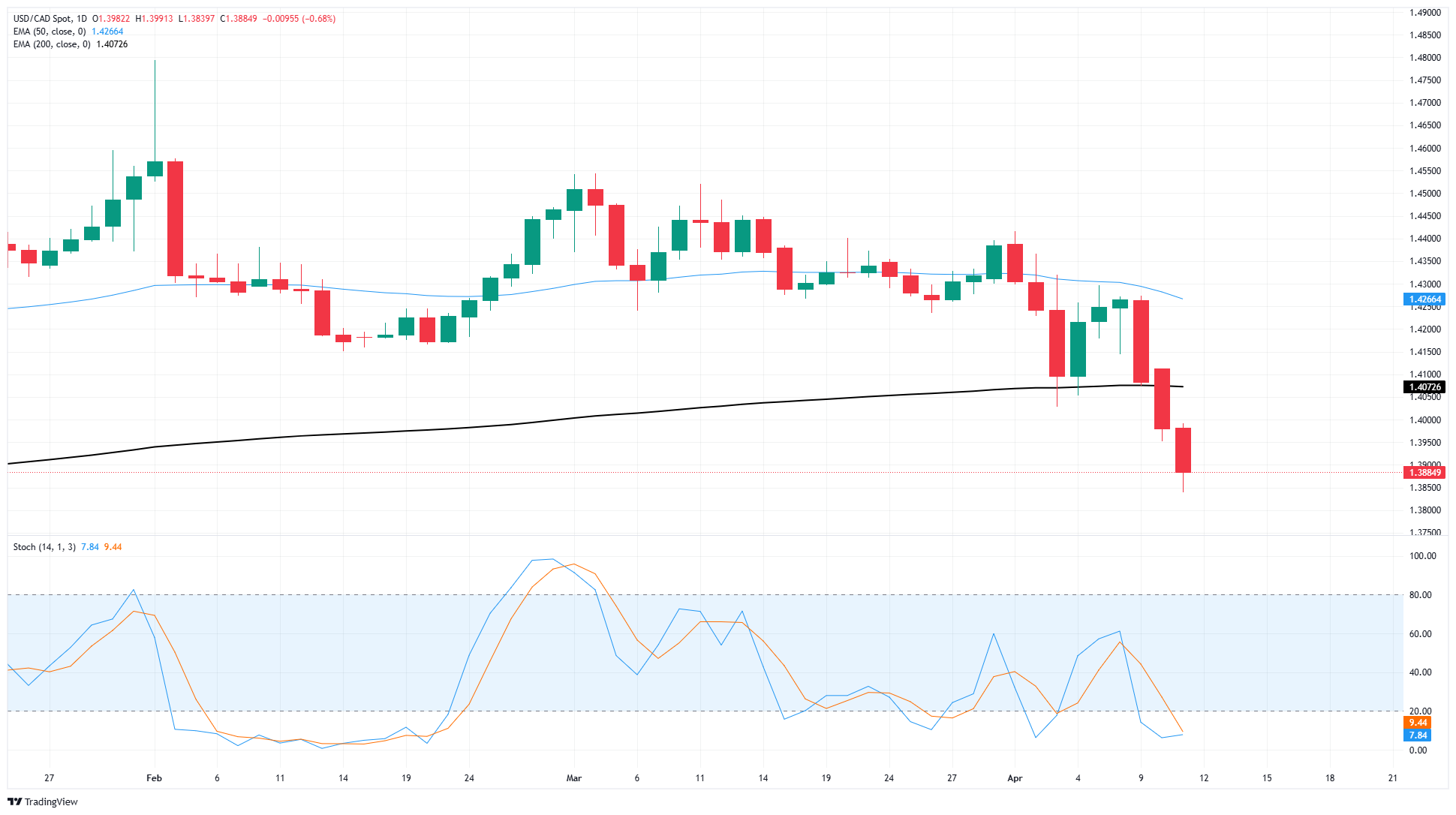
The Canadian Dollar’s 0.66% gain on Friday has dragged USD/CAD to a weekly loss of 2.3%, and accelerated the pair into its fifth-straight week-on-week loss as the Loonie gets bolstered by a general weakening in Greenback market demand. USD/CAD has smashed through the 200-day Exponential Moving Average (EMA) at 1.4072, putting the pair on pace for extended declines.
On the bullish side, technical oscillators are flashing oversold warning signs on USD/CAD as the pair explores multi-month lows below the 1.3900 handle. Near-term price action is at risk of running aground on old technical swing points priced in between 1.3800 and 1.3900 through the two middle quarters of 2024.
USD/CAD daily chart
Canadian Dollar FAQs
The key factors driving the Canadian Dollar (CAD) are the level of interest rates set by the Bank of Canada (BoC), the price of Oil, Canada’s largest export, the health of its economy, inflation and the Trade Balance, which is the difference between the value of Canada’s exports versus its imports. Other factors include market sentiment – whether investors are taking on more risky assets (risk-on) or seeking safe-havens (risk-off) – with risk-on being CAD-positive. As its largest trading partner, the health of the US economy is also a key factor influencing the Canadian Dollar.
The Bank of Canada (BoC) has a significant influence on the Canadian Dollar by setting the level of interest rates that banks can lend to one another. This influences the level of interest rates for everyone. The main goal of the BoC is to maintain inflation at 1-3% by adjusting interest rates up or down. Relatively higher interest rates tend to be positive for the CAD. The Bank of Canada can also use quantitative easing and tightening to influence credit conditions, with the former CAD-negative and the latter CAD-positive.
The price of Oil is a key factor impacting the value of the Canadian Dollar. Petroleum is Canada’s biggest export, so Oil price tends to have an immediate impact on the CAD value. Generally, if Oil price rises CAD also goes up, as aggregate demand for the currency increases. The opposite is the case if the price of Oil falls. Higher Oil prices also tend to result in a greater likelihood of a positive Trade Balance, which is also supportive of the CAD.
While inflation had always traditionally been thought of as a negative factor for a currency since it lowers the value of money, the opposite has actually been the case in modern times with the relaxation of cross-border capital controls. Higher inflation tends to lead central banks to put up interest rates which attracts more capital inflows from global investors seeking a lucrative place to keep their money. This increases demand for the local currency, which in Canada’s case is the Canadian Dollar.
Macroeconomic data releases gauge the health of the economy and can have an impact on the Canadian Dollar. Indicators such as GDP, Manufacturing and Services PMIs, employment, and consumer sentiment surveys can all influence the direction of the CAD. A strong economy is good for the Canadian Dollar. Not only does it attract more foreign investment but it may encourage the Bank of Canada to put up interest rates, leading to a stronger currency. If economic data is weak, however, the CAD is likely to fall.
Author

Joshua Gibson
FXStreet
Joshua joins the FXStreet team as an Economics and Finance double major from Vancouver Island University with twelve years' experience as an independent trader focusing on technical analysis.