CAD/CHF Price Analysis: Bulls eye long opportunity from support structure


Developing story
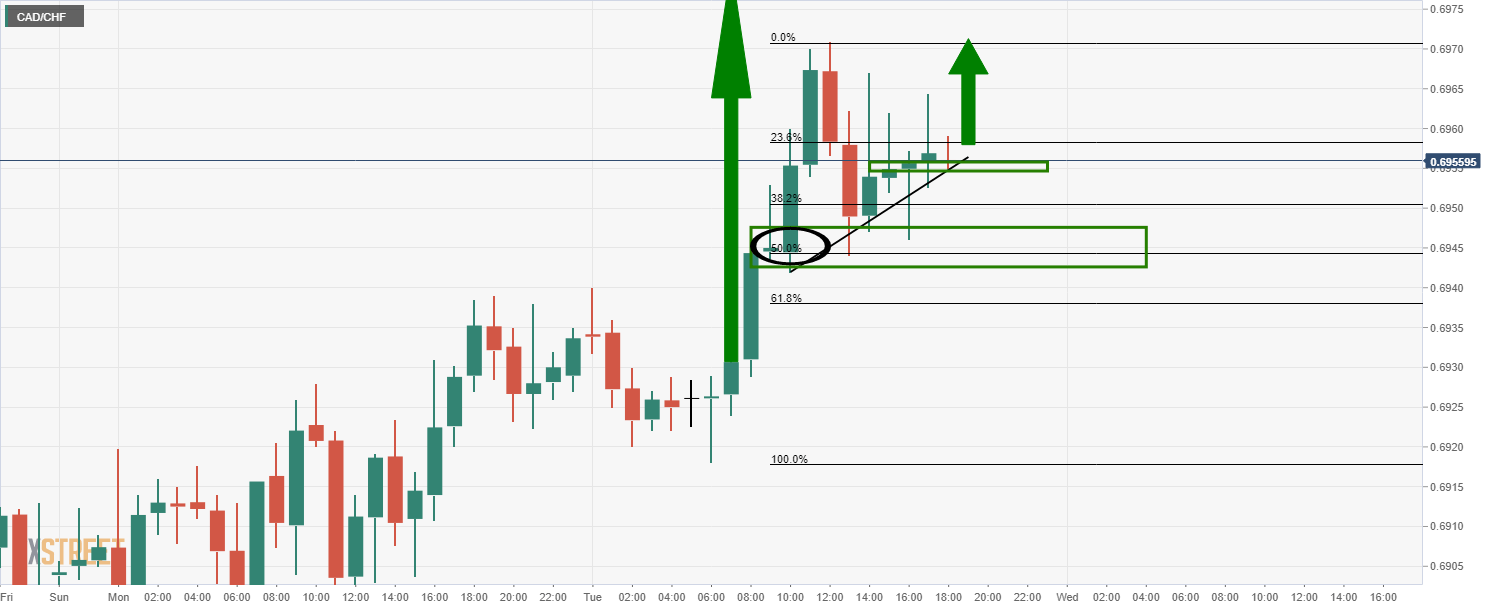
CAD/CHF has made an hourly bullish impulse followed by a 50% mean reversion from which the price has held and pushed higher to form a support structure, keeping the bullish trajectory intact.
Bulls can enter at support and seek a push higher on the shorter-term frames, such as the 15-min chart.
The following charts display the price action and motive for a long position for a 1:2 risk to reward day trading set-up.
Note, the criteria of the trade is to manage the position on a 15-min time frame and move stop to breakeven at the earliest opportunity (explained below).
The trading strategy has a 60% win rate, meaning risking a low percentage per trade, using breakeven targets and setting a minimum of a 1:2 risk to reward ratio are essential for the strategy's success.
1-hour chart
15-min chart
-637345809299643311.png)
As illustrated on the 15-min chart, the price has stabilised at a 50% mean reversion point, bursting higher within the correction of the hourly bullish impulse and has formed a support structure.
The support structure offers an opportunity to enter long, with a stop-loss below the recent lows for a 1:2 risk-reward ratio.
If the price moves higher and forms fresh support from the latest resistance structure, the stop-loss can be moved to breakeven for a free ride towards the target zone.
If the price breaks below the entry, the stop-loss is there as a last resort.
Depending on the price action below support, the take profit can be moved to entry to target a breakeven exit. If the price action remains bullish within drawdown, the stop loss can remain in place as last resort.
Live updates to follow...
Update
-637345842235156834.png)
As can be seen, the original trendline has been moved lower to compensate for the fact that the prior price action and break over was not a fake-out.
The price has deteriorated below the entry and support structure.
If the price fails to hold the trendline support and closes below, the set-up will be nullified and the target can be brought to entry on the hope that the trade will result in a breakeven.
If the price fails to move back to the entry, in the near future, it is highly likely that the trade will result in a small loss (the strategy caters for 40% of losing and breakeven trades)
Update
So far, the price has held the trendline support:
-637345847275231508.png)
The target remains in place for a 1:2 risk to reward.
Update
Position closed for breakeven due to too much bearish divergence on the MACD.
The market can be monitored again for re-entry IF the conditions and price action form bullish structure.
-637345855413303938.png&w=1536&q=95)
At this juncture, the old support structure is expected to act as new resistance and best practise is to limit trading losses - (Afterall, trading is actually just about managing risk).
Monitoring for long entry
As explained, the market can be monitored again for re-entry IF the conditions and price action form bullish structure.
The following presents a possible outcome IF the price holds in the bullish territory, (price above 21 moving average and MACD above zero):
-637345866378804620.png)
Update
In early Asia, spreads make the strategy impossible to trade, however, price action is favourable for a long entry here.
A raw spread or ECN broker is the solution where spreads are minimal.
-637345913243529903.png)
Update: Long position created
-637345970969611536.png)
The spread resumed back to 1 pip at an ECN broker enabling the buy limit to be filled and stop-loss placed appropriately below the lows.
The risk was set to a higher % risk but of course according to the strategy's limitations.
-637345973964851909.png)
As can be seen, the price has since moved to breakeven for a free ride towards the target.
Update: Target achieved
The target of 0.69764 was reduced to 0.6974 to close the trade on signs of exhaustion in the final 15-min bar's price action.
-637346062368580711.png)
The exit was well placed
-637346079710448779.png)
An example of when hindsight can be pleasurable in trading!
Author
Ross J Burland
FXStreet
Ross J Burland, born in England, UK, is a sportsman at heart. He played Rugby and Judo for his county, Kent and the South East of England Rugby team.

















