Gold eases from record high amid profit-taking
- Gold price pulls back from all-time high in Wednesday’s early European session.
- The stronger-than-expected US GDP report and profit-taking weigh on the Gold price.
- Fed rate cut bets and safe-haven flows might cap the downside for XAU/USD.

Gold price (XAU/USD) eases from a record high of $4,526 during the early European trading hours on Wednesday as traders book some profits. Additionally, the upbeat US Gross Domestic Product (GDP) data might also weigh on the Gold price. It’s worth noting that strong GDP often boosts the US Dollar (USD), making Gold more expensive for non-US buyers, pressuring prices.
Nonetheless, the potential downside for the yellow metal might be limited as persistent geopolitical uncertainty, particularly in the US-Venezuela conflict, might keep safe-haven demand elevated.
Growing expectations of further US Federal Reserve (Fed) rate cuts next year could boost the Gold price. Financial markets are pricing in multiple Fed interest rate reductions in 2026 amid signs of easing inflation and sluggish jobs growth. Lower interest rates could reduce the opportunity cost of holding Gold, supporting the non-yielding precious metal.
Financial markets are likely to remain subdued ahead of the Christmas holiday. Traders await the release of the US Initial Jobless Claims data later on Wednesday for fresh impetus. The market consensus was for 223,000 initial jobless claims for the week ending December 13, compared to 224,000 in the previous reading.
Daily Digest Market Movers: Gold corrects from record high despite Venezuela tensions
- Venezuela’s parliament on Tuesday approved a measure that criminalizes a broad range of activities that can hinder navigation and commerce in the South American country, such as the seizure of oil tankers. The law, which includes "other international crimes," comes after recent US actions against Venezuelan oil shipments.
- The US Gross Domestic Product (GDP) grew at a 4.3% annualized pace in the third quarter (Q3), according to the Bureau of Economic Analysis on Tuesday. This figure came in stronger than the expectation of 3.3% and followed 3.8% growth in Q2.
- The Conference Board's Consumer Confidence Index declined to 89.1 in December from 92.9 in November.
US President Donald Trump said on Tuesday that he expects his Fed Chair to lower interest rates if the economy is doing well. - Trump noted that the next Fed chair will be someone who believes in lower interest rates "by a lot”. He indicated that disagreement with his views would disqualify candidates from consideration for the Fed’s top job. The comments are likely to heighten concerns among investors and policymakers about Federal Reserve independence.
- White House Adviser Kevin Hassett said that the Fed is not cutting interest rates quickly enough, even though the US economy grew at a much faster-than-expected pace in the third quarter, per CNBC.
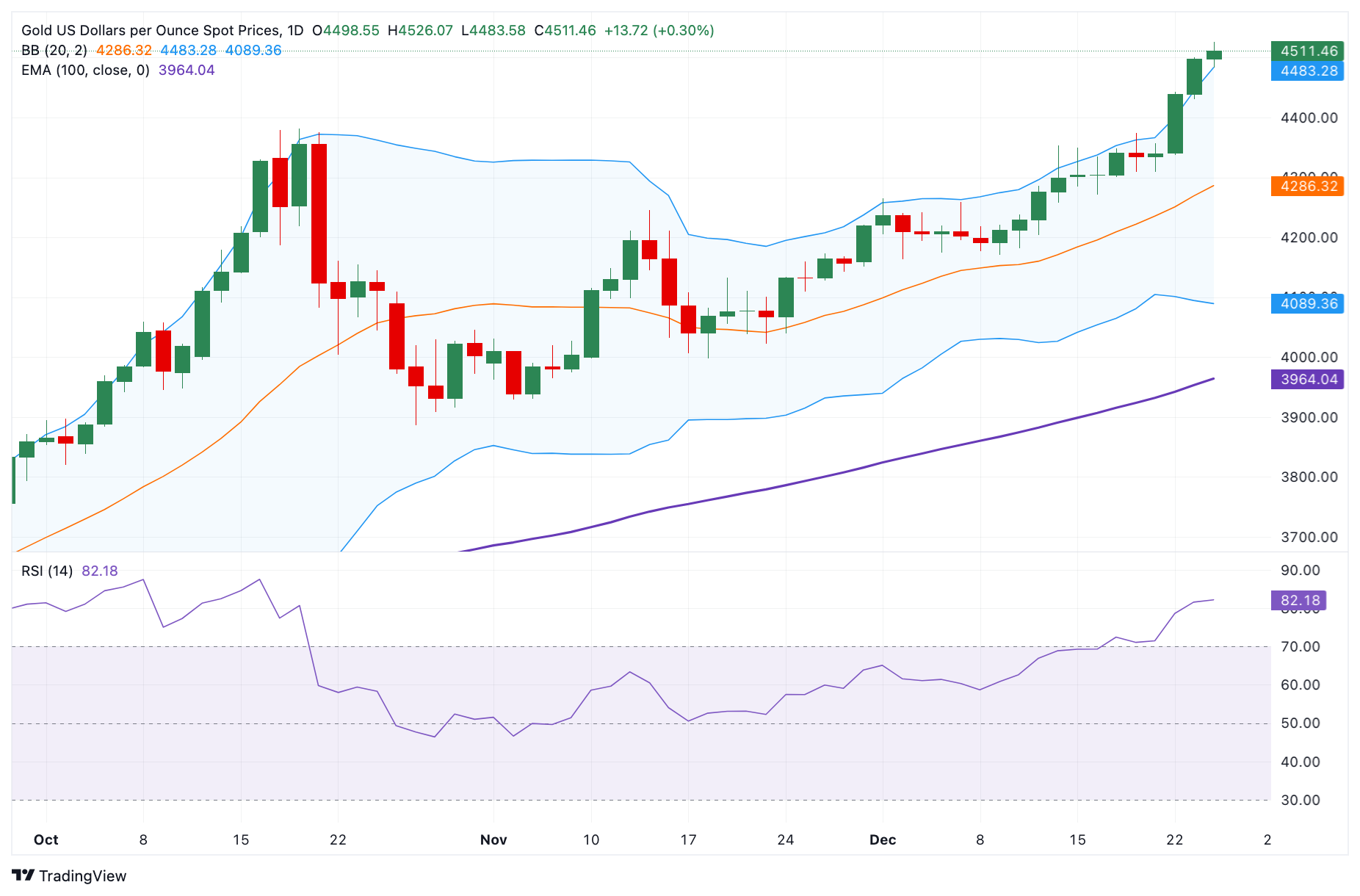
Gold continues its bullish trajectory, overbought RSI warrants caution for bulls
Gold loses momentum on the day. However, in the longer term, the path of least resistance is to the upside as the yellow metal is well-supported above the key 100-day Exponential Moving Average (EMA) on the daily chart. The Bollinger Bands widen, suggesting strong trend continuation.
Despite the bullish trend, the 14-day Relative Strength Index (RSI) is located above 70, indicating an overbought condition. This suggests that any upside extension could be tempered by a period of digestion before the next leg higher.
Green candlesticks and sustained trading above the $4,500 psychological mark could make another run toward $4,550, en route to a round figure of $4,600.
On the flip side, the first downside target for Gold is seen at the December 22 low of $4,338. Any follow-through selling below the mentioned level could expose the December 17 low of $4,300.
Gold FAQs
Gold has played a key role in human’s history as it has been widely used as a store of value and medium of exchange. Currently, apart from its shine and usage for jewelry, the precious metal is widely seen as a safe-haven asset, meaning that it is considered a good investment during turbulent times. Gold is also widely seen as a hedge against inflation and against depreciating currencies as it doesn’t rely on any specific issuer or government.
Central banks are the biggest Gold holders. In their aim to support their currencies in turbulent times, central banks tend to diversify their reserves and buy Gold to improve the perceived strength of the economy and the currency. High Gold reserves can be a source of trust for a country’s solvency. Central banks added 1,136 tonnes of Gold worth around $70 billion to their reserves in 2022, according to data from the World Gold Council. This is the highest yearly purchase since records began. Central banks from emerging economies such as China, India and Turkey are quickly increasing their Gold reserves.
Gold has an inverse correlation with the US Dollar and US Treasuries, which are both major reserve and safe-haven assets. When the Dollar depreciates, Gold tends to rise, enabling investors and central banks to diversify their assets in turbulent times. Gold is also inversely correlated with risk assets. A rally in the stock market tends to weaken Gold price, while sell-offs in riskier markets tend to favor the precious metal.
The price can move due to a wide range of factors. Geopolitical instability or fears of a deep recession can quickly make Gold price escalate due to its safe-haven status. As a yield-less asset, Gold tends to rise with lower interest rates, while higher cost of money usually weighs down on the yellow metal. Still, most moves depend on how the US Dollar (USD) behaves as the asset is priced in dollars (XAU/USD). A strong Dollar tends to keep the price of Gold controlled, whereas a weaker Dollar is likely to push Gold prices up.
Author

Lallalit Srijandorn
FXStreet
Lallalit Srijandorn is a Parisian at heart. She has lived in France since 2019 and now becomes a digital entrepreneur based in Paris and Bangkok.